You’re Overpaying for AI. Here’s Why.
November 24, 2026
Your Agent Is Mostly Reading, and You’re Paying Full Price
A year ago, nobody cared to read the token costs on an AI pilot budget. The demo worked, the invoice was small, and the conversation moved on to accuracy. That era is over. Menlo Ventures estimates enterprises were spending on AI at a pace of $176.8 billion a year by September 2026, up from $33 billion in 2025. Gartner expects the cost of running a single agentic workflow to rise more than fivefold through 2028. Some of that is good news. Companies spend more when things work. But a growing share of the bill comes from another change. The work moved from chat to agents, and agents eat tokens in a way chat never did. This issue is about where those tokens go, why most of them don’t need your best model, and what “model agnostic” means once you strip the buzzword off it. It’s part one of two. On December 15, we follow the bill into long-running agents.
Your agent is mostly reading
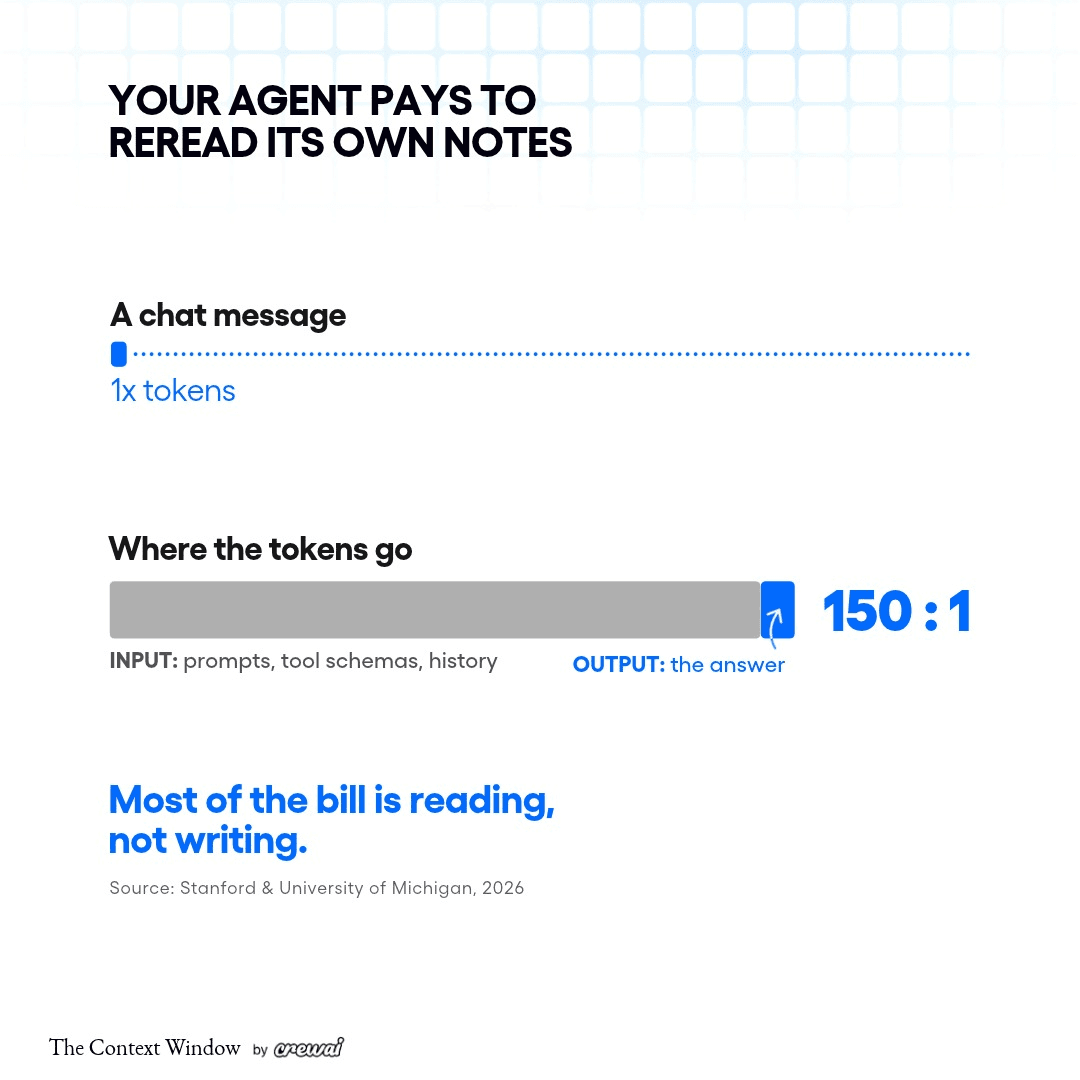
A chat is one question and one answer. An agent is a loop. It reads its instructions, reads its tool definitions, calls a tool, reads the result, then rereads everything before deciding the next step. Every trip around the loop sends the full context again. Coding agents show it most clearly. A 2026 study of 500 real coding tasks by researchers at Stanford and the University of Michigan found that agents read more than 150 tokens for every one they wrote. Sit with that ratio for a second. Most of your bill isn’t the answer. It’s the agent rereading its own notes, at whatever price you’re paying for your smartest model. At scale, this stops being theoretical. A contact-center outsourcer put it to the test. It ran a CrewAI Flow head to head against a plain agent that simply hands a model its tools. Both used the same model and the same tools, and both handled real multi-turn conversations. The Flow gave equal or better answers at noticeably lower token cost. Nothing about the model changed. The only difference was how the work was structured.
The bill is splitting in two
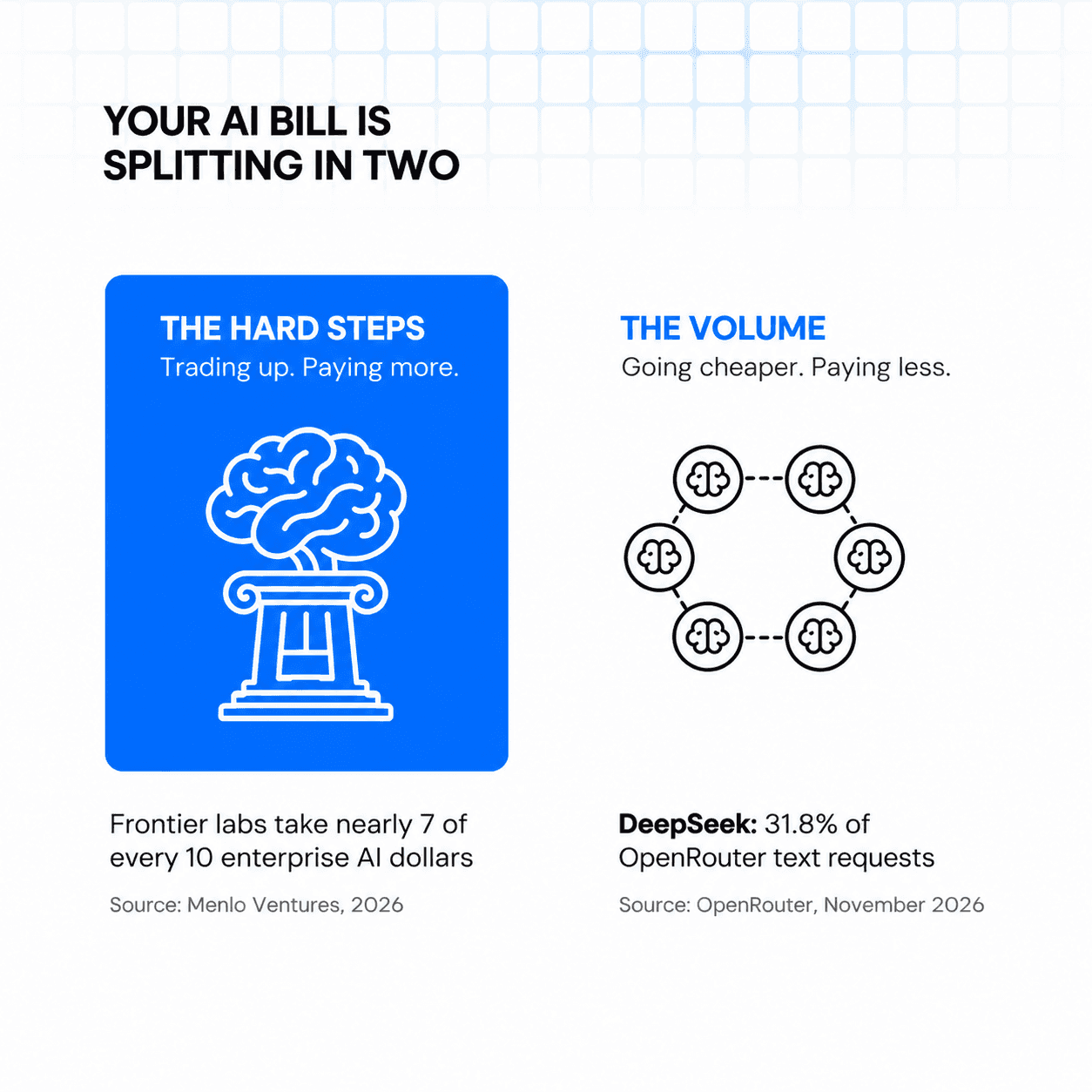
This is where the easy take, “just use cheaper models,” falls apart. Enterprises aren’t trading down. Menlo found the opposite. A year ago, the most popular models charged $1.25 to $3 for every million tokens they read and $10 to $15 for every million they wrote. Today’s leaders charge $4 to $10 to read and $20 to $60 to write. For the hardest reasoning, buyers are choosing to pay more. At the same time, the volume is going somewhere else. In the week of 9 November, DeepSeek alone handled 31.8% of text requests on OpenRouter, the multi-model API that many developers route their traffic through. OpenRouter’s Head of Insights reports that agent tokens on the platform are up 106x since early January. Human tokens are up 7x. Both trends are true at once, and together they’re the real story. The sharpest teams are not the ones that are choosing between a cheap model and an expensive one. They pay frontier prices for the steps that need frontier thinking and send everything else somewhere cheaper.
The default is the expensive part
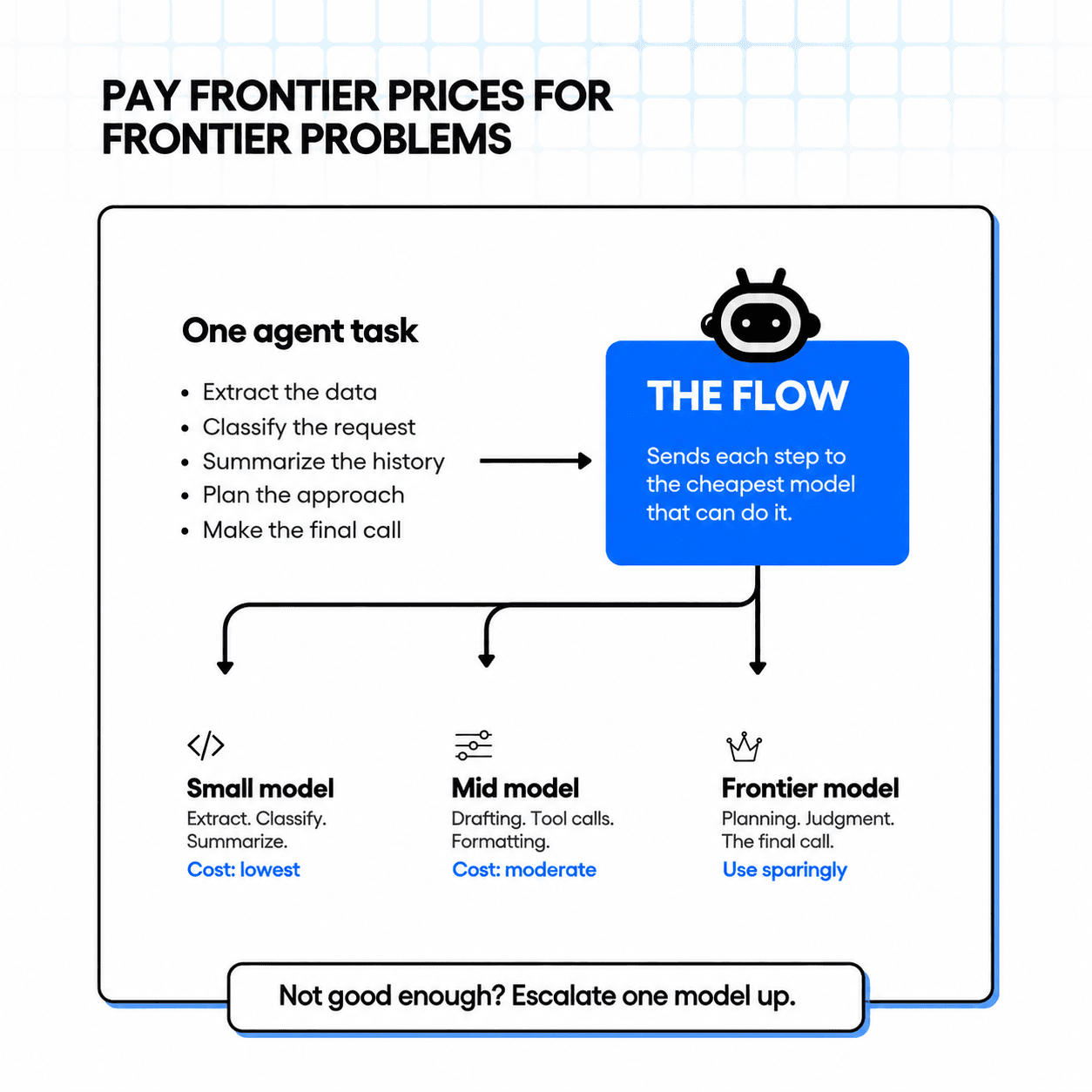
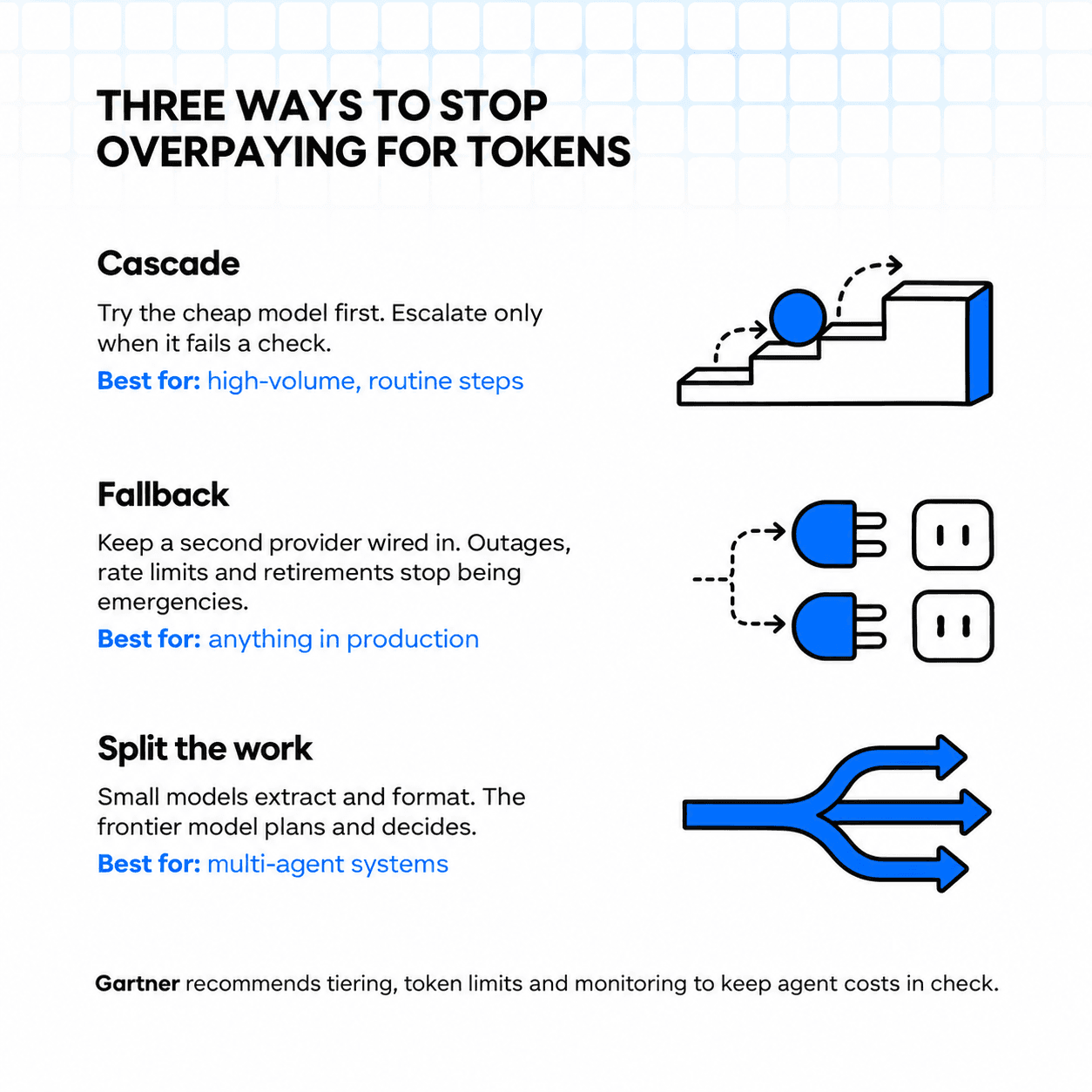
Most teams never chose to run every step on one model. It just happened. They picked a model for the prototype, the prototype worked, and the prototype became production. Lock-in rarely arrives as a decision. It arrives as a default. Being model agnostic is the fix, and it’s less exotic than it sounds. You treat the model as a swappable component. That’s the idea behind running production agents on one runtime, any cloud, any model: the model is a choice you make per step, not a contract you sign once. Pulling a date from an invoice, tagging a support ticket and summarizing a long thread are jobs small models handle well, quickly and for a fraction of the price. Planning a multi-step approach, making a judgment call on incomplete information and signing off on the final output are where you spend. Gartner’s 2026 guidance lands in the same place. It says to route routine, high-frequency work to efficient small or domain-specific models and to save frontier inference for complex, high-value reasoning. For coding agents, it goes further: break the work into smaller tasks for smaller models, and escalate only when the complexity calls for it.
What changes when you build this way
Routing becomes your cost control. In CrewAI, every agent can run on its own model. A Flow then decides which steps get a small, cheap model and which get a frontier one, so the routine work and the hard calls each go where they belong. You make that choice step by step instead of once for the whole company. CrewAI connects directly to the major model providers and works with routing services like OpenRouter and LiteLLM, which add extras like fallbacks and spending budgets. Those are useful options, not the strategy. The strategy is knowing which step deserves which model, and being able to change your mind without a rewrite.
Cheap per token isn’t always cheap per task. One study tested AI agents on hands-on technical tasks run from the command line. Setups that used about a third as many tokens took 20 to 80% longer to finish. Tokens are one cost. Time, retries and failed runs are others. That’s why routing without evals is just guessing at a lower price, and it’s why we built evals into CrewAI. João’s post on what good looks like → Open-weight doesn’t automatically mean cheap. Kimi K3’s official API lists at 15 per 3/ million tokens, the same range as the frontier models. The savings from open models come from where and how you run them, not from the label. Run them inside your own cloud and you control both the cost and the data, because nothing leaves your environment. Lock-in hits through retirements, not price hikes. Providers retire models on their schedule, not yours. When the model you’re pinned to goes away, its replacement can cost more, and you migrate against a deadline. A team that already routes across models treats it as a settings change. Budgets need guardrails. Gartner predicts that through 2027, enterprises running AI agents in IT operations on uncapped token pricing will overshoot their initial cost expectations by more than 50%. Quotas, per-agent budgets and token monitoring tied to business outcomes aren’t finance busywork anymore. They’re architecture. Last issue, we showed guardrail checks on CrewAI climbing from 71K to 1.77M a month. Budget caps are the same idea, applied to spend. So here’s the question to bring to your next planning meeting: What share of your agent’s steps actually need your most expensive model, and who on your team can answer that today? If nobody can, that’s your first project. Want help finding out? Book a working session
What we’re doing at CrewAI
We pay the same token bill our customers do, so a lot of what we build is about spending tokens on purpose. Take the Field Hand, the build we covered in Edition 13. When we rebuilt it on CrewAI, it used 0.94x the tokens and latency of the hand-built version, and 7 out of 7 answers matched. That means the same answers, with slightly fewer tokens and a slightly shorter wait. Routing happens step by step, too. One build in our catalog runs a cheap model on its routine branches and calls the expensive model only on the one branch that needs it. Some of the biggest savings come from deciding when an agent runs at all. Teams on the platform choose their schedules deliberately, like a daily 8am run instead of constant polling. At least three builds dropped continuous polling because of what it cost.
This week’s finds
One great long form read -
Making startups powerful by Paul Graham
Two tweets in the spirit of not taking ourselves too seriously:
Funniest thing about AI Twitter
Why does this look like a horror movie, lol
Three songs you should add to your work playlist:
Maria También: Khruangbin
Awake: Tycho
Tieduprightnow: Parcels
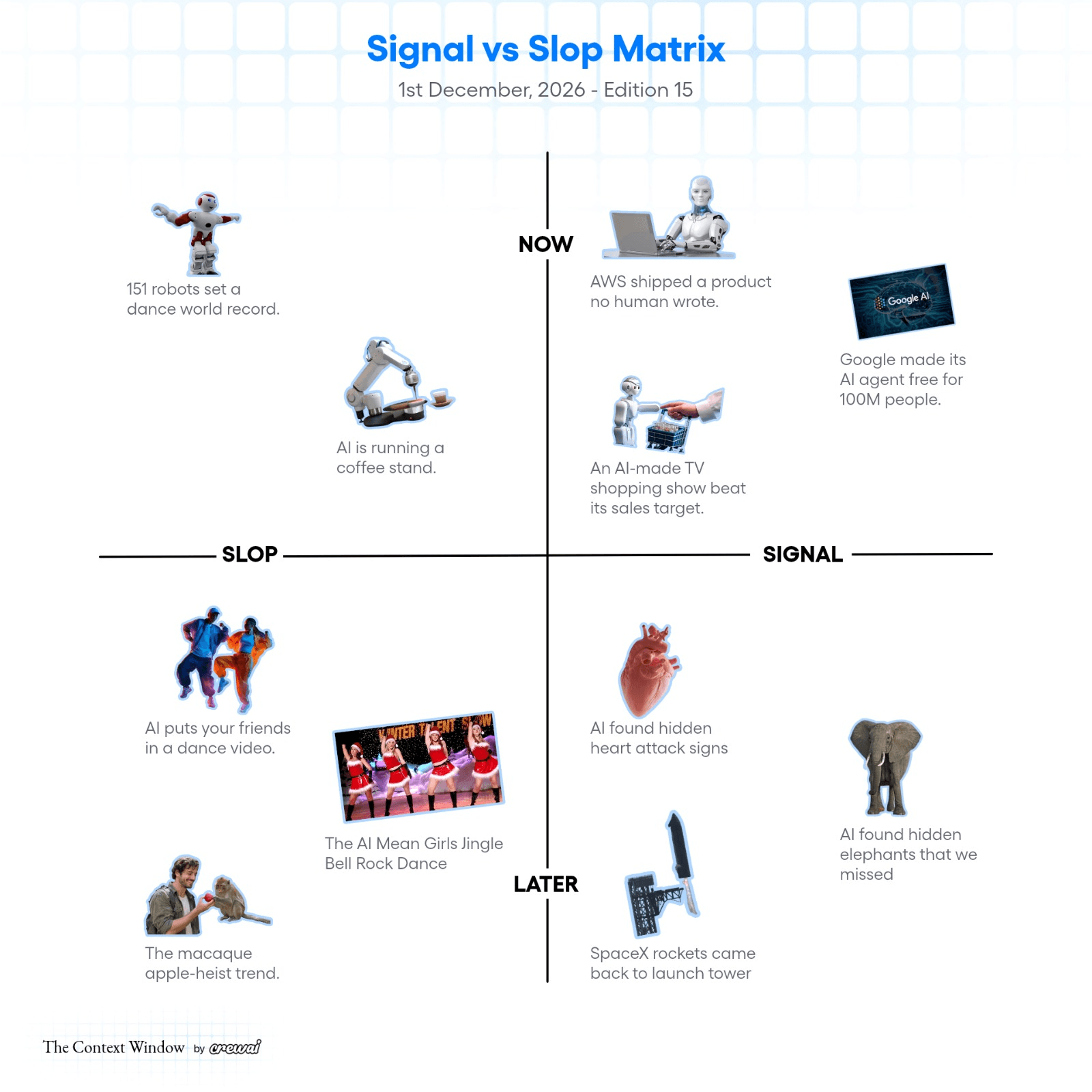
Signal vs Slop Matrix
Twice a month, we plot what happened in AI on two axes. Slop ↔ Signal: was there actual substance, or was it noise? Now ↔ Later: is this something you should act on this quarter, or a signal about where things are headed in 1-3 years? Let's see what happened:
NOW / SIGNAL: Act on this
AWS shipped a product no human wrote. On November 11, Amazon CTO Werner Vogels launched AWS Emulator, a local sandbox covering more than 200 AWS services, built and tested entirely by AI agents. The repository has 29,684 commits, and the first one landed three weeks before launch. emergentbyteiota
Google made its AI agent free for 100M people. On November 17, Gemini’s task features became free in six countries: the US, Japan, Korea, Canada, Australia and India. The agent mode used to require a paid AI Pro or Ultra plan. cryptobriefingandroidcentral
An AI-made TV shopping show beat its sales target. Hyundai Home Shopping launched a TV shopping show with no human host and no camera crew, using its AI-REAL system. A trial run hit 120% of its sales target. Suppliers’ production costs fell by more than 80%, and the first product sold was Jeju kiwis. aitoolsrecaplabmemo NOW / SLOP: You can ignore this
151 robots set a dance world record. The humanoid robots performed a synchronized routine on the streets of Shenzhen on November 17 and set a new Guinness World Record. The previous record of 110 robots was set only in October. teleamazonas
AI is running a coffee stand. At a Shenzhen park refreshment stand, one robot makes ice cream while another makes coffee, drawing curious visitors who film them. The startup behind them sells up to 300 coffees a day at the park. euronewskhaleejtimes LATER / SIGNAL: Start thinking about this
AI found a hidden warning sign for sudden cardiac death. The AI was trained on more than 440,000 EKGs collected in Sweden. It reads ordinary EKG images that hospitals already collect, so screening could improve without a new test. sciencedaily
A rocket that flew to orbit came home to its launch tower. On Saturday, giant mechanical arms caught SpaceX’s Starship in midair, 22 hours after it left the same launch site. SpaceX says the catch shows Starship can be fully reused for moon and Mars travel. NPR
AI found elephants that human counts missed. Machine learning models used by the Kenyan group Save the Elephants found large animal populations that manual counts had missed entirely. Analyzing the photos used to take researchers nine months. Now it takes hours. archynewsyukrmedia LATER / SLOP: Won’t matter, won’t last
The Mean Girls Jingle Bell Rock dance is back early, as AI videos. Friend groups recreate it every Christmas, and AI versions started circulating around November 11. getstarrd
The macaque apple-heist trend. In these AI clips, someone happily eating a red apple gets jumped by a wild macaque, which takes a huge bite and leaves them staring at the camera in disbelief. getstarrd
AI puts your friends in a dance video. AI versions of the viral Dip On Em dance with four dancers started showing up around November 18: you and three friends, dancing in the place from your first photo. Getstarrd