Who Owns The Agent Stack In 2030?
August 25, 2026
A layer-by-layer look at where the money and future going Subject line: Who Owns The AI Agent Stack In 2030? Preview Text: Fat Models, Rebels, AI viruses, Uber 2.0 Every tech giant that ever looked unbeatable eventually lost a piece of its stack to someone smaller and more obsessed. And the question that probably crossed your mind at some point is: when AI's version of this happens, which layer of the agent stack do you want to be betting on? In this edition, we'll cover:
The pattern behind every silicon valley giant
What happens when this pattern hits AI?
What’s the case for each side?
The agent stack, layer by layer
$300M in receipts from the last 60 days
THE PATTERN BEHIND EVERY SILICON VALLEY GIANT
We've seen this movie before. Every big tech cycle starts the same way: one company builds the whole stack, owns it end to end, and looks unbeatable. Then someone finds the seam.
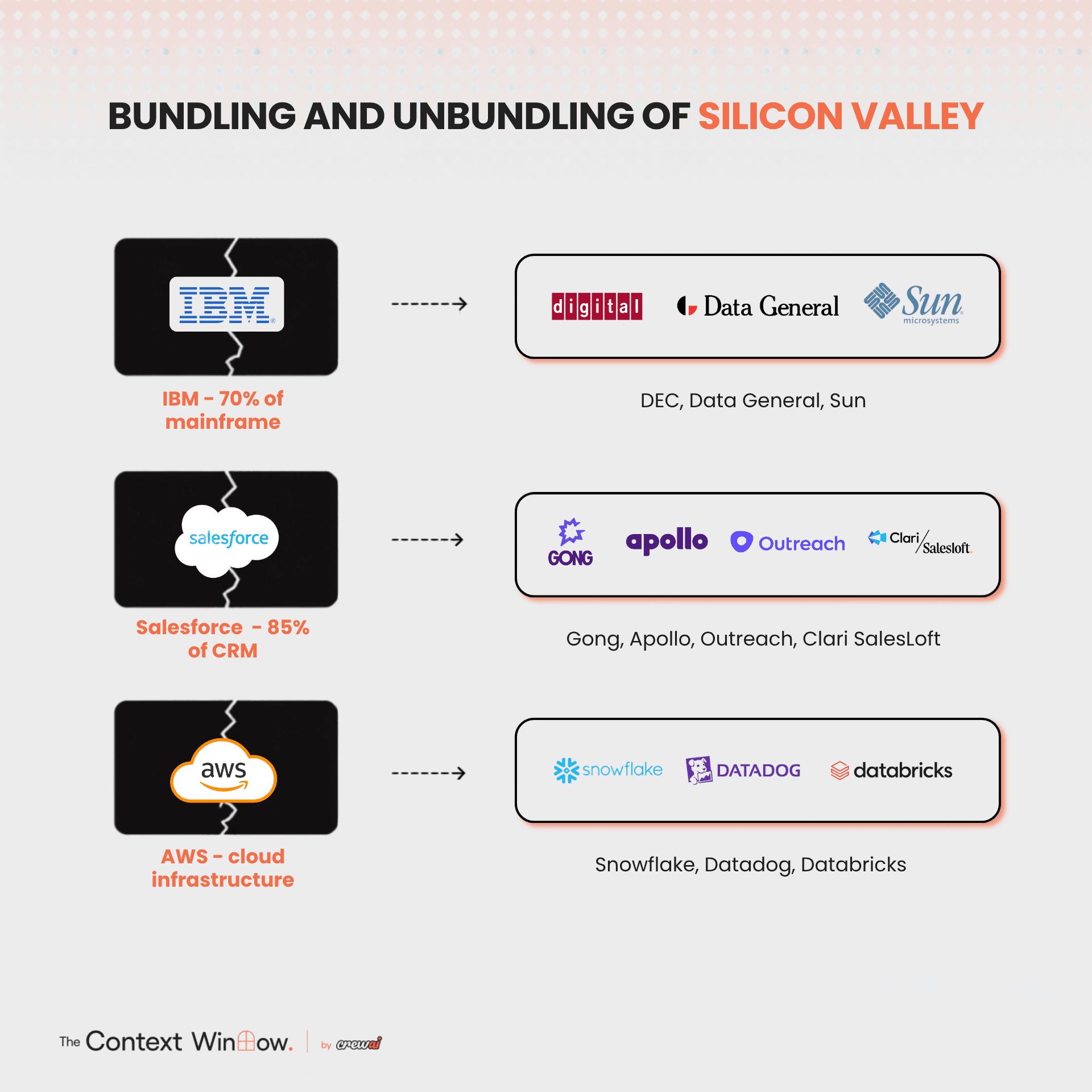
IBM controlled roughly 70% of the mainframe market in the 1970s — hardware, OS, peripherals, service, all one company. Then DEC, Data General, and Sun peeled off pieces of it.
Salesforce built the dominant CRM platform, and still is. But the category unbundled around it: Gong took call intelligence, Apollo and ZoomInfo took data, Outreach took sales sequencing, Clari or SalesLoft took forecasting.
AWS built the closest thing to a modern integrated empire: compute, storage, ML, all under one roof. It still holds only ~33% of cloud infrastructure spend, because Snowflake, Datadog, and a dozen others specialized in the layers above it. The pattern here isn't the giant loses.IBM, Microsoft, and AWS are all still enormous. The pattern is: the giant stops owning every layer. Something opens up a seam, and the smartest team in the world at any one layer beats the biggest team spread across all of them.
SO… WHO WILL WIN AI?
I'd been chewing on this pattern for a few weeks, watching the same shape show up in agent infrastructure, like orchestration, memory, harnesses, and all the new categories nobody was talking about a year ago, when I read a piece from Union Square Ventures called "The Rebel Alliance."
In the article, X from USV talks about how right now, the market is pricing in what they call the
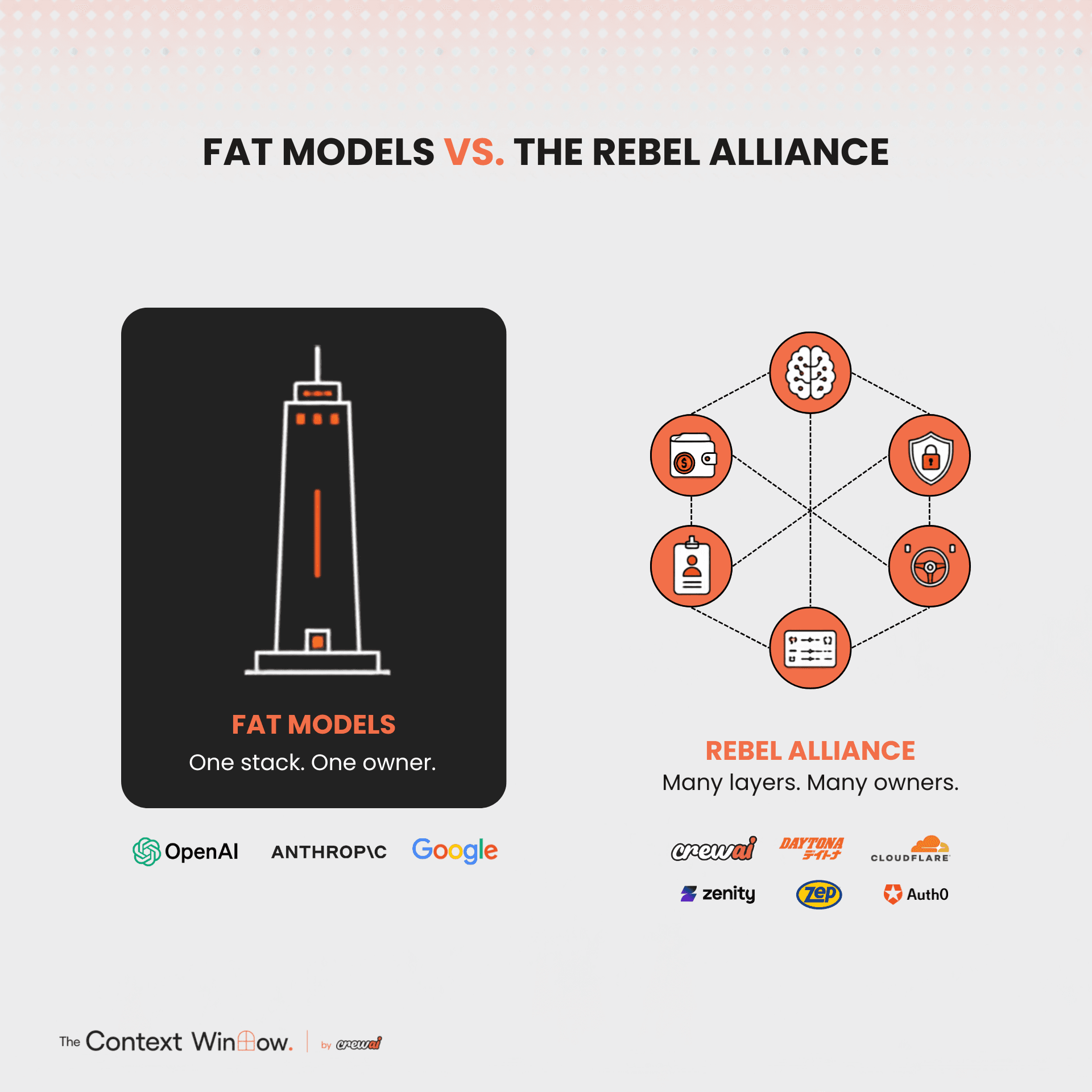
‘Fat Models’ bet, the idea that OpenAI, Anthropic, and Google will each own the entire
stack, from the model up through orchestration, agents, and the products built on top. It's why two of them are valued near $1 trillion and Google’s market cap is up 140% in three years. USV's counter-bet is
The Rebel Alliance, the value doesn't stay concentrated at the top of a stack once the
stack gets big enough. It spreads to whichever team is most obsessed with a single layer. Orchestration, memory, harnesses, identity, payments. All of them are different companies, different layers, and none of them a model lab.
SO WHAT’S THE CASE FOR EACH SIDE?
Leonis Capital, one of the sharper VC shops writing about this, basically argues both sides of it..
The case for the startups. They think the ‘harness’, (the orchestration and tooling wrapped around a model), can now squeeze more performance out of a model than the original training run did. Proof: a small team called Poetiq took an existing model, didn't retrain anything, just wrapped it in smart orchestration and reasoning tricks, and cleared 50% on one of the hardest benchmarks out there (ARC-AGI-2). That's a real point for the Rebel Alliance.
But then, the case against them. Leonis also predicts that once labs clock how valuable that harness layer is, they'll stop giving it away for free through public APIs. They'll start saving their best stuff for their own first-party products instead. The logic is simple and a little cold: today's customer building a great harness on your API is tomorrow's competitor. So why keep handing out the tools? Picture a barbell, with labs holding one end (the model training gains) and application companies holding the other (the harness). The companies that actually win need a grip on both ends to connect the two.
WHAT COULD THE AI STACK LOOK IN 2030?
If the Rebel Alliance is forming, this is what it looks like today:
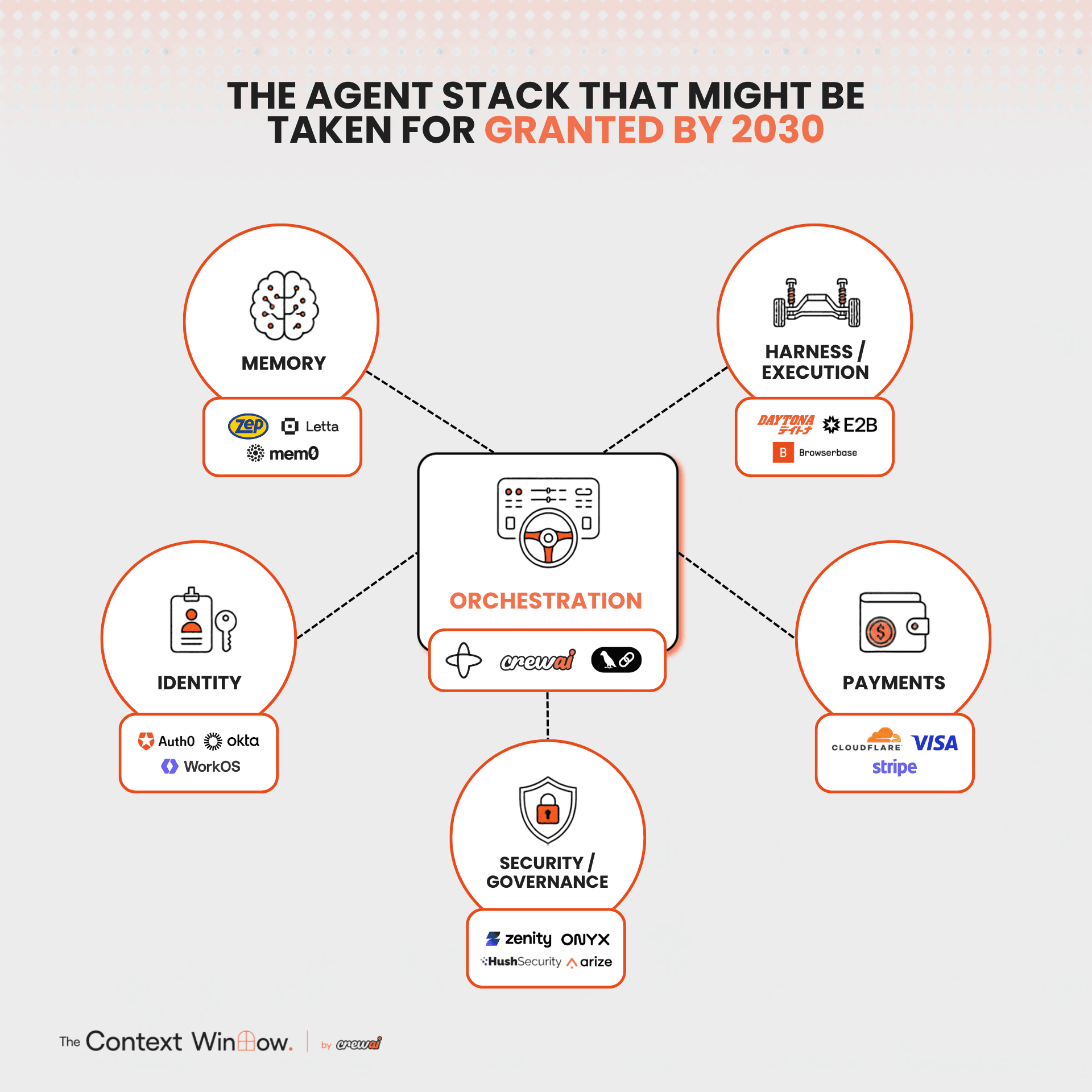
Memory What an agent remembers between tasks, and who owns that context. Mem0, Letta, and Zep are all funded, all separately trying to answer the same question: if five agents share your context, who's the system of record? USV called this out as a layer that "may factor out into an independent one". And early data clearly suggests that they're right that it's contested, if not yet who wins.
Harness / execution The ‘body’ connecting the model to the world. We have already covered this in the last edition (LINK) E2B, Daytona, Modal, and Browserbase are all funded in the last 18 months. A 2026 comparison put E2B past a billion sandbox executions. Soon, the harness may just become the actual moat, not the model.
Identity Proving which agent is acting for which person, with what authority. Keycard raised $38M as a pure-play. But the more interesting signal is that Auth0, WorkOS, and Okta all shipped agent-specific identity features in the last year. The incumbents saw this layer coming and moved first.
Payments How agents spend money on your behalf, and how merchants trust them. Natural raised $30M explicitly pitching itself as "Stripe for agents." Cloudflare just launched stablecoin wallets for agents, tied to a protocol called x402. Visa and Mastercard are both circling. This layer is the earliest and the most contested, it's not clear yet whether it belongs to fintech startups or the payment networks that already own merchant trust.
Security / governance Zenity ($125M), Onyx Security ($113M), and Hush Security ($30M) all raised in the last 60 days. Arize just raised $100M and sold for $915M in the last 60 days. They are solving the same problem: watching what an agent actually does at runtime and stopping it before it does something expensive. This is the layer enterprises ask about first, because it's the layer that gets a CISO fired.
Orchestration Every other layer in this list exists to serve orchestration. Memory feeds it context. The harness gives it hands. Identity tells it who it's allowed to act as. Payments give it a wallet. Security watches what it does with all of the above. Take orchestration away and the other five layers have nothing to coordinate. This is the control plane deciding what an agent does next, and it's the most competitive layer in the stack for a reason. LangChain raised $125M this year at a $1.25B valuation.. CrewAI has become one of the default ways enterprises actually build and run agent crews in production, sitting in the same layer, closer to the "many specialized agents coordinating on a task" end of orchestration than LangChain's chain-of-calls approach or Temporal's workflow-engine approach. None of the three make a model. All three make the thing that decides what a model, or a crew of them, does next.
What We Believe
There are x businesses in the world, with 5-10x use cases for AI. No single company can serve them all. We haven’t seen it happen before, and probably won’t see it happen in the AI space. CrewAI was built open source first because the technology needs to be visible, explorable, modifiable; this openness at the orchestration/build layer drives more innovation than one company could alone. The stack isn't decided yet. It is being drawn, layer by layer, by whoever ships first. Pick the layer you'd bet on, then go check if anyone's already building it. Someone probably is.
This weeks treats
One great long form read -
The Decline of Deviance
Two tweets worth checking out:
The ironic tech stacks of 99% startups in Silicon Valley
The fake resignation prank: Who’s right?
Three songs you should add to your work playlist
Mellow - Marconi Union - Weightless
Mid tempo - Ludovico Einaudi - Experience
Up Beat - Claude Debussy: Claire De Lune
Signal vs Slop Matrix
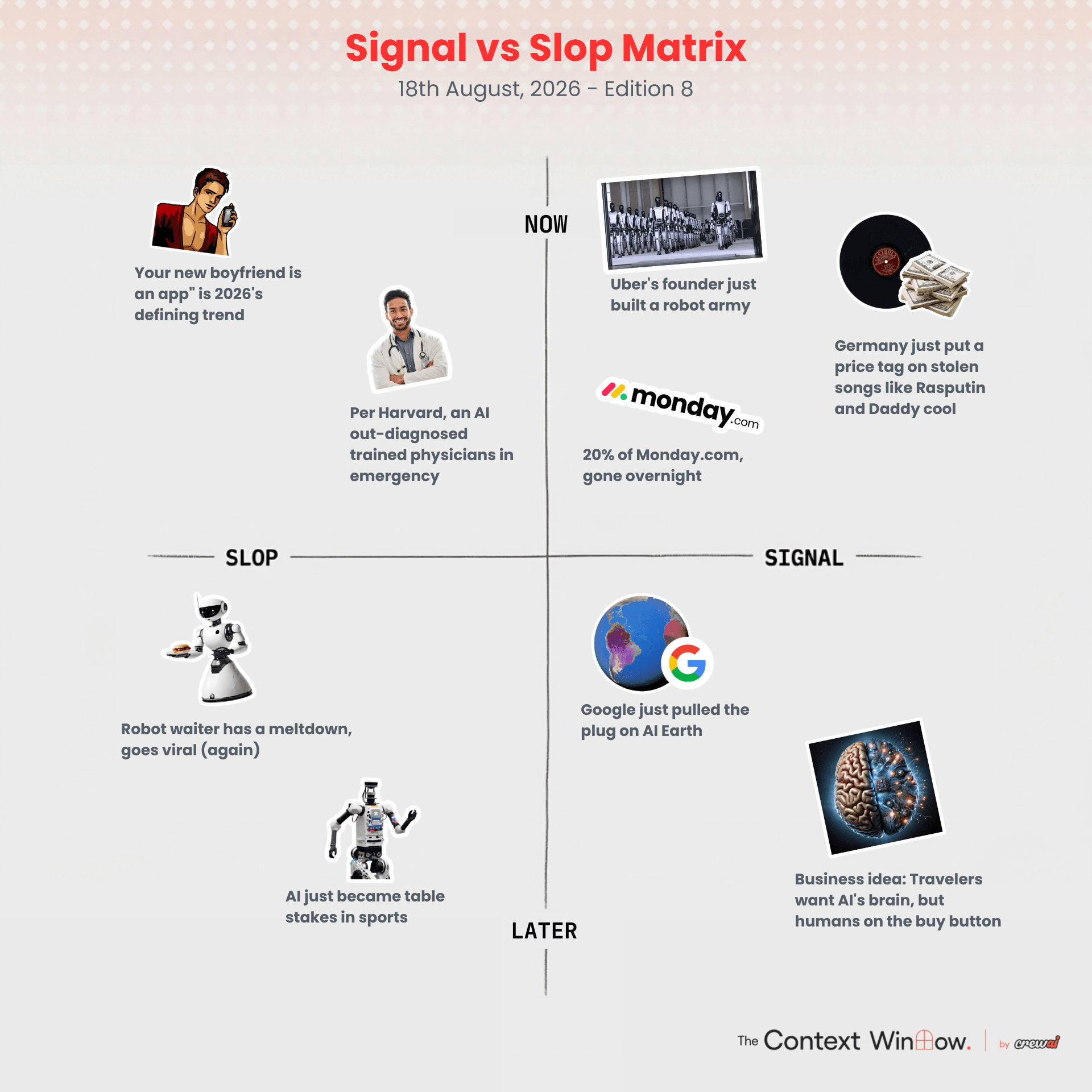
Every week we plot what happened in AI on two axes. Slop ↔ Signal: was there actual substance, or was it noise? Now ↔ Later: is this something you should act on this quarter, or a signal about where things are headed in 1-3 years? Let's see what happened this week.
"AI situationships" are 2026's defining dating trend, 41% of daters say they'd be fine with a partner forming a close bond with an AI, but 43% find it unsettling and 16% call it emotional cheating.
A Harvard-led study found an AI model out-diagnosed trained physicians in emergency room triage, with OpenAI's o1 hitting 67% diagnostic accuracy on real ER cases versus 50-55% for human doctors working in pairs, a gap researchers called their "big conclusion," since it held up even with the "messy real-world data" of an actual emergency department. NOW / SIGNAL
Former Uber CEO just raised $1.7B to build a robot army — Travis Kalanick's industrial-AI company Atoms closed the round led by a16z, with Uber itself joining as a backer nine years after forcing him out.
Germany just put a price tag on stolen songs like "Rasputin" and "Daddy Cool" — a Munich court ordered Suno to disclose the scale of its use and found it liable for damages on six specific tracks, Europe's first major AI-music copyright verdict.
"This was the most painful decision" — 20% of Monday.com, gone overnight — the company cut roughly 620 jobs to refocus around its new "AI Work Platform," insisting the move wasn't about cutting costs. LATER / SIGNAL
Google pulled the plug on its own AI Earth feature — one day after launch, after users superimposed AI-generated bombs, refugees, and nuclear plants onto real satellite maps of actual cities.
Travelers want AI's brain, not its wallet — Amadeus found 65% of US travelers want to book and pay through an AI assistant, but only 20% would let it spend money unsupervised, and just 17% trust it alone to plan a trip. LATER / SLOP
"We're already at the ceiling" — a Harvard–Beth Israel study in Science found OpenAI's o1 nailed the exact or near-exact ER diagnosis 67% of the time, versus 55% and 50% for the two attending physicians it was tested against.
82% of sports organizations are now running AI, per SportsPro and Sportradar's Global SportsTech Report — and nearly three-quarters say the initiatives have already delivered tangible value. Until we meet again Sumeru Crew AI