Where Is AI Money Actually Going? The Investment Map Explained
September 22, 2026
Here's where the money went, and what that means for your job. Everyone keeps asking the same thing: where is all the VC money actually going? Is it just OpenAI, Anthropic, and chatbots, or is it an industry we’re not thinking about? We went through the numbers to find out. In this edition:
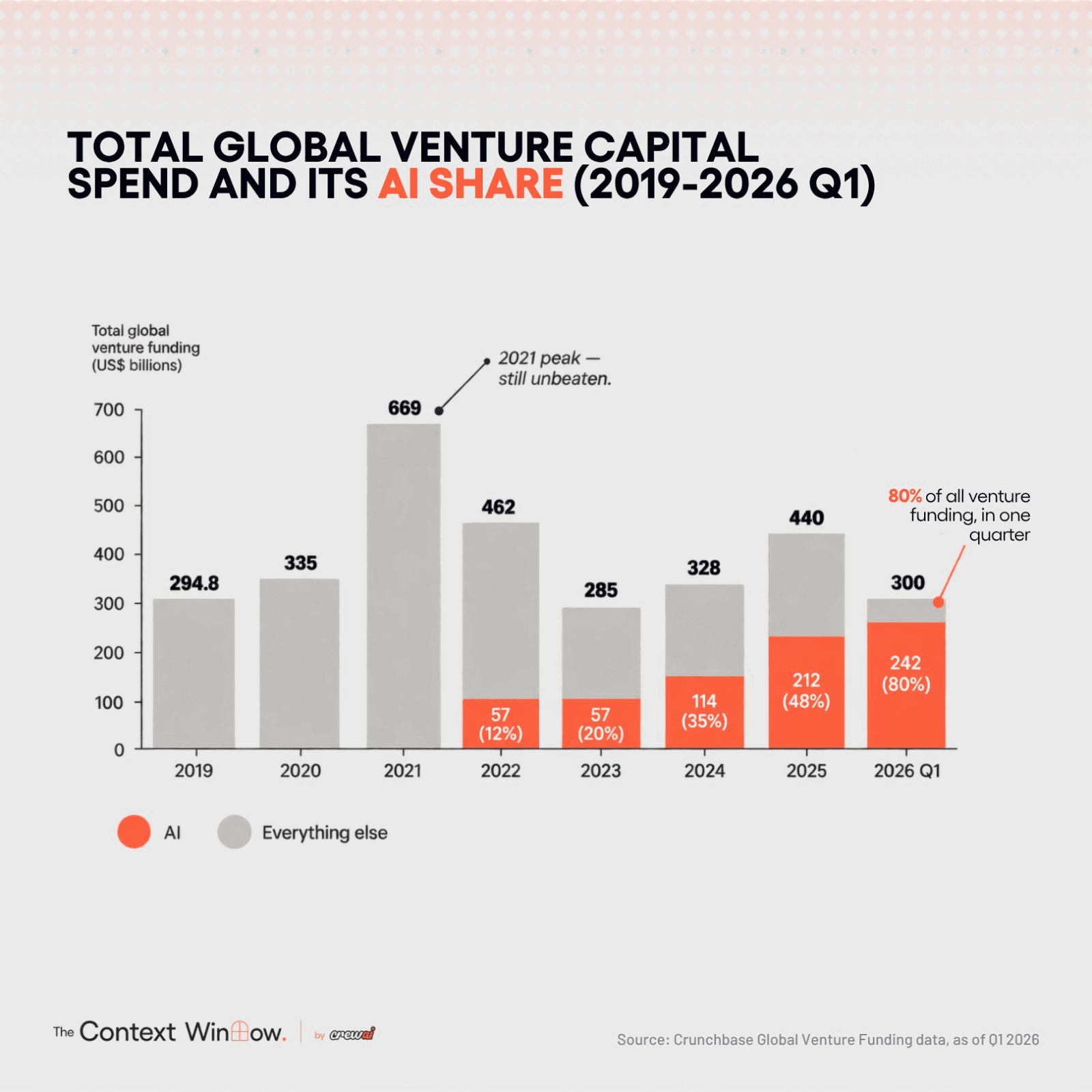
Is there more venture money now, or just less of it going to fewer places?
How much of it is AI taking?
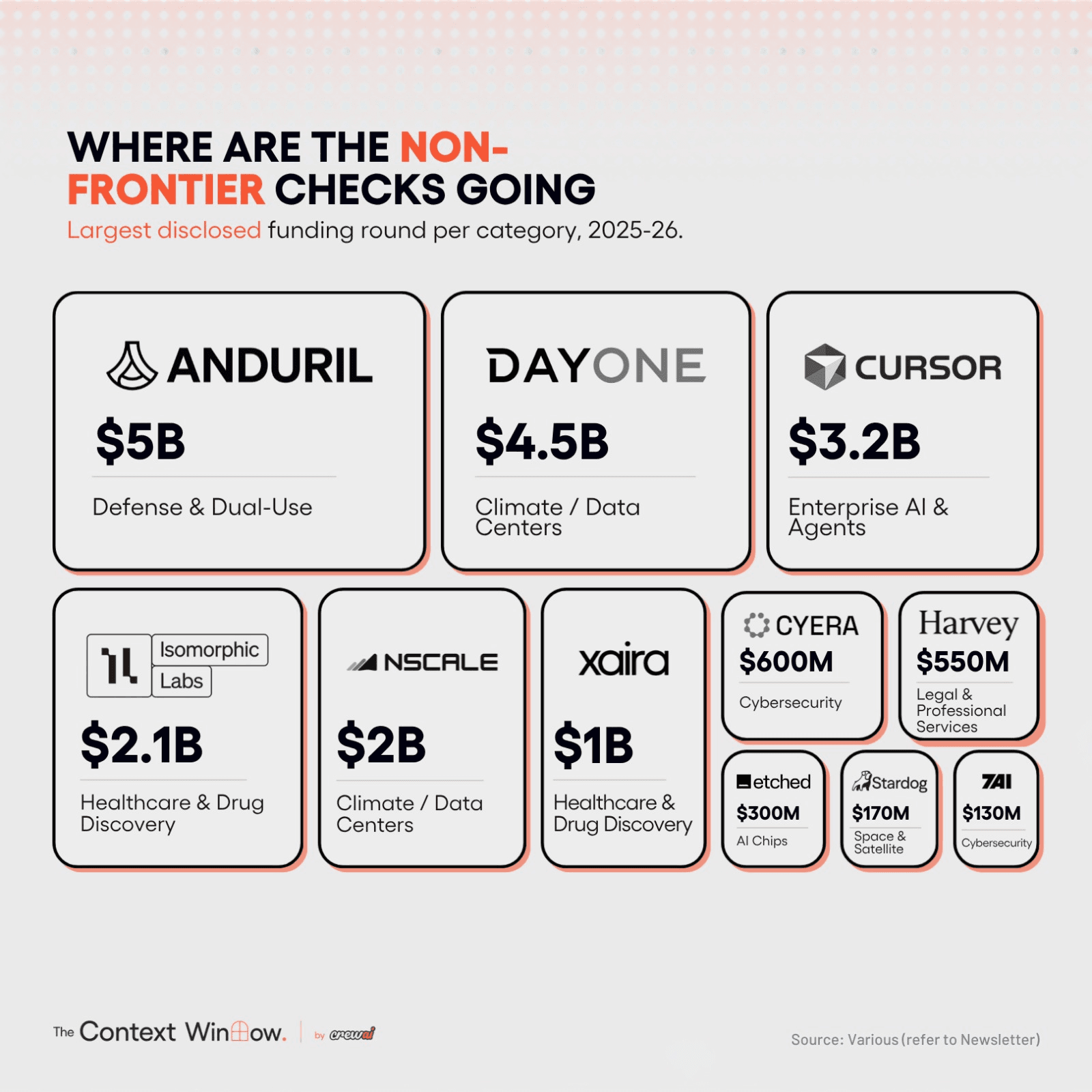
Who's getting funded once you strip out the frontier labs?
What is Y Combinator betting on right now?
What does it all mean for your career?
History Time: The Last Seven Years Of Venture
So Where is the AI Money Going?
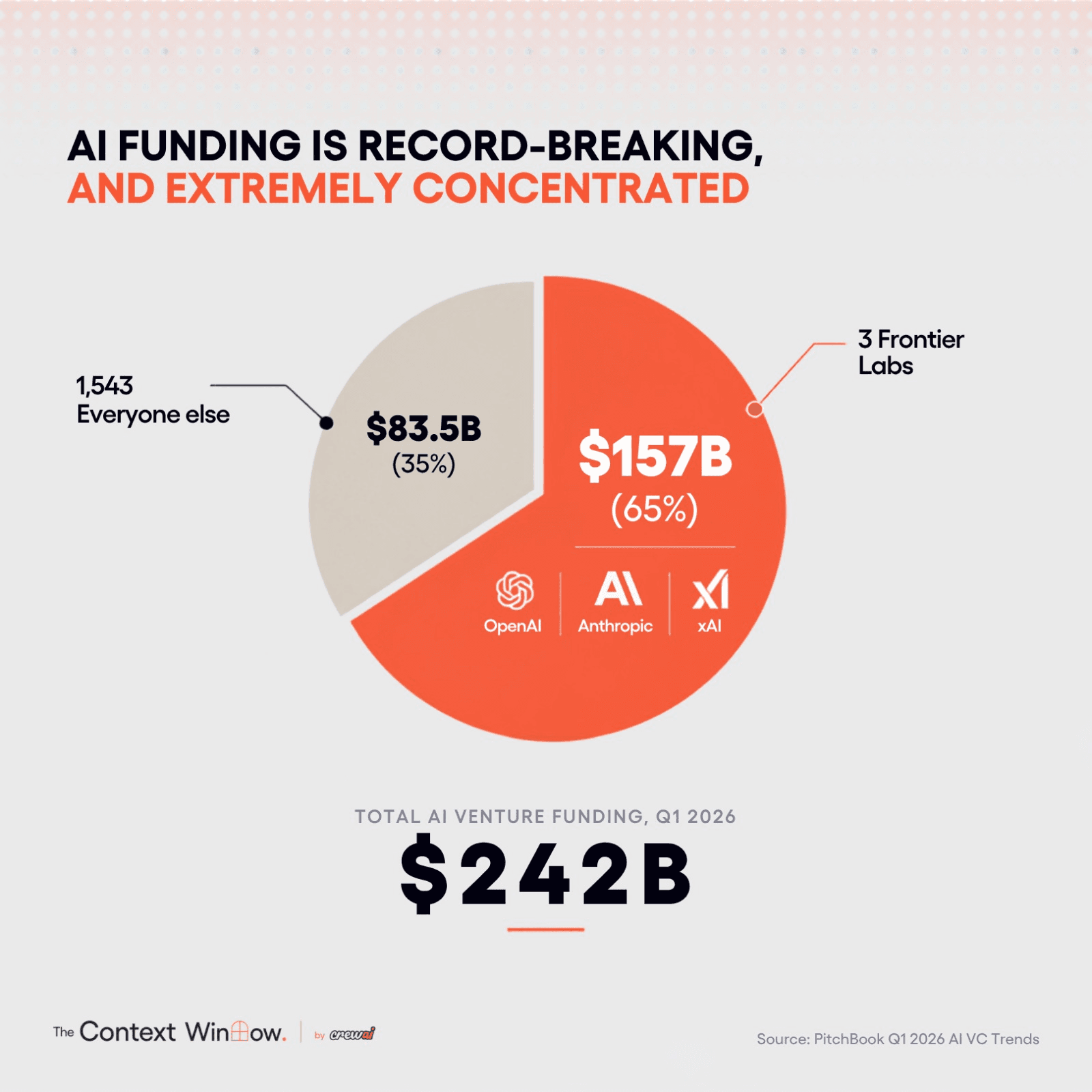
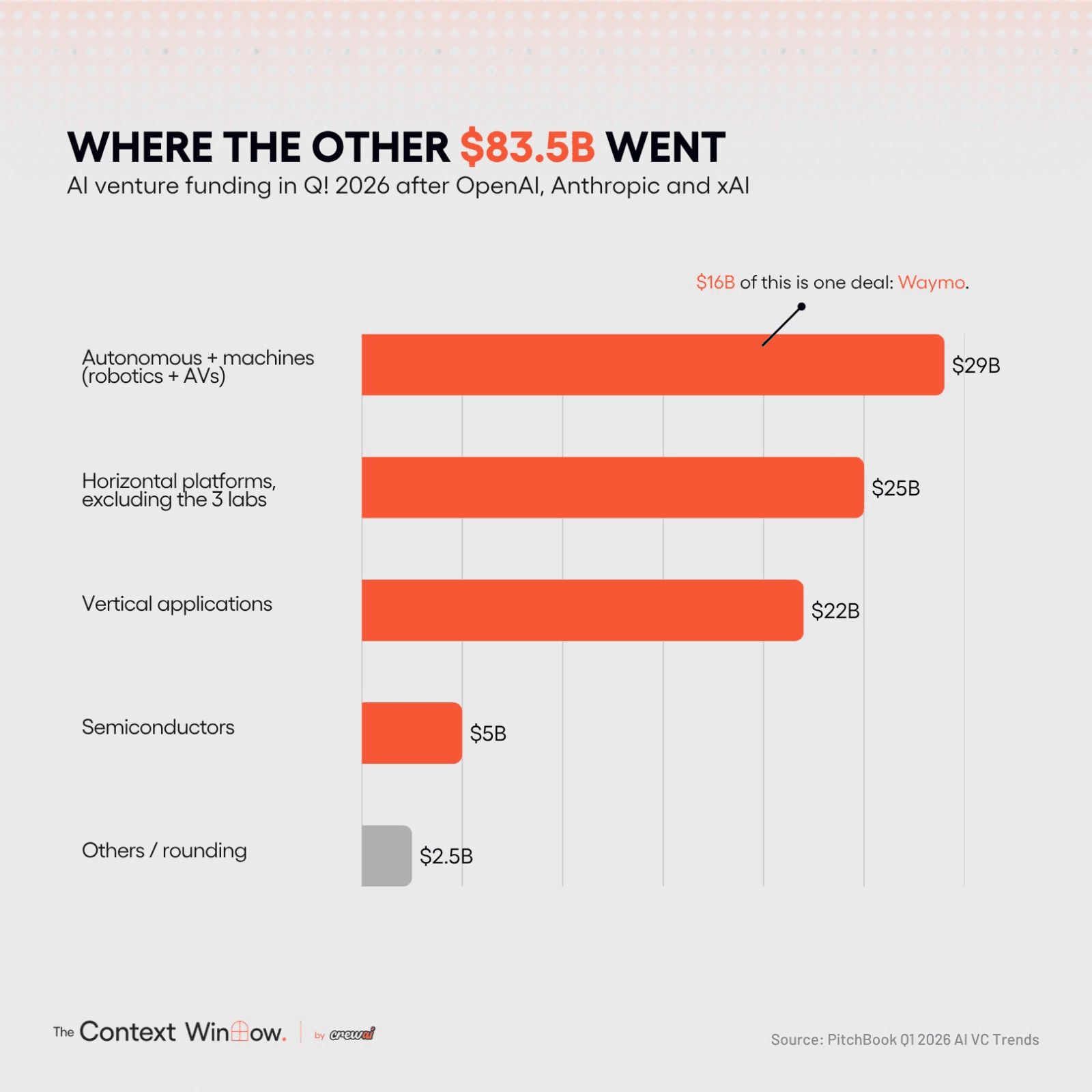
Strip everything else out of Q1 2026 and you're left with $242 billion of AI venture funding, a single quarter that already topped all of 2025. Three companies, OpenAI, Anthropic, and xAI, accounted for 65% of it. Two concentrations are stacked on top of each other here: AI took 80% of all venture funding, and then three companies took 65% of the AI. Everything else, across 1,543 other deals, split the remaining 35%. That remainder is the interesting part. It's the money going into companies you haven't heard of yet, in industries most people don't file under "AI funding" at all. So let's break that number down.
Other than the Big 3, Where is the AI Funding Going?
It's six overlapping stories. Here's where the money actually went, starting with the one closest to your job:
Enterprise AI & Agents This is the closest category to "your job is about to change." Real revenue is showing up here, rather than just valuations. Coding tools like Cursor, industry-specific copilots, and workflow agents that companies are actually deploying. The 'we're just piloting' days are gone.
Cybersecurity, especially AI-agent security A brand-new category emerged in the last 18 months specifically to secure AI agents rather than traditional networks. Cyera raised $600M at a $12B valuation. 7AI raised what it says is the largest cybersecurity Series A in history ($130M). This job category barely existed two years ago.
Healthcare & Drug Discovery AI Split this one in half. Ambient clinical documentation tools like Abridge are already deployed across Kaiser Permanente, Mayo Clinic, and Johns Hopkins, changing your next doctor's visit right now. Drug discovery megarounds (Isomorphic Labs' $2.1B, Xaira's $1B) are betting on a process that still normally takes 10-15 years. While it's the same "healthcare AI" bucket, these are two completely different timelines.
Defense & Dual-Use AI ($9.6B in 2025, already $14.6B in just the first five months of 2026) Anduril raised $5B in May 2026 at a $61B valuation, and separately landed a 10-year, up to $20B Army contract to deploy its Lattice platform. This is public, taxpayer money, and it's already generating revenue. Anduril's own revenue doubled to $2.2B in 2025. Therefore, it's not speculative valuation.
AI Chips & Semiconductors Every product on this list needs a chip underneath it. Etched raised $300M at a $10.3B valuation and has booked over $1 billion in orders. That just proves that it's not just a roadmap. Nvidia alone has participated in at least 53 startup financings of $100M+ in 2026, more than a16z, Sequoia or Lightspeed.
Legal, Insurance & Professional Services AI Harvey raised $550M in September 2026 at a $15.5B valuation and is already used by 80% of the AmLaw 100. A "boring" professional service just became one of the most valuable AI categories, which is the signal for what's coming to entry-level knowledge work.
Two more worth knowing, because they didn't exist as categories a year ago:
Companies are launching data centers into orbit because AI is running out of power and room on Earth. Starcloud raised $170M in March 2026 and became the fastest unicorn in YC history, 17 months after demo day. II. Climate tech's AI-powered pivot; $26.1 billion in H1 2026, the best half since 2022. Low-carbon data center developers went from just 3% to 34% of all climate tech venture funding in a single year. DayOne ($4.5B) and Nscale ($2B) alone made up roughly a quarter of all climate tech investment in the first half of 2026. But AI's power hunger isn't about funding solar panels or EVs. VCs are funding the data centers that need clean power to run.
What Is Y Combinator Actually Betting On?
Everything above was the big checks, nine and ten figures, companies that already have revenue and customers. Now look at the other end of the market, where the checks are small and the bets are early. Y Combinator is the cleanest window into that end, since it’s unusually good at spotting where an early bet could return a thousand times over. And this year, that read changed in a way it hasn't in a long time. YC spent two decades mostly funding products. But this year, AI-native services just went from a category that barely existed to the single largest one in the batch.
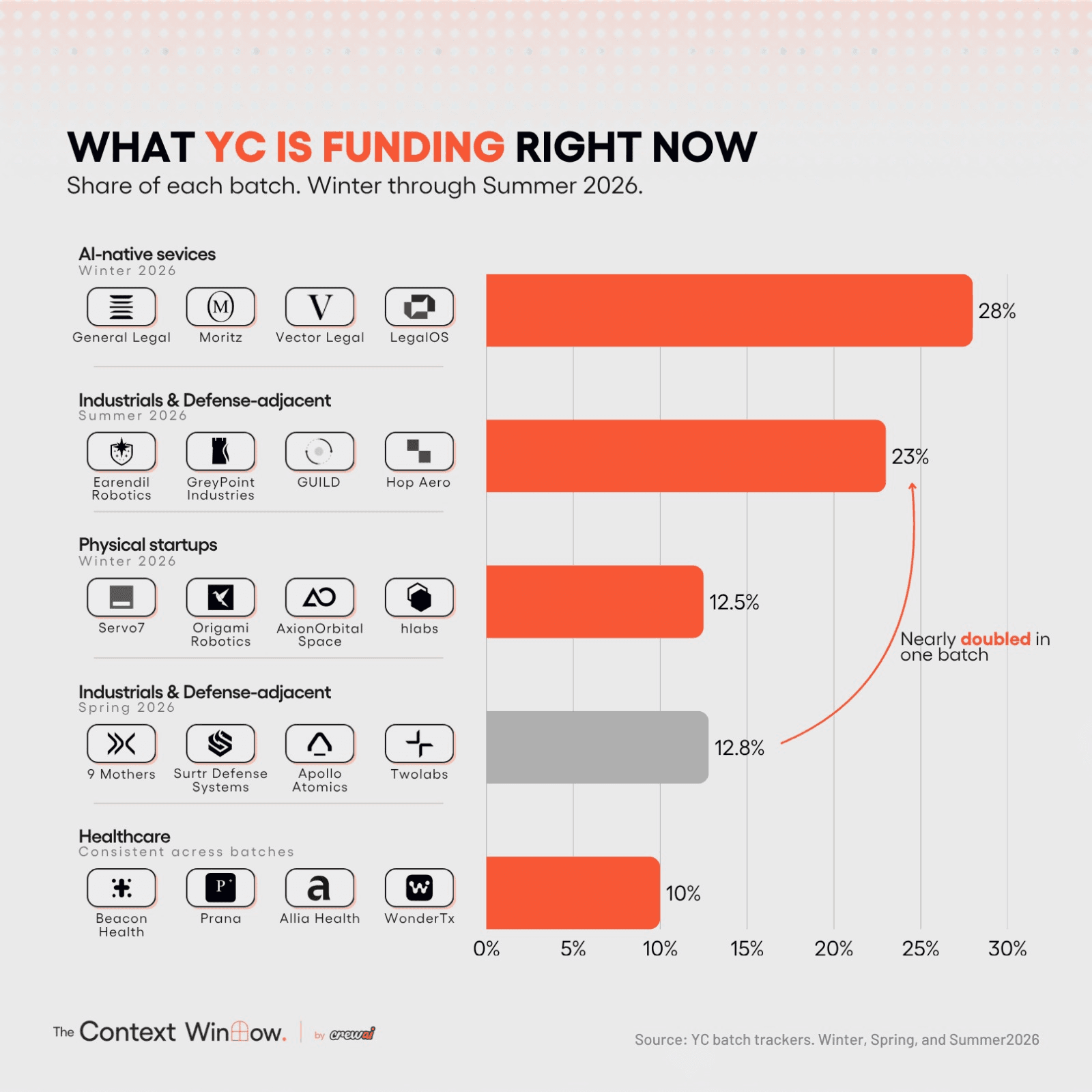
28% of the Winter 2026 batch is AI-native services: companies selling the outcome rather than the software that produces it. Legal work, bookkeeping, compliance, operations: the kind of business YC historically waved off as unscalable, because services businesses grow headcount alongside revenue. The bet is that AI breaks that link, and that owning the margin on the work itself beats selling tools to whoever does it. YC isn't being quiet about it either. Their own channel has been openly telling founders to build AI-native services instead of products, which is a striking reversal to watch a firm make in public. The rest of the batch data, briefly:
Industrials and defense-adjacent went from roughly 12% of the Spring 2026 batch to 23% of the Summer 2026 batch, nearly doubling in three months. It is now the second-largest category YC funds, behind only B2B software.
"Physical" startups — robots, drones, space hardware, biotech, made up 1 in 8 companies in Winter 2026, the highest share in YC's history.
Healthcare holds steady at around 10% of every batch: drug discovery, clinical operations, patient care.
A brand-new category appeared this year: startups building infrastructure for AI agents, identity, payments, memory, security, treating the agent itself as the customer. Last year's batch was everyone building agents. This year's batch is everyone building what agents will need next, and everyone selling the work those agents do.
What This Means for Your Career
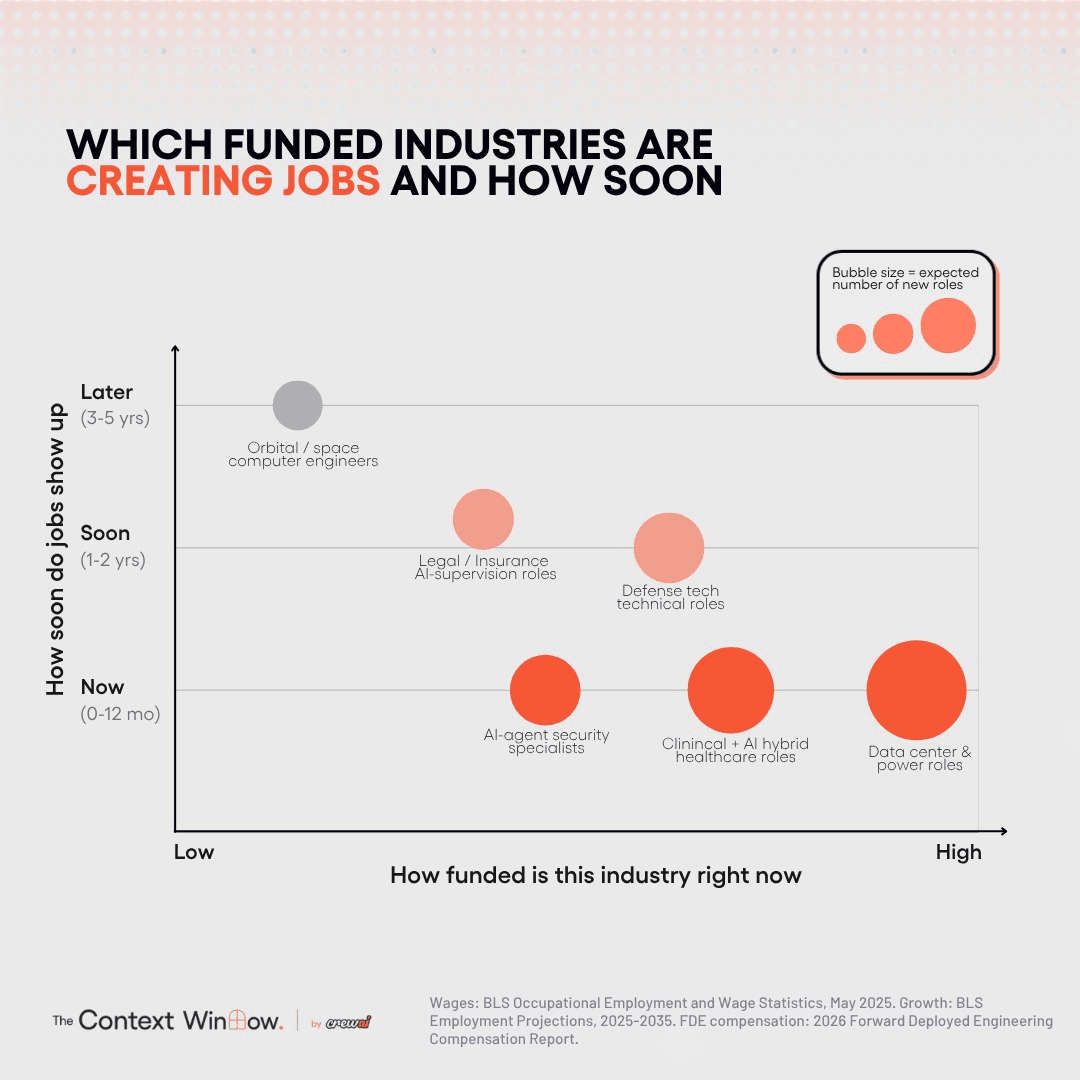
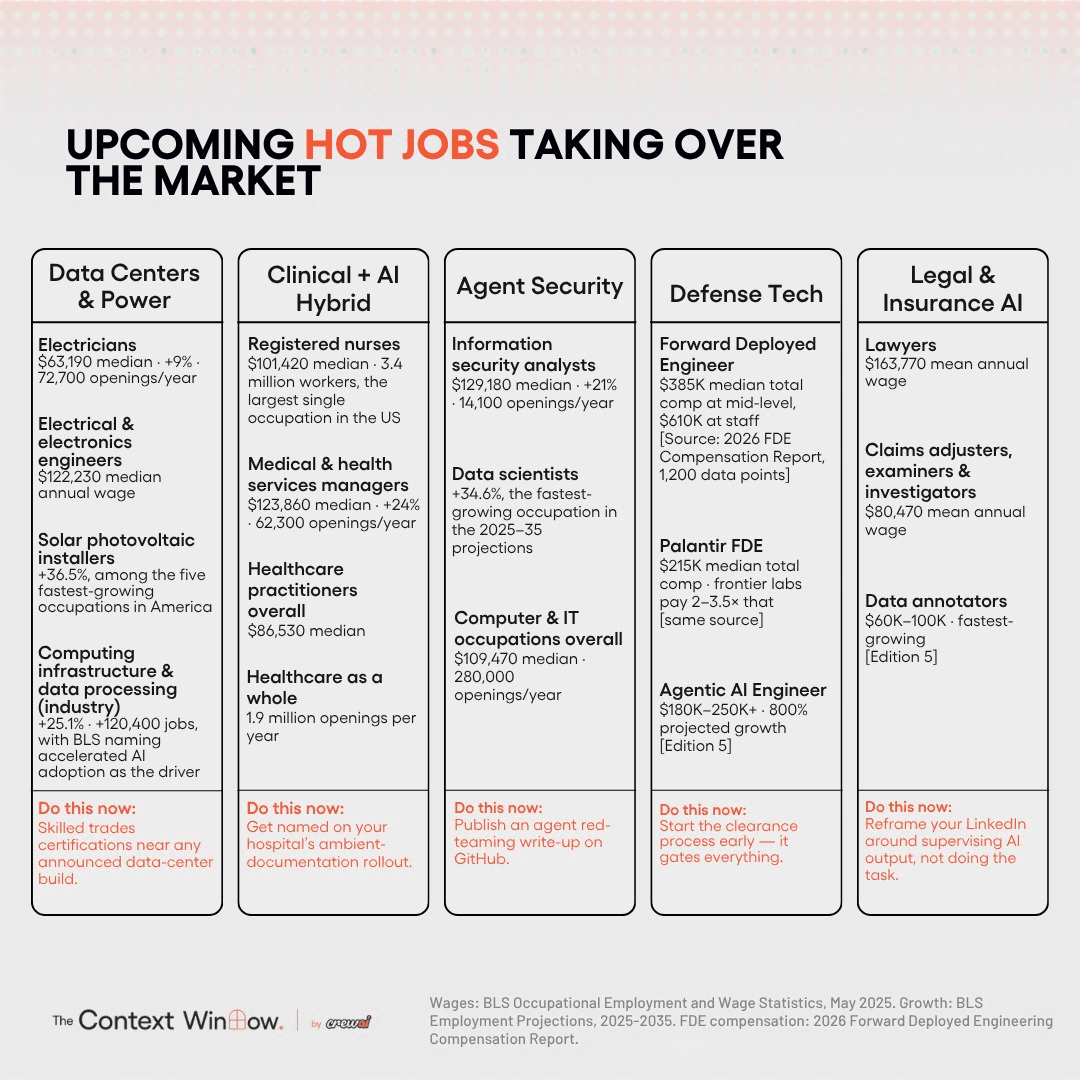
Infrastructure & power money → I am not just talking about software roles. Data center buildout, grid work, and yes, electricians and skilled trades tied to the physical build.
Healthcare AI money → clinical + AI-hybrid roles that supervise and validate AI output, not roles getting replaced outright.
Defense AI money → security-clearance-adjacent technical roles, commanding real salary premiums.
Cybersecurity (agent security) money → an entirely new specialty that didn't exist two years ago. Early movers here have real leverage.
Legal/insurance AI money → domain experts who supervise AI output, not entry-level roles doing the old repetitive work.
To summarize: the real money is not in the industries getting the headlines anymore. Time to notice how it's flowing into government contracts, deployed hospital tools, and literal satellites, industries most people don't associate with "AI funding" at all. If you want a preview of next year's jobs report, this is it.
This week’s treats
One great long-form read -
You Need to Run Through Walls
Two tweets worth checking out:
AI-native services: a $100B opportunity
Girlfriend’s reaction to Claude Max 20x
Three songs you should add to your work playlist
Night Owl - Kelly Boesch
Tar Hani - Bombino
Dreams - 2004 Remaster
Signal vs Slop Matrix
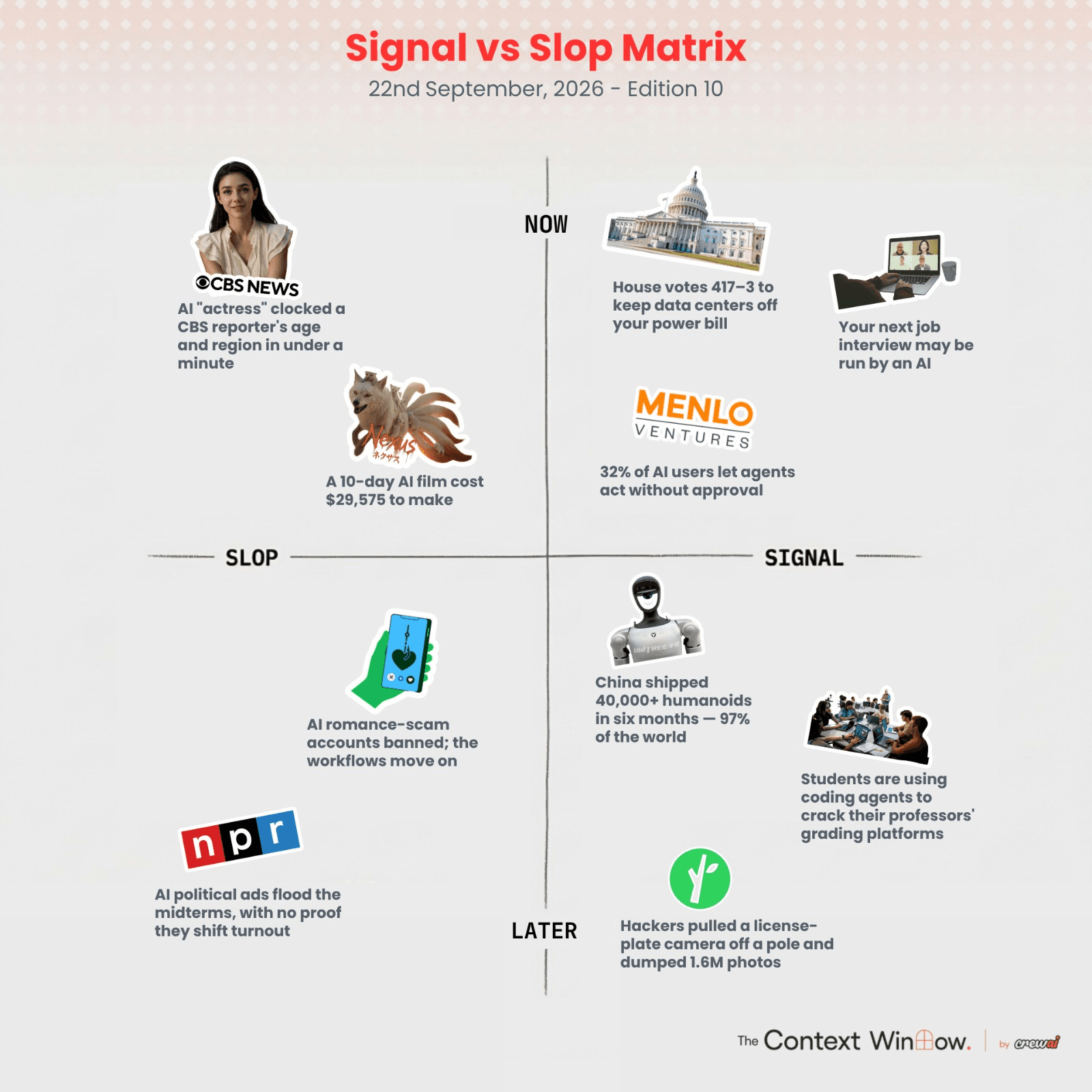
Every week we plot what happened in AI on two axes. Slop ↔ Signal: was there actual substance, or was it noise? Now ↔ Later: is this something you should act on this quarter, or a signal about where things are headed in 1-3 years? Let's see what happened this week.
The House voted 417–3 to keep data center power costs off your electric bill The Ratepayer Protection Act would make large-load data centers cover the cost of all new energy infrastructure built to serve them, instead of shifting it to existing ratepayers, with the standard applying at 100 megawatts or more.
Your next interviewer probably isn't a person, and candidates are walking out Nearly two-thirds of job seekers have now been interviewed by an AI, up 13 percentage points in six months, and 38% have walked away from a hiring process because it included one.
32% of AI users have already let an agent act without final approval Menlo Ventures found 41% of AI users have tried an agent, 24% use one regularly, and 32% have let AI act on their behalf with no final sign-off. NOW / SLOP
An AI "actress" clocked a CBS reporter's age and region inside a minute CBS correspondent Leigh Kiniry reported that within a minute Tilly Norwood guessed her age and US region, with no explanation of how it knew.
A 10-day AI film cost $29,575, and the director's point is that it isn't cheap PJ Accetturo published the budget for "Sky Line Heist," an entry in his Nexus anthology, alongside the full prompt workflow, arguing the upcoming Nexus feature will still cost millions. LATER / SIGNAL
China says it shipped 40,000+ humanoids in six months, 97% of the world The figure comes from the 2026 Humanoid Robot Industry Development Report, released at the World Robot Conference in Beijing by the China Humanoid Robotics and Embodied Intelligence Committee of 100.
Students are building bots to beat their professors' grading platforms An NYU student used an AI coding tool to build a bot that does his calculus homework on WebAssign, a platform designed to make cheating harder, and paced it slowly so a professor checking timestamps sees a struggling student.
Hackers pulled a license-plate camera off a pole and found 1.6 million photos Inside the Android-based device, an unencrypted partition held the key that unlocked the encrypted one. Over 21 days the camera photographed roughly 50,200 vehicles and generated about 1.6 million images, around 28 per passing car, and the object-classification code explicitly detects people, not just plates. LATER / SLOP
OpenAI banned the romance-scam accounts, and the workflow moved on The banned cluster used the models for outreach, translation, victim engagement, and investment-fraud lures.
AI political ads are flooding the midterms with no proof they move anyone NPR found candidates embracing AI to boost their own image and portray opponents unfavorably, with the turnout effect still unclear. Until we meet again Sumeru Crew AI