What is an AI Native Enterprise?
June 16, 2026
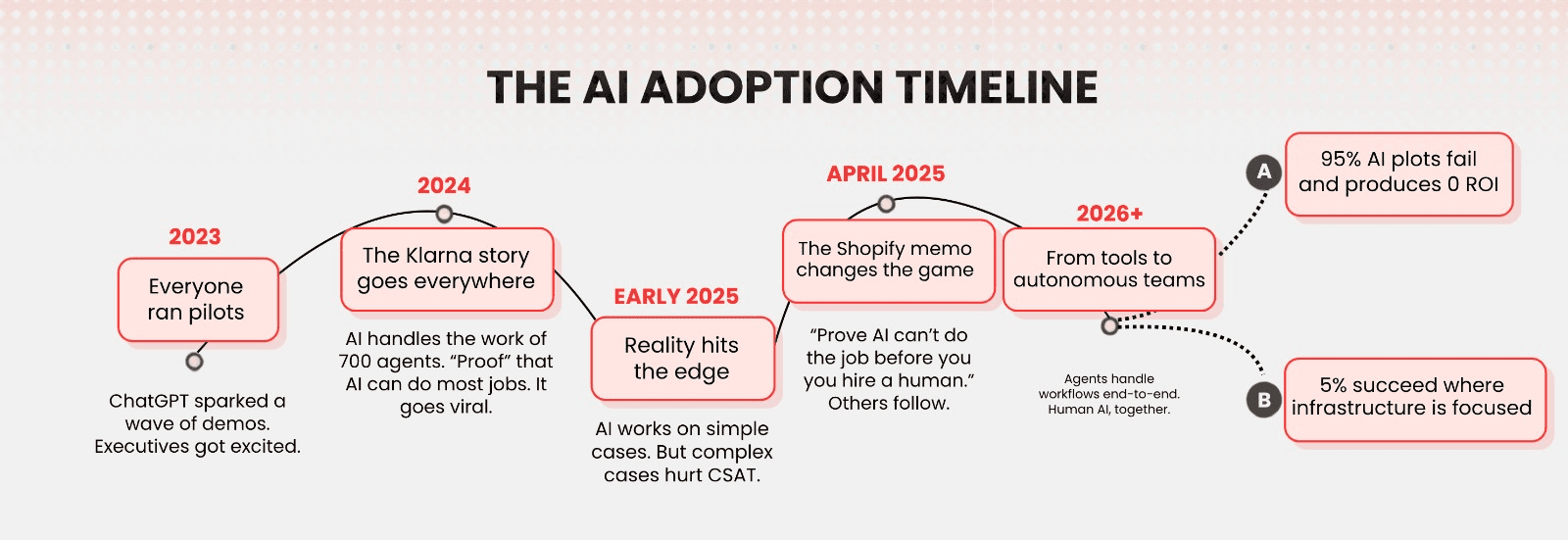
And where the $2.5 trillion in enterprise AI spending went In the last year, more than 4,500 CEOs have collectively spent over $2,500,000,000,000 ($2.5 trillion) on AI. In today’s edition, let’s discuss: Where the money went (and why 95% of pilots failed) Two kinds of enterprises emerging: AI-layered vs. AI-native AI initiatives of companies like Klarna, and Shopify Let’s review the timeline of how we got here:
Let’s Walk the Timeline.
2023: ChatGPT launches in November. Hit a million users in five days. By early 2024, it's the fastest-growing technology product in internet history, 100M users in two months.
2024: AI demos start showing up. Klarna announces an AI customer service agent handling work equivalent to 700 full-time agents with two-minute resolution times. JPMorgan Chase rolls out LLM Suite to 60,000+ employees, creating investment banking presentations in 30 seconds instead of hours. Salesforce launches Agentforce.
Early 2025: Klarna starts rebuilding human support capacity. The AI crushed routine queries but failed on fraud disputes, payment hardship, anything requiring judgment. Repeat contacts spiked. CEO Sebastian Siemiatkowski tells Bloomberg the strategy 'went too far.' McDonald's, after three years testing IBM's voice system, shuts it down mid-2024.
April 2025:Shopify goes the other direction. Tobi Lütke sends a memo: "prove AI can't do the job before you hire a human." Others follow.
2026: 95% of AI pilots fail. But companies with measurement infrastructure outperform the market by 1,200 basis points. Shopify had built that infrastructure first: LLM proxy, 24+ MCP servers, open tooling, performance reviews with AI fluency metrics. The memo worked because the architecture existed. Copycats who issued the same memo without the infrastructure got people pasting AI output into their work.
What’s the Thesis Here?
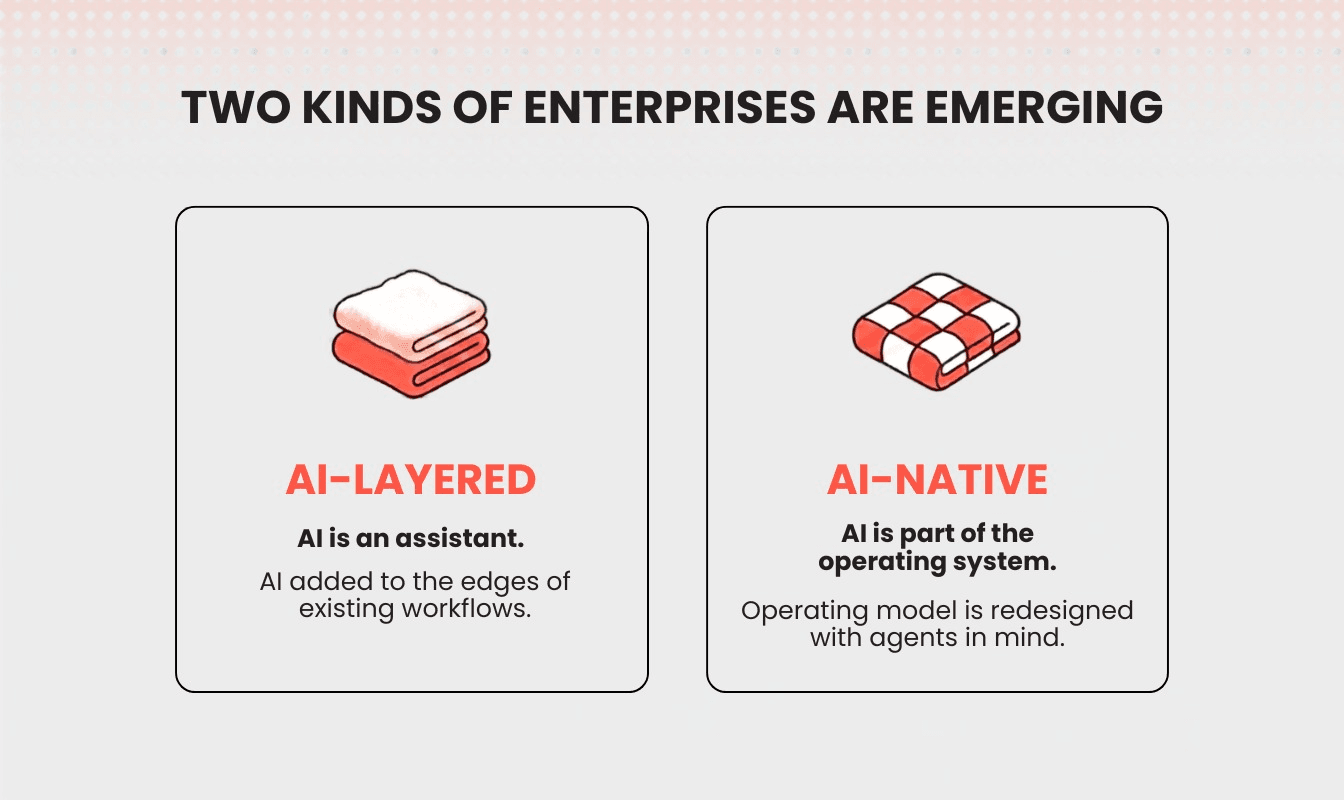
AI-layered: AI added to the edges of existing workflows. The processes, org chart, and decision ownership are all the same. The AI responds to prompts. Remove it, and the business still runs the same way it always did.
McDonald's Voice Ordering: AI added to drive-thru operations with 85% accuracy. While it struggled with accents and ambient noise, ordering workflow and staffing increased significantly.
Duolingo: CEO announced ‘AI-first’ strategy in which they decided to phase out contractors, restrict hires unless teams automated more work. While the course structure and learning model was unchanged, AI was added to the content pipeline.
AI-native: The operating model is redesigned with agents in mind. AI influences how work gets prioritized, how decisions flow through systems, how the business responds to what's happening in real time. Remove it and core operations break. These companies have a core foundation in AI.
GrowthX: Expert workflows codified into executable code running 500k+ workflow instances monthly. The system orchestrates where humans intervene and learns from each decision to improve future workflows. The orchestration layer is core to operations.
Humblytics: Multi-agent workflows orchestrate lead enrichment, campaign strategy, ad creation, and reporting across Meta/Google. Agents execute 500k+ runs monthly and manage website content programmatically. Removing the agent infrastructure breaks the operating model. PwC found that companies embedding AI across multiple functions, not in isolation, are 3x more likely to achieve meaningful ROI and run 4 percentage points higher profit margins. One question that cuts through almost every situation: when you added AI, did the work change, or just the tools? || If the process is the same and the AI is sitting alongside it, you're AI-layered. You might still extract value. But you are not compounding.
How AI-Native Companies Are Built
Embedded AI Across Multiple Functions at Once
The biggest example is how Shopify has started using AI for website performance benchmarking. Previously, a human had to manually compile site audit data to show prospects Shopify's speed advantage. Now the system handles it automatically.
SAP went further. At Sapphire 2026, the company announced the Autonomous Enterprise, a complete operating model redesign. They rewrote their ERP around agents. The SAP Business AI Platform combines BTP, Business Data Cloud, and Business AI, while the Autonomous Suite deploys 50+ Joule Assistants and 200+ agents across Finance, HR, Procurement, Supply Chain, and CX. Example: In a live demo, an agent identified a $24M margin-impact anomaly, generated requirements and technical specs, and coordinated multiple agents to resolve it.
Fiverr restructured around AI-native capabilities. In September 2025, the company launched a transformation focused on infrastructure, product, go-to-market, and operations. As the CEO put it: "We don't need as many people to operate the existing business. A leaner organization lets us work more closely as a team." AI now powers customer support, knowledge consolidation, SLA reduction, marketplace integrity, and fraud detection. The workforce shrank, but capability expanded. II. Built Governance Before Scaling, Not After Governance is the rules, oversight, and controls that define how AI systems operate. Basically, who can use them, what data they access, how decisions get reviewed, what happens when something goes wrong. Without it, enterprises end up with AI systems running in isolation, producing unpredictable results, or creating compliance risk. This is where Hyland stands out. They launched an Enterprise Agent Mesh with governed orchestration, lifecycle management, and observability. By grounding agents in industry-specific data, it reduces hallucinations and enables real business workflows like claims processing, contract review, and document routing.
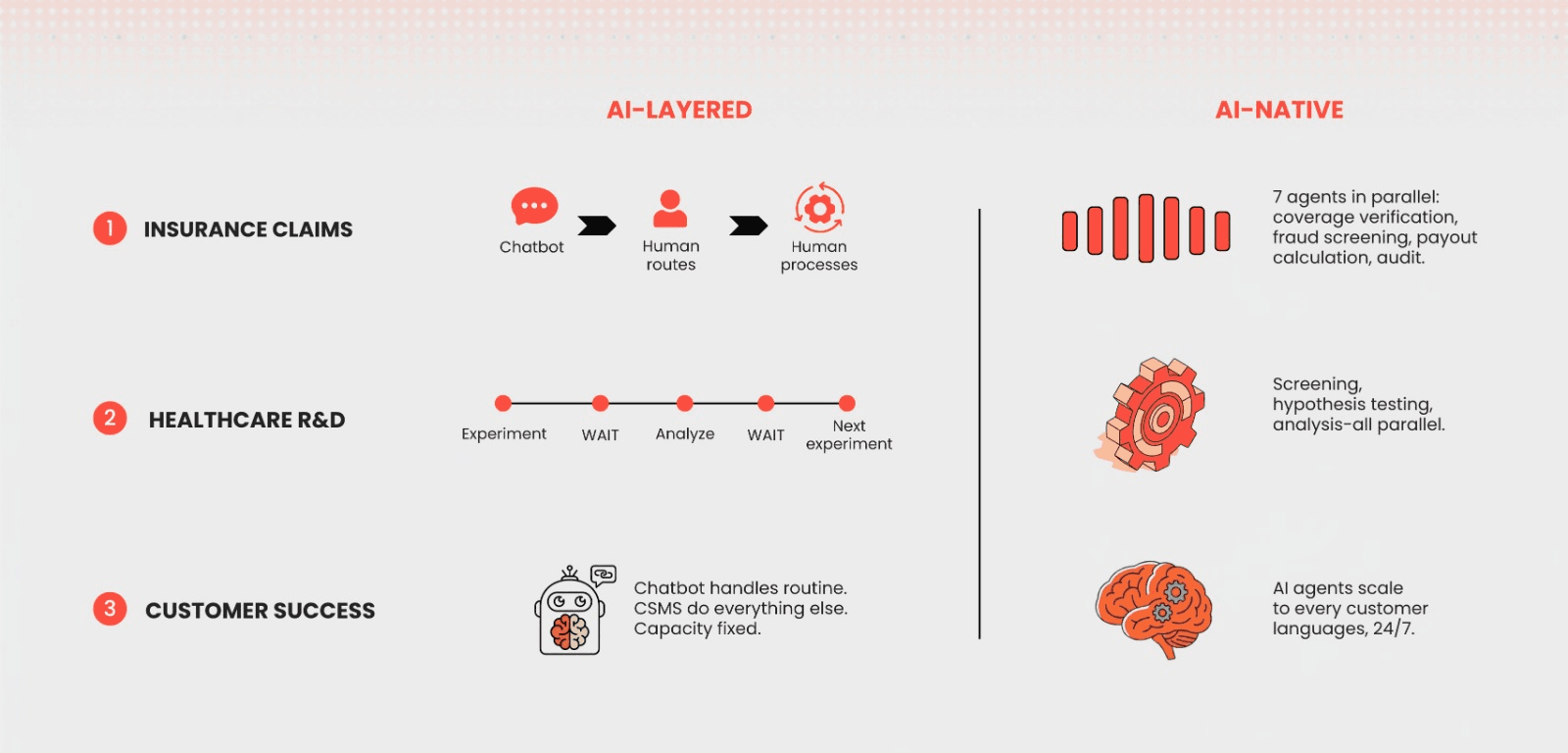
The Difference: Two Workflows
Insurance Claims AI-Layered: Bolt an AI chatbot onto the claims portal. The customers submit documents, the bot extract some data, then humans manually route and process each claim sequentially as before. AI-Native: Allianz's Project Nemo, which involves seven specialized AI agents run in parallel: coverage verification, fraud screening, payout calculation, audit. Resolution drops from days to hours. While the humans approve the final payout, the workflow orchestrates agents.
Healthcare R&D AI-Layered: Add an AI tool to help researchers analyze datasets faster, researchers still run experiments one phase at a time, waiting for results before moving to the next step. AI-Native: UCSF and SandboxAQ compressed neurodegenerative disease research timelines from years to months by running AI-driven molecular screening, hypothesis testing, and data analysis in parallel. Research cycles changed fundamentally.
Customer Success AI-Layered: Deploy an AI chatbot to answer routine customer questions while CSMs handle everything else manually, capacity stays fixed, coverage stays limited. AI-Native: Salesforce's AI agents removed the capacity ceiling entirely. Instead of choosing which accounts get attention, teams now scale proactive engagement across every customer in real-time translation across seven languages. Engagement became autonomous.
What We're Doing at Crew Internally
Our CEO built an internal AI superagent called Iris. It handles everything from building crews and flows to day-to-day automations. We're embedding field deployment engineers within teams to document manual processes and redesign them from scratch. We're also building a master use case library from the 77,000+ crews our open-source community has created with CrewAI. And we're making CrewAI Studio, our no-code automation Builder, more powerful with new tools and integrations so non-technical teams can build their own agents without engineering overhead. Excited for the things that are coming out soon!
This weeks treats
One great long form read -
Monks In the Casino by Derek Thompson
Two tweets worth checking out:
The optimistic scenario of AI by Aaron Levie
The Japanese legend of trusting the detour
Three songs you should add to your work playlist
Dle Yaman by Djivan Gasparyan Link (soft)
Hey Now by London Grammar Link (mid tempo)
Kuzola by Pongo Link (upbeat)
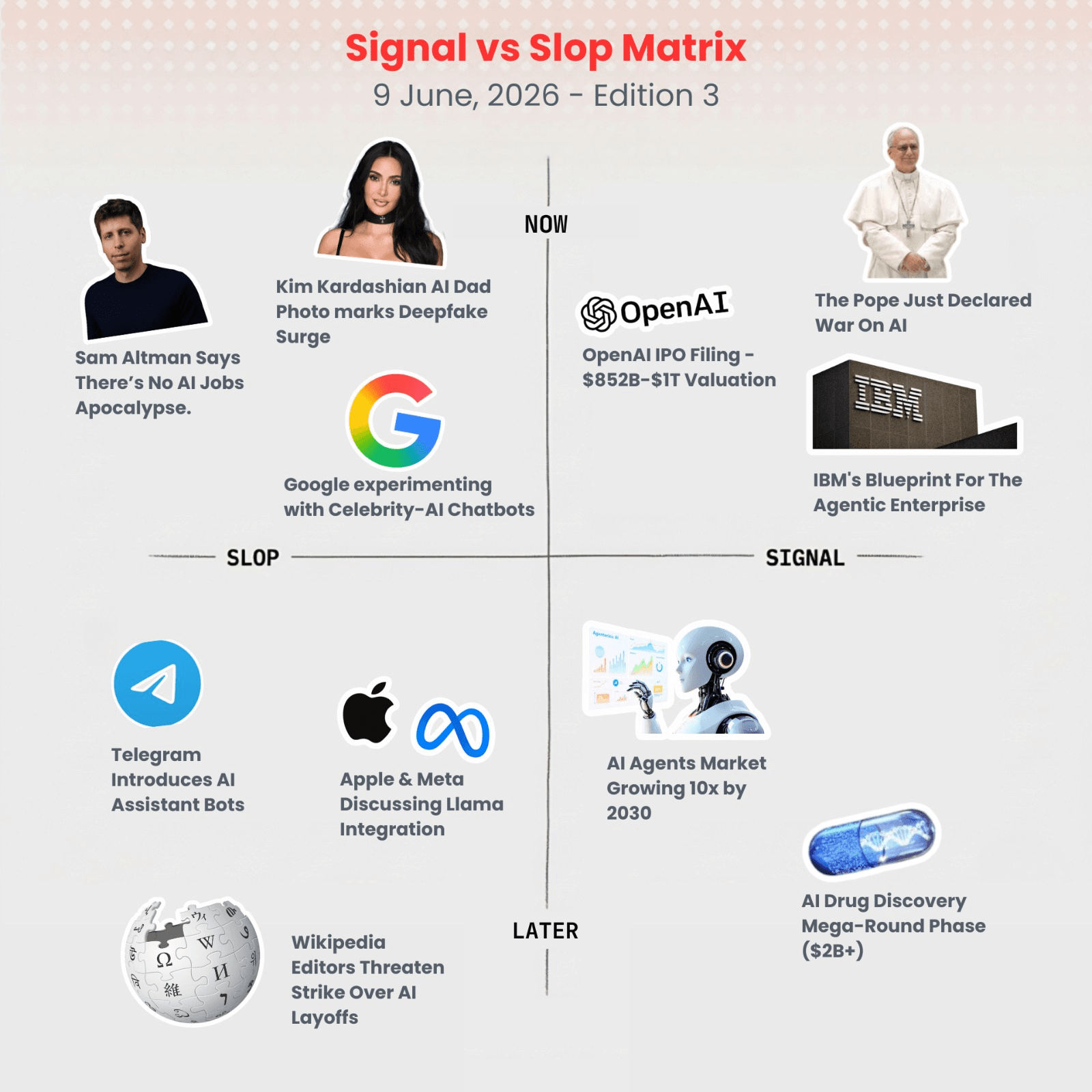
Signal vs Slop
Every week we plot what happened in AI on two axes. Slop ↔ Signal: was there actual substance, or was it noise? Now ↔ Later: is this something you should act on this quarter, or a signal about where things are headed in 1-3 years? Let's see what happened this week.