What is an Agent Harness, Really?
August 11, 2026
The one question every AI team should be asking right now Take the same AI model and put it in two different tools. In one, it works like a sharp engineer. In the other, it fumbles the exact same task, even though the model itself hasn't changed. On Terminal Bench, a public coding leaderboard, the same model scores very differently depending on which tool it runs inside. It’s not the model that’s the variable. It’s everything built around it. That "everything around it" is called the harness. Boris Cherny, who built Claude Code, says he no longer prompts the model directly. He writes the harness that prompts it for him.
In this edition:
what an "agent harness" actually is, in plain English
the difference between a harness and a framework
The guiding principles of building a harness
How to build one in crew AI
This week’s 2x2 signal / slop matrix So, let's begin.
The model is not the agent
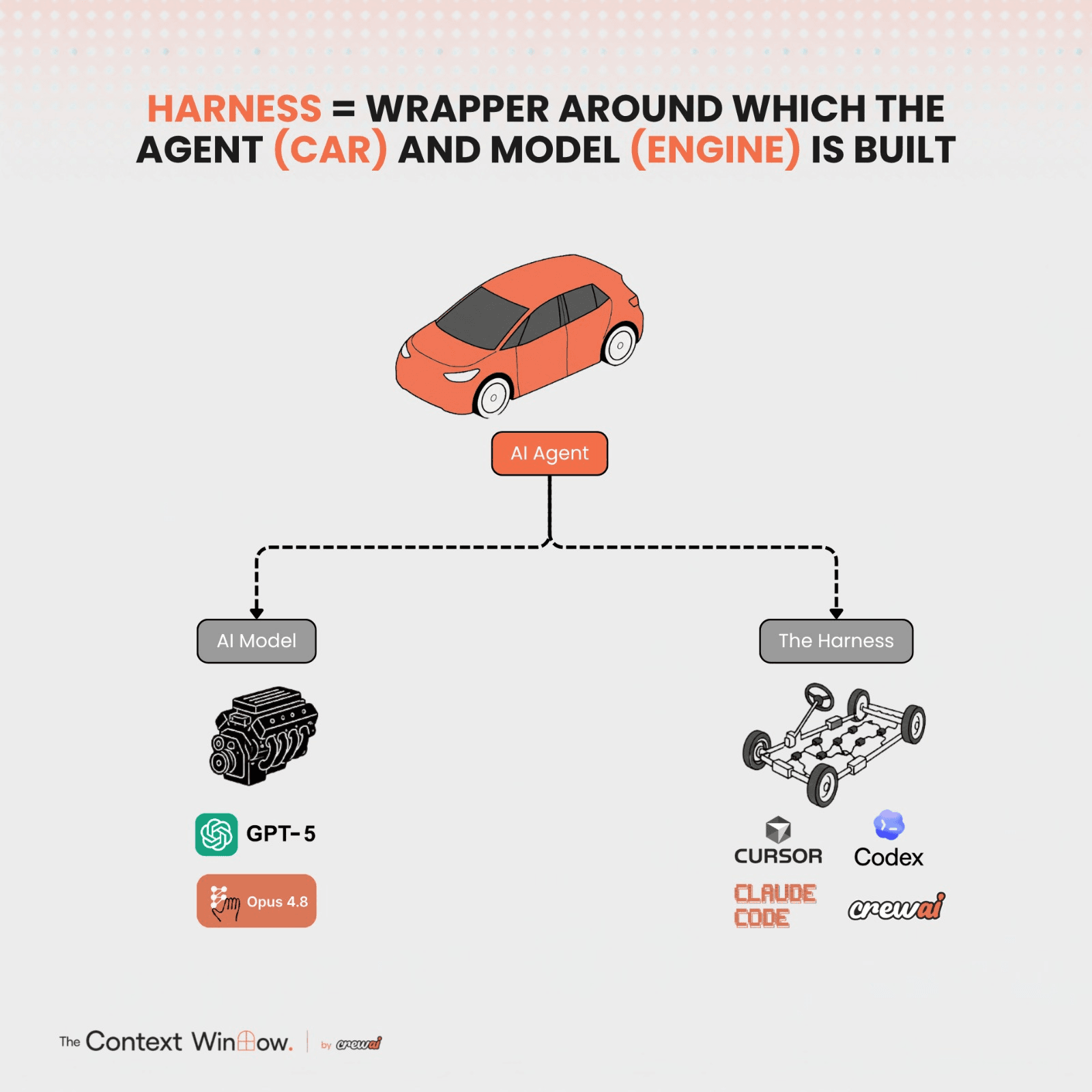
The model is not the agent. A raw model takes text in and puts text out. That's genuinely all it does. It can't open a file. It can't check its own homework. It has no idea when a task is actually finished. Here's the definition: an agent harness is all the things that surround the model to make it perform a certain way.
What's actually inside a harness
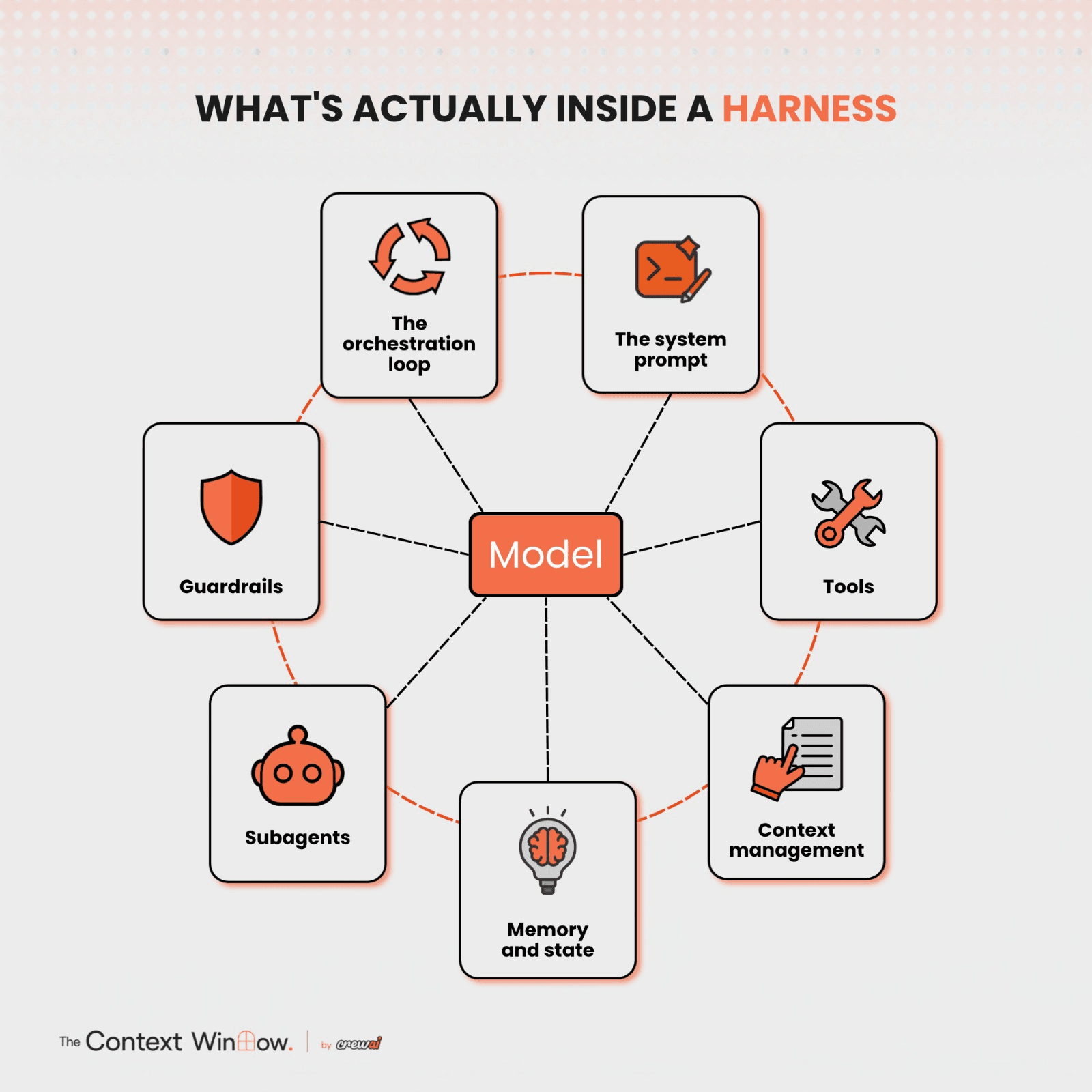
If you strip away the technical jargon, in its core, every harness is really doing seven jobs:
The orchestration loop. This includes: Assembling context → calling the model → parsing the output → executing tools → feeding results back → repeating until done. Mechanically it's a while loop. The loop's decisions are the harness's biggest opinions: does the agent plan before acting? How many turns does it get? What counts as done?
The system prompt. This is the harness's constitution. Who the model is, how it should behave, what it should refuse. Change nothing but this and you get a measurably different agent.
Tools. A model with only a file reader can advise. A model with a shell, an inbox, or a database can actually do the work. And it's not just about which tools. Only a tool with a sharp description and clean error messages will be used correctly. A vague one will get misused.
Context management. The model can only see what's inside its context window, and that window is limited. Load too much, and important details get buried. The harness controls what goes in: which files, how much history, what gets cut when space runs low. Context is a budget. Good harnesses spend it on what matters, feeding the model the right three files instead of an entire codebase.
Memory and state. Without memory, every task starts from zero. A good harness remembers what happened last time, so the agent gets sharper the more it runs.
Subagents. One context window can't hold everything. A subagent gets its own context, its own tools, a narrow task, and returns a clean summary to the parent. It's context management by other means.
Guardrails. What's the agent allowed to do on its own, and what needs a human to approve first? Sending an email autonomously and deleting a production database are not the same risk.
A quick example: Say you build an agent to triage your
inbox.
In edition 5(link) , we built an email organizer / triage agent. Let’s see how important of a role does the harness play in it.
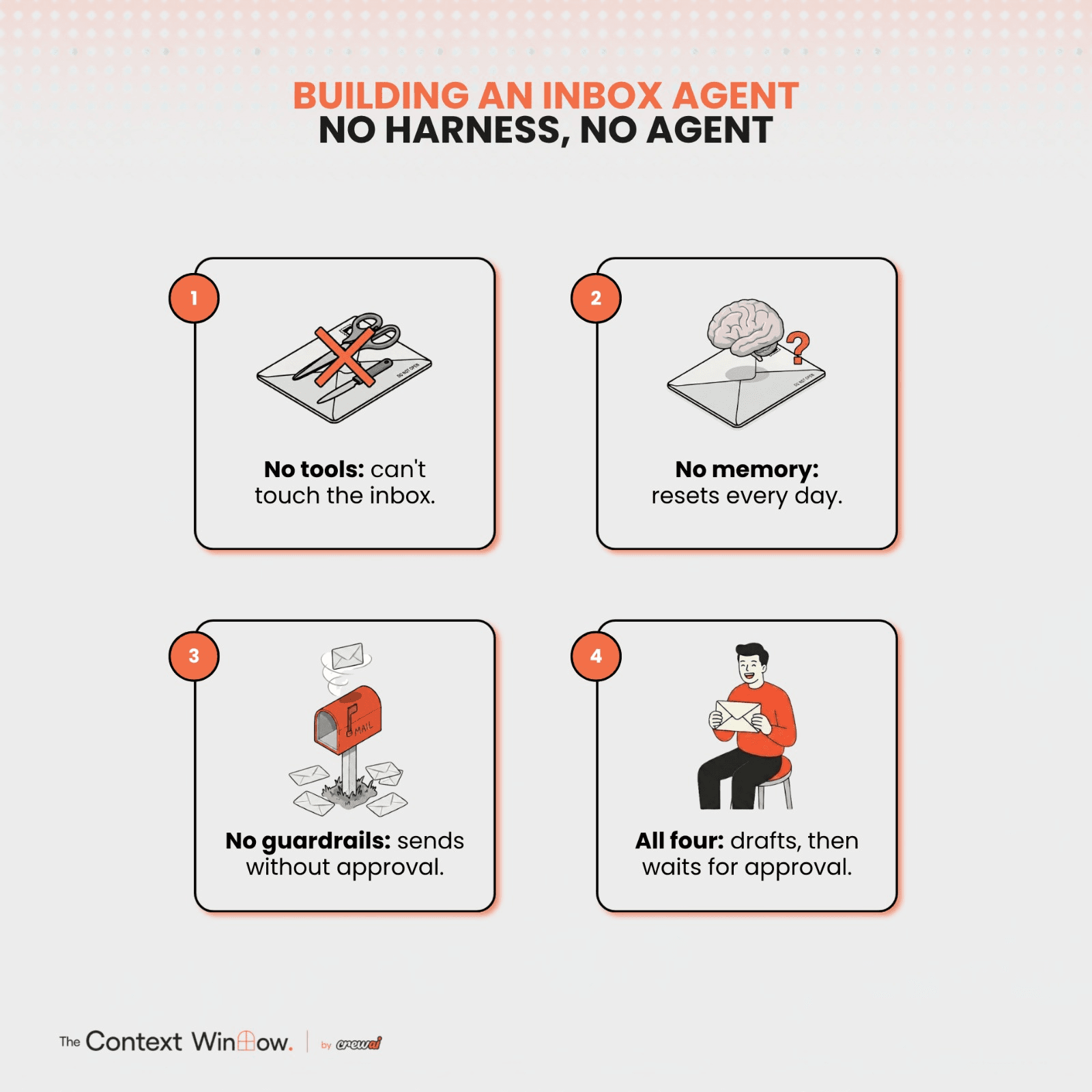
Give it only instructions and no tools, and it can describe what it would do, but it can't touch your inbox.
Give it tools but no memory, and it re-learns your priorities from scratch every single morning.
Give it memory but no guardrails, and one day it "helpfully" sends a reply on your behalf that you never approved. The harness is what turns "can describe the task" into "can actually do the task, safely."
Harness or framework?
So far we've talked about "harness." Now let's bring in a second word you'll hear a lot: framework. Some people often use these two words to mean different things, while others think they’re the same. Let's clear that up. Earlier, people saw it like furniture: A harness is a couch that shows up ready to sit on. A framework is flat-pack furniture, parts and a manual, and you build it yourself. That's outdated now. Modern frameworks like CrewAI also come ready to use. A few lines of code, and you already have a working agent, no assembly required. So "assembly required or not" isn't the real difference anymore. The real difference is: can you change how it works, or not?
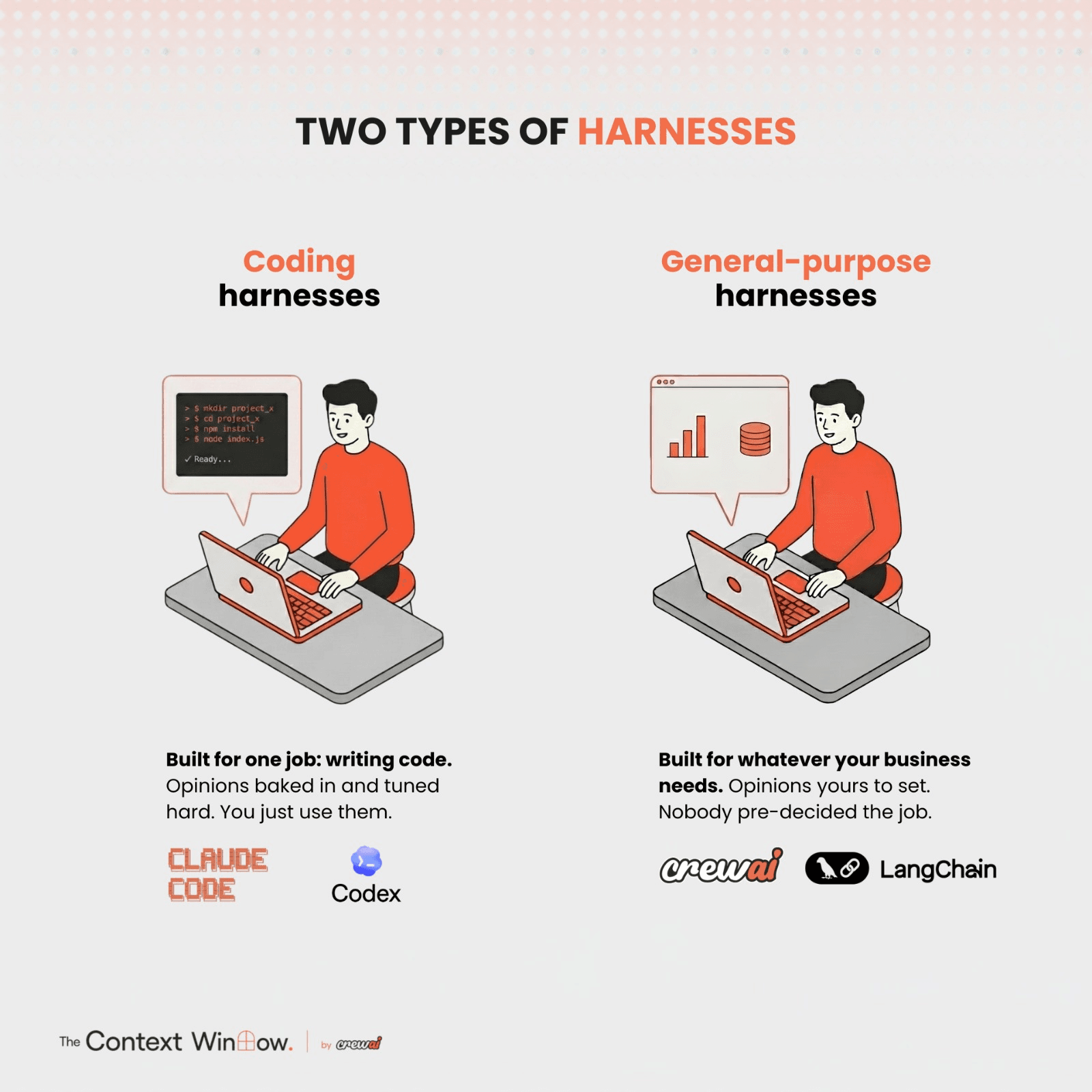
Coding harnesses (e.g. Cursor, Claude Code, Codex) These are built for one job only: writing code. The opinions are baked in and tuned hard for that one thing. You can’t configure them. You just use them.
General-purpose harnesses (e.g. CrewAI and its peers) The underlying idea is the same, but the opinions are yours to set and frameworks like crewai give you the toolkit to extend your own harness.. Instead of writing code, you're building an agent for support, research, finance, ops, or whatever your business actually needs. Nobody pre-decided the job for you, because nobody else's business looks like yours.
This is the split that explains almost every debate about "which agent tool is best." A coding harness and a general harness are solving different problems altogether rather than competing for each other. So here's the question worth screenshotting and sending to your team: "Is our agent broken because the model isn't good enough, or because nobody actually designed the harness around it?"
Guiding Principles of Building a Harness
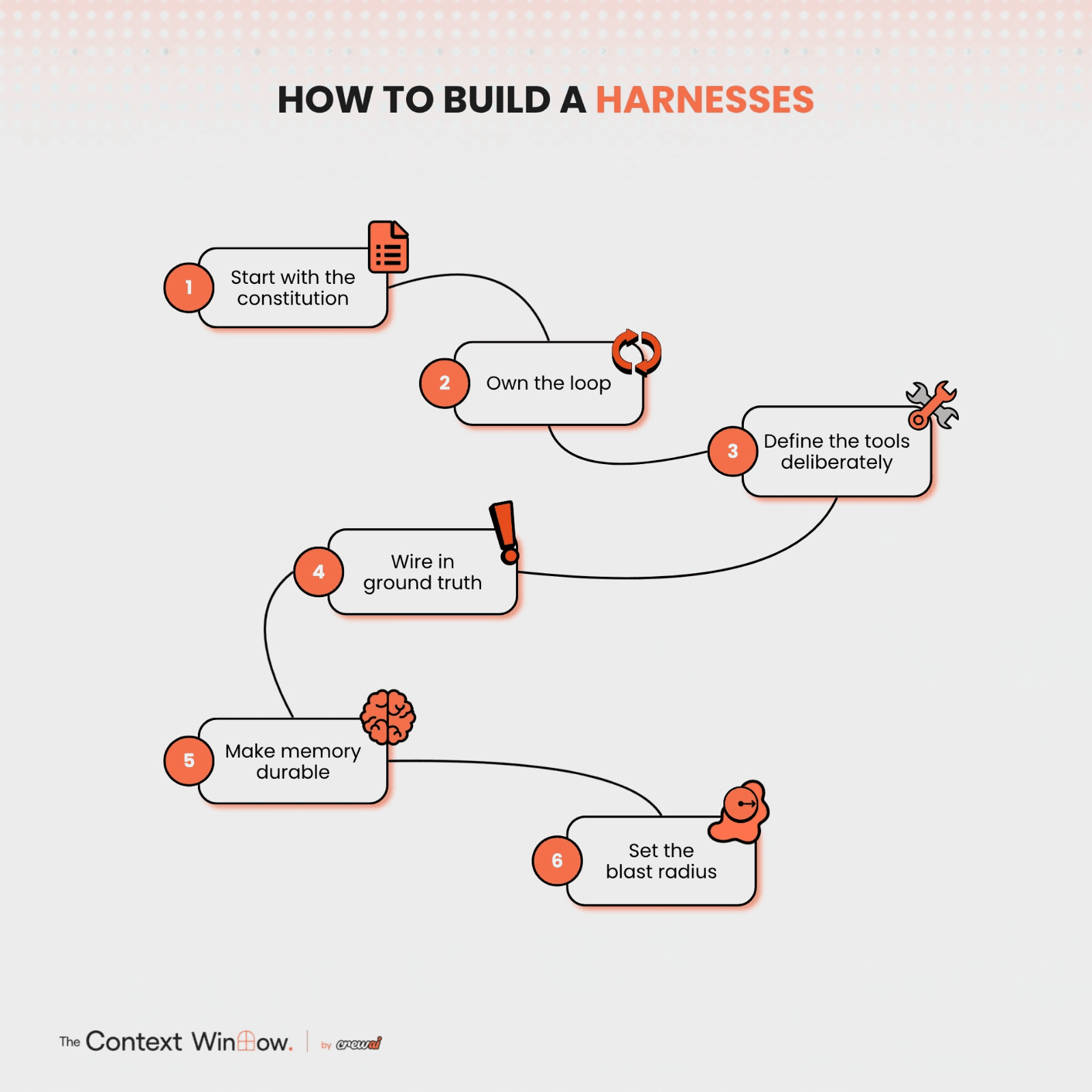
If your problem is coding, inherit a coding harness. The opinions are already tuned. For anything else, you're building the opinions yourself. Here's the order that works:
Start with the constitution. Give the agent a specific role and goal. "Senior support analyst who escalates billing disputes" beats "helpful assistant."
Own the loop. Every harness runs on a loop (gather context, call the model, see what it wants to do, run that action, feed the result back in, and repeat) until the task is actually finished. Does the agent think through a plan before acting, or does it improvise step by step? How many attempts does it get before you step in? And critically, what actually counts as "done"? If you don't answer these upfront, the model ends up making these calls on its own, which is usually where things go wrong.
Define the tools deliberately. Tools are what let the agent act instead of just talk (read a file, run code, send a message). But giving it tools isn't enough on its own. Each tool needs a clear explanation of what it does and when to use it, plus an error message the model can actually understand if something goes wrong. A tool with a vague description gets misused. Example: the model reaches for the wrong tool, or uses the right one incorrectly.
Wire in ground truth. Find your version of a compiler error (a check, a schema, a second reviewer. When something fails, fix the harness so it can't fail that way again) don't just retry.
Make memory durable. Short-term memory keeps track of what's happening during the current task, so the agent doesn't lose the thread halfway through. Long-term memory carries over between sessions, so the agent remembers what it learned last time instead of starting from zero every single run.
Set the blast radius. Not every action carries the same risk. An agent drafting an email is very different from an agent deleting a production database. "Setting the blast radius" means deciding, upfront, exactly which actions the agent can take completely on its own, and which ones need a human to approve first. The idea underneath all six is: while models guess, systems can't afford to. So you build guessing into small, contained steps, and make everything connecting those steps predictable. That's what "reliable" really means. It doesn't mean zero failures, but failures you can see and recover from.
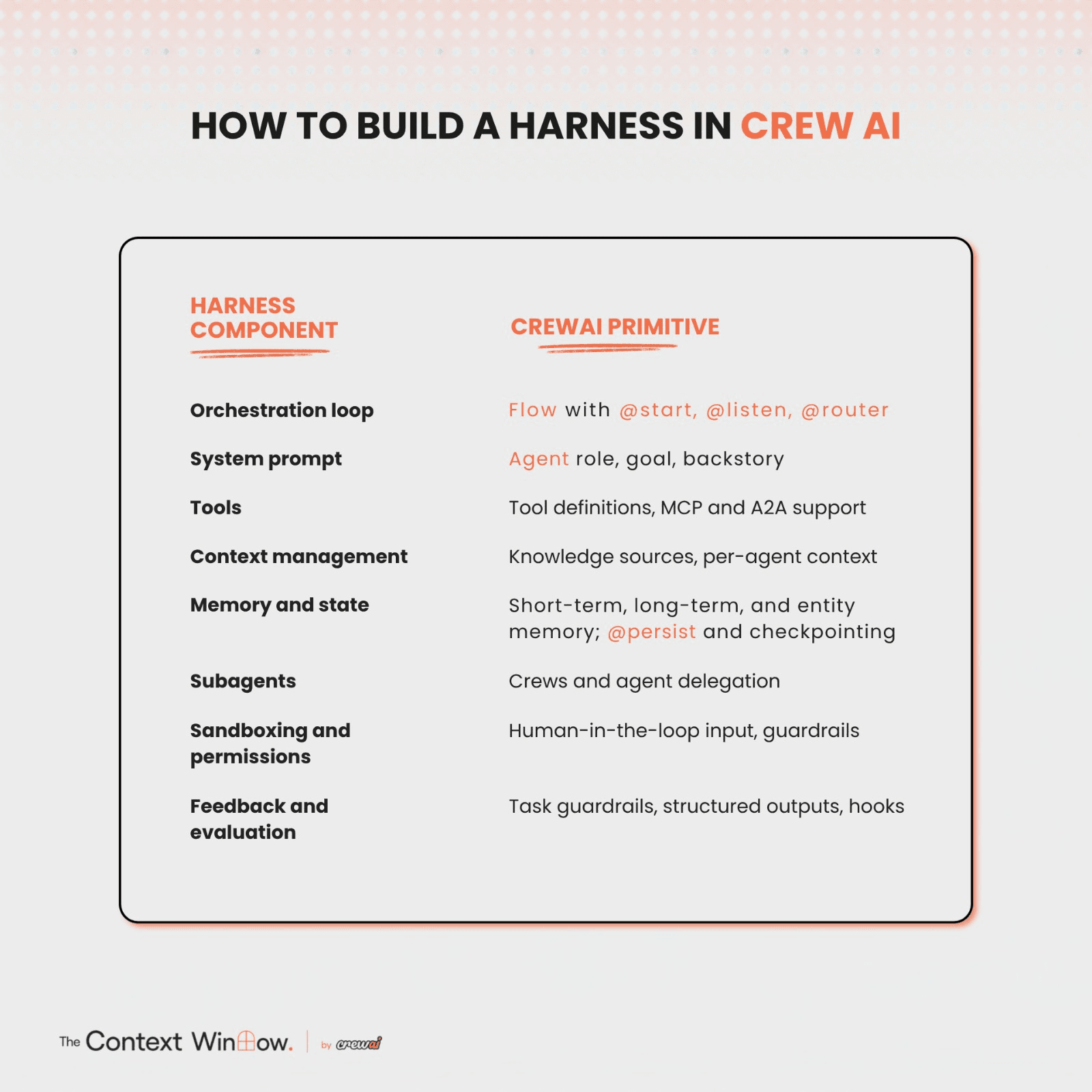
How to build it in CrewAI
Every piece above maps directly to something in CrewAI:
In practice, it's two loops. The inner loop is one agent's turn ( think, act, check). The outer loop is Flow. It decides which turn happens next, in what order, and what happens if a step fails. The agent gets freedom inside its turn. The Flow decides everything between turns. That split is the whole point: keep the unpredictable part small and contained, keep everything around it dependable.
Final Words
The model brings intelligence. The harness brings the opinion. What it sees, what it touches, when it stops, how it knows it is right. The benchmarks show harness design dominates model choice. Coding agents proved what a great harness can do in one domain. Now every domain needs its own. That opinion is how you improve results for a given use case. The model can take it far, but the harness is what completes it. Lorenze Jay Hernandez Lead OSS Engineer @Crew AI
This weeks treats
One great long form read -
Jason Cohen: Ruthless prioritization while the dog pees on the floor
Two tweets worth checking out:
My 5-question process that forces high agency work
The next wave of startups won’t do this
I’ve got a guy
had dinner with a billionaire tech founder (you know them)
Three songs you should add to your work playlist
Succession Music - Work like Kendall Roy (soft)
Everybody knows - Sigrid (mid tempo)
Tantra | World Music x Trip Hop x Indian Classical Fusion (upbeat)
Signal vs Slop Matrix
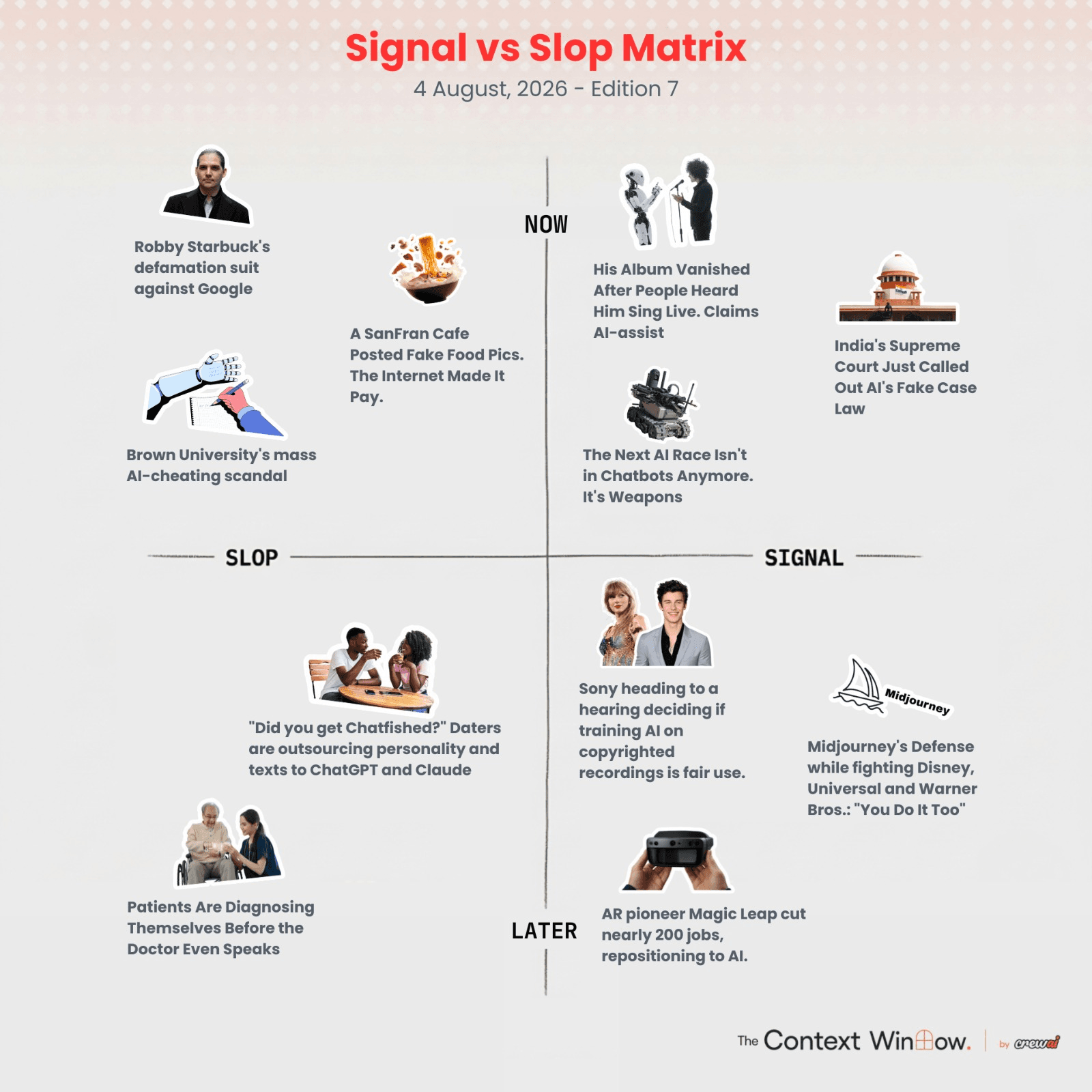
Every week we plot what happened in AI on two axes. Slop ↔ Signal: was there actual substance, or was it noise? Now ↔ Later: is this something you should act on this quarter, or a signal about where things are headed in 1-3 years? Let's see what happened this week.
India's Top Court set aside tribunal orders built on hallucinated AI-generated precedents and is mid-consultation on formal court-AI rules, a template others will watch
The Real AI Arms Race Isn't in Chatbots Anymore Shield AI's $1.5B raise, Helsing's €1.8B round, and the Anduril-Archer tie-up pushed July's disclosed military-autonomy funding past $3B
Credo V Daniels' debut vanished from Apple Music after his live vocals didn't match his polished studio sound, reigniting AI-assist suspicions. 🔴 NOW / SLOP
San Francisco's Grind & Unwind pulled its AI menu photos after a viral pile-on, and actual graffiti, over food that looked like "loofahs and lungs."
A Delaware judge let Robby Starbuck's AI-defamation suit against Google move forward July 25. The first real test of whether a company is liable for what its chatbot says about a real person.
Brown University’s midterm exam average jumped to 96 (historically 60s–80s), with 40 of 86 students scoring perfect, leading to investigation on the AI scandal. 🟡 LATER / SIGNAL
Sony, the only major label that didn't settle, heads to a summary-judgment hearing that could decide whether training AI on copyrighted recordings is fair use.
Fighting Disney, Universal, and Warner Bros. over copyrighted characters, Midjourney is demanding the studios disclose their own internal AI use, a discovery tactic nobody's tried before.
AR pioneer Magic Leap cut nearly 200 jobs, repositioning as a component supplier as capital shifts from spatial computing to AI. ⚪ LATER / SLOP
Daters are outsourcing texts to ChatGPT and Claude. Bloomberg names it "chatfishing" inspired by the Hinge match whose lines felt suspiciously polished.
A French physicians' roundtable grappled with patients arriving armed with self-generated AI diagnoses Catch you next week. Sumeru, Crew AI