What does software look like in 2030?
May 19, 2026
Hi, I’d like to welcome you to the first edition of The Context Window by Crew AI. Every week I'll send you one big idea about where AI is actually headed. These are the ideas you wished you knew about 6-9 months from now. CrewAI is used by 64% of the Fortune 500 companies, so I get front access to what people are doing with Agentic. I want to share those learnings with you.
Rigid Software
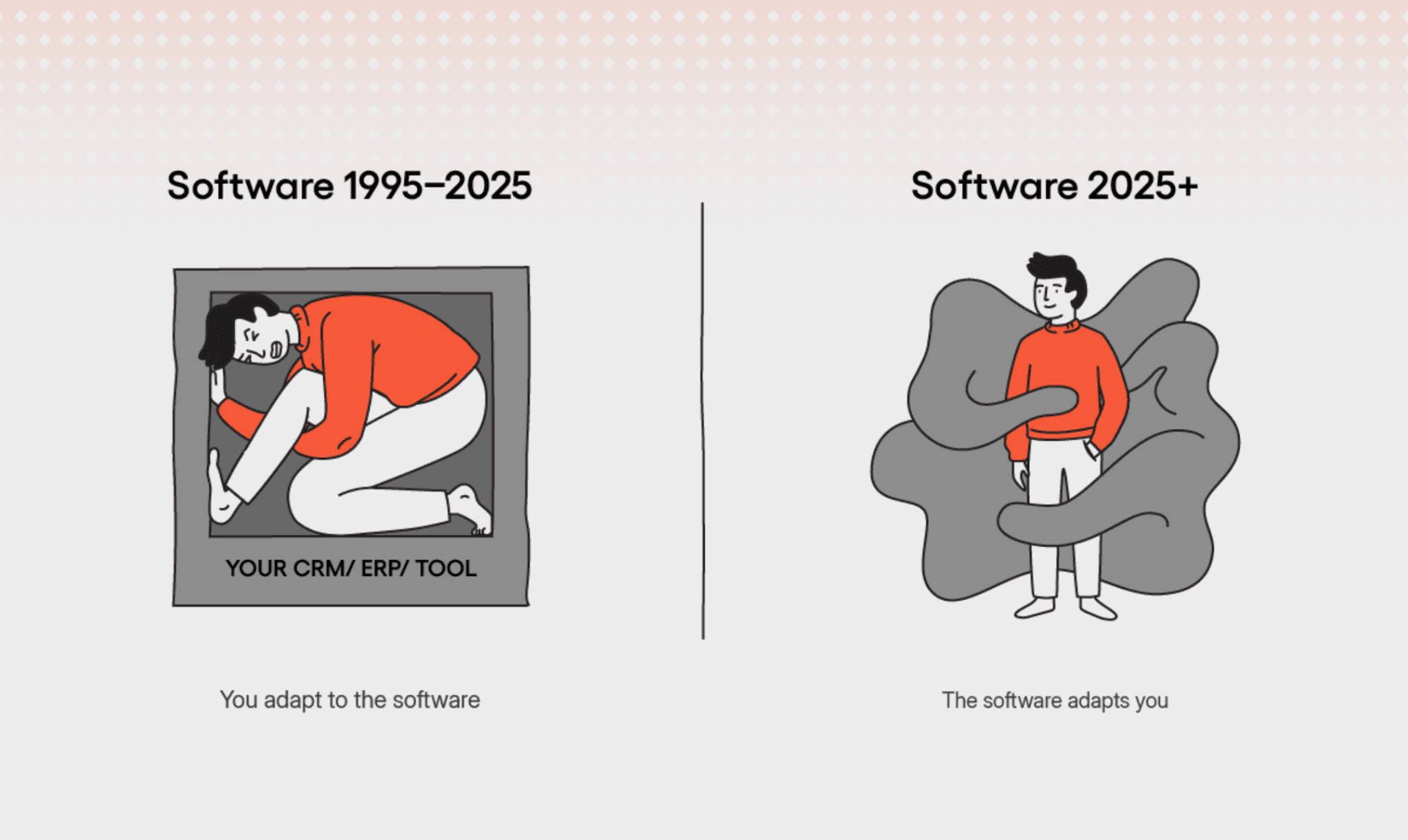
Think about your favorite piece of software for a second. Now think about how you actually use it. Every employee in your company runs a customized configuration of every tool they use - in their head. The three features they actually open. The Slack channel they use as a to-do list. The spreadsheet that shadows the official CRM. For thirty years, we've called this user behavior. Or edge cases. It's actually a sign that humans work around the software, and not the other way around.
The adaptation tax
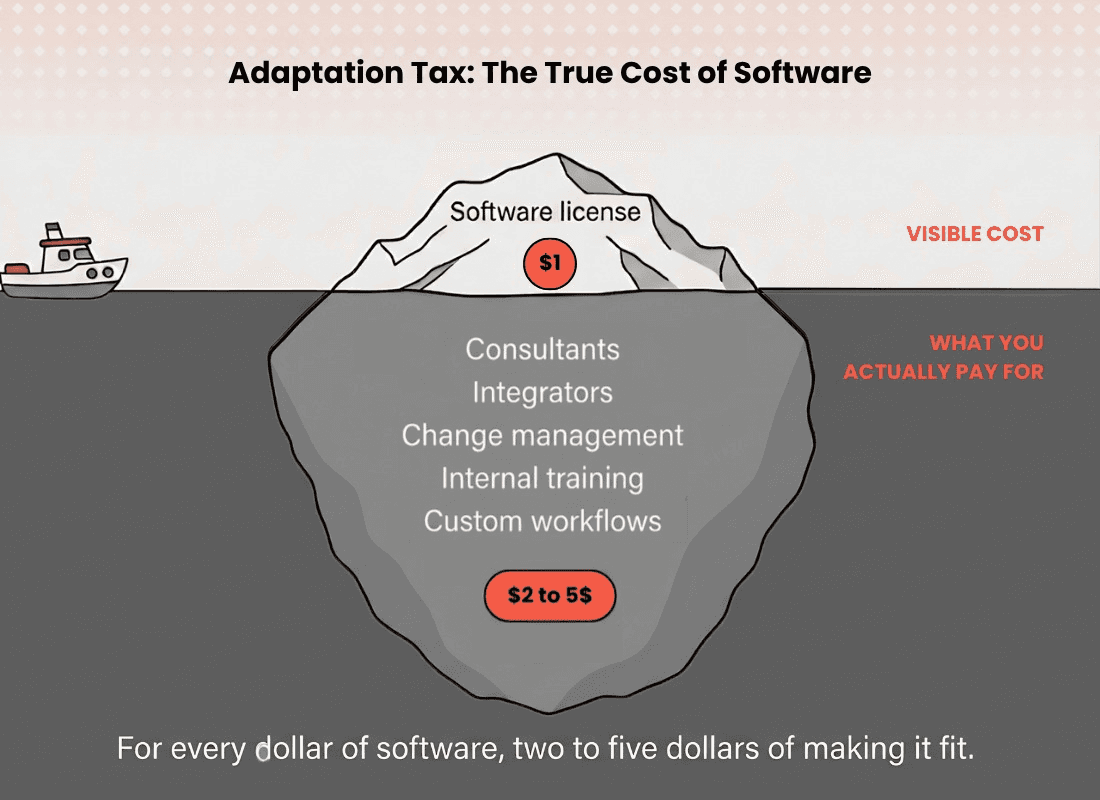
For three decades, software has been rigid. Pendo found that ~80% of features in the average enterprise app are rarely or never touched. And the 20% we do use? It doesn't fit out of the box. Entire job titles like ‘customer success manager’ and ‘user enablement’ exist for one reason: to make rigid software fit the way real teams actually work. The industry rule of thumb: for every $1 a company spends on enterprise software, it spends another $2 to $5 on consultants, integrators, and internal teams making the thing actually usable.
That's the adaptation tax. We've been paying it our whole careers.
The vibe-code moment
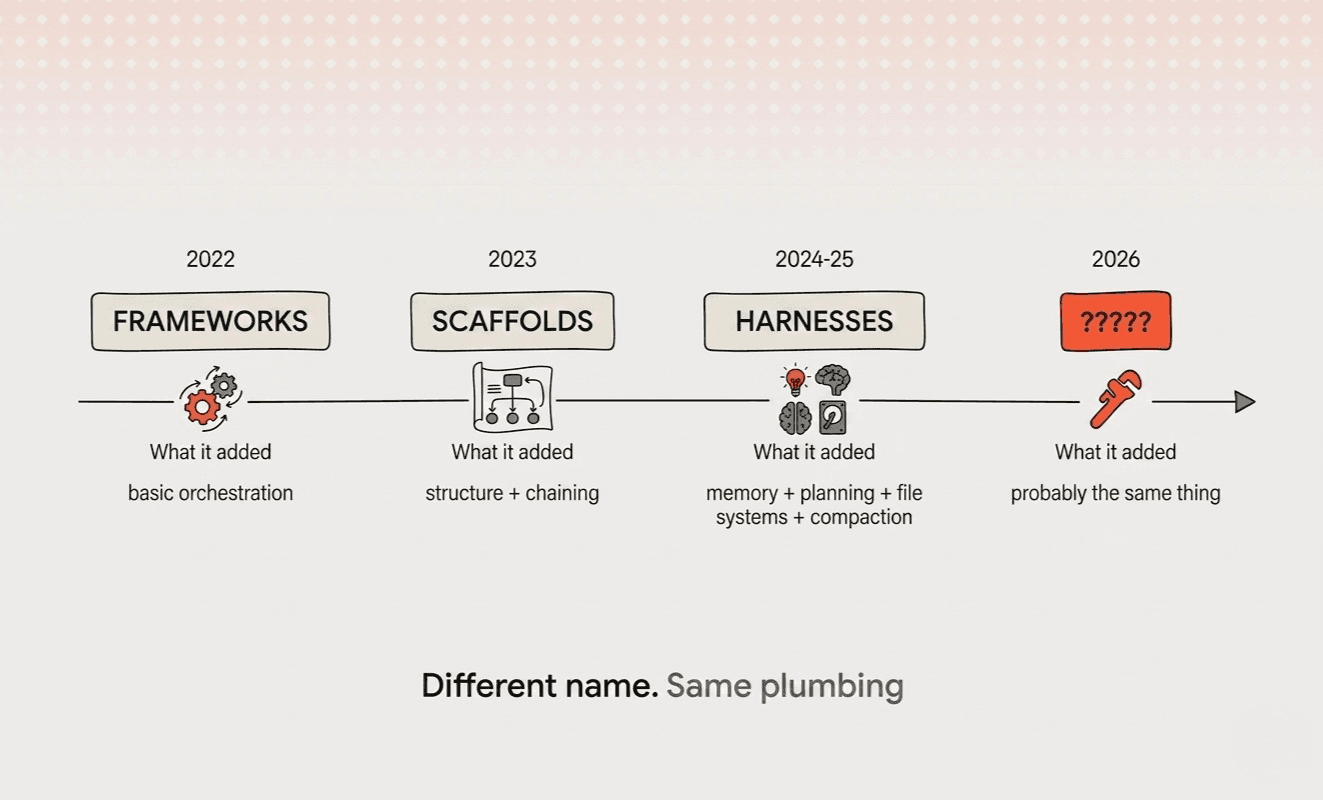
And then suddenly, building got cheap. Fast. The app and its custom configuration can be vibe-coded for my use-case over a weekend. Meanwhile, most of the industry's energy is going into the wrong question: - “What do we call the things that helps us build AI and agents beyond my use-case, but for my team or the entire organization, yet avoid the same adaptation tax of prior decades? “ Frameworks became scaffolds. Scaffolds became harnesses. Each new label promises to be more opinionated than the last, more memory, more planning, more built-in.
As João, our founder, says it: "Vibe-code an app over the weekend. Spin up an agent with a few API calls. The distance between idea and working prototype has collapsed to almost nothing, and will collapse to nothing faster than most expect." Enterprises have a different instinct. If building is this cheap, why are we still overpaying for tools we barely use? That’s when João figured out: "I think the real opportunity is harder than vibe-coding, and potentially more valuable."
The future: entangled software
What if, instead of customers building stripped-down clones of your product, the product itself adapted to each role? João calls this entangled software. The metaphor comes from physics. When two particles become entangled, the state of one instantly reflects the state of the other. There's no wire between them. They just match. Apply that to software: the user’s behavior shapes the product. The product shapes how the customer works. Over time, the two become inseparable.
Agents will go in this direction too. They can learn how your team operates and implement the patterns that matter. João: "Entangled software is the future of agents. We've recently been able to peek at what fully entangled agentic systems look like, and how transformative they can be." We've gotten our first look and it changed how I think about every other tool I use. More on that soon.
What compounds when building is cheap
If anyone can vibe-code the surface-level version of your product over a weekend, what's actually defensible? Not the feature list. Not the framework you chose. Not the harness you wrap around it. The things that compound:
Distribution. How many of the right buyers you can actually reach.
Proprietary data. Years of customer behavior nobody else has.
Trust earned in production. Reputation that took real deployments to build.
Products that get smarter the more they're used. A flywheel that compounds.
João: "You can't vibe-code the thousandth customer's accumulated patterns feeding back into the product. That flywheel is earned, not built." If you sell software, the feature moat is the weakest one to defend. Anything you can screenshot can be cloned in a weekend by your customer's engineering intern. If you buy software, use the one that gets smarter with each use, that compounds in value and can dynamically adjust across the uncertainty of models, compute, and usage. Tools that compound with use will eat tools that don't. So here's the question for every CTO and AI team reading this (it’s better if you screenshot this question and share it on your slack): “Are you building a product your customers will outgrow in twelve months, or one that grows with them?”
What we're doing at Crew
CrewAI has over 2 billion agent runs. We're now working toward agents that emerge and evolve from how your team already works, not agents you have to configure. João: "You don't set up agents, they emerge from how your team works. Your processes, your data, your patterns become the agent's intelligence. That's not a framework. That's not a harness. It's something new." That's where most of our time is going right now.
What we recently built
We launched a new product - Discovery. Most POCs stall not because the tech failed, but because the use case was not validated. Discovery fixes that by matching your business context against patterns from billions of real agentic executions, and surfacing specific, evidence-backed use cases for AI agents in minutes instead of weeks. Early users are running Discovery multiple times across different business units. It's live now for every CrewAI user. Try it now for free
This weeks treats
One great long form read -
How to do great work by Paul Graham
Two tweets worth checking out:
25 questions every exec should ask as they transform their business with AI
THIS HARVARD STUDY JUST PUT AN LLM AHEAD OF ER DOCTORS
Three songs you should add to your work playlist
Dew by Alboe
Night Owl by Kelly Boesch
Bougodani by Boubacar Traoroe
Signal vs Slop
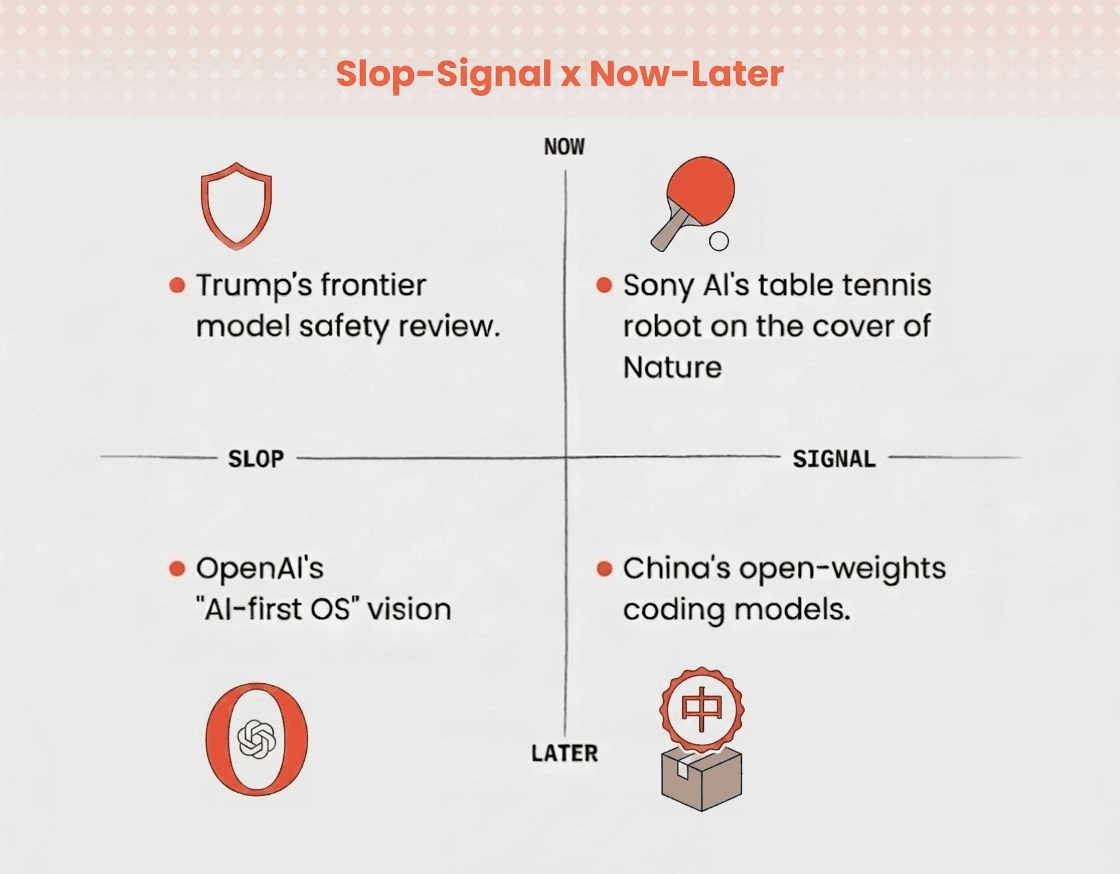
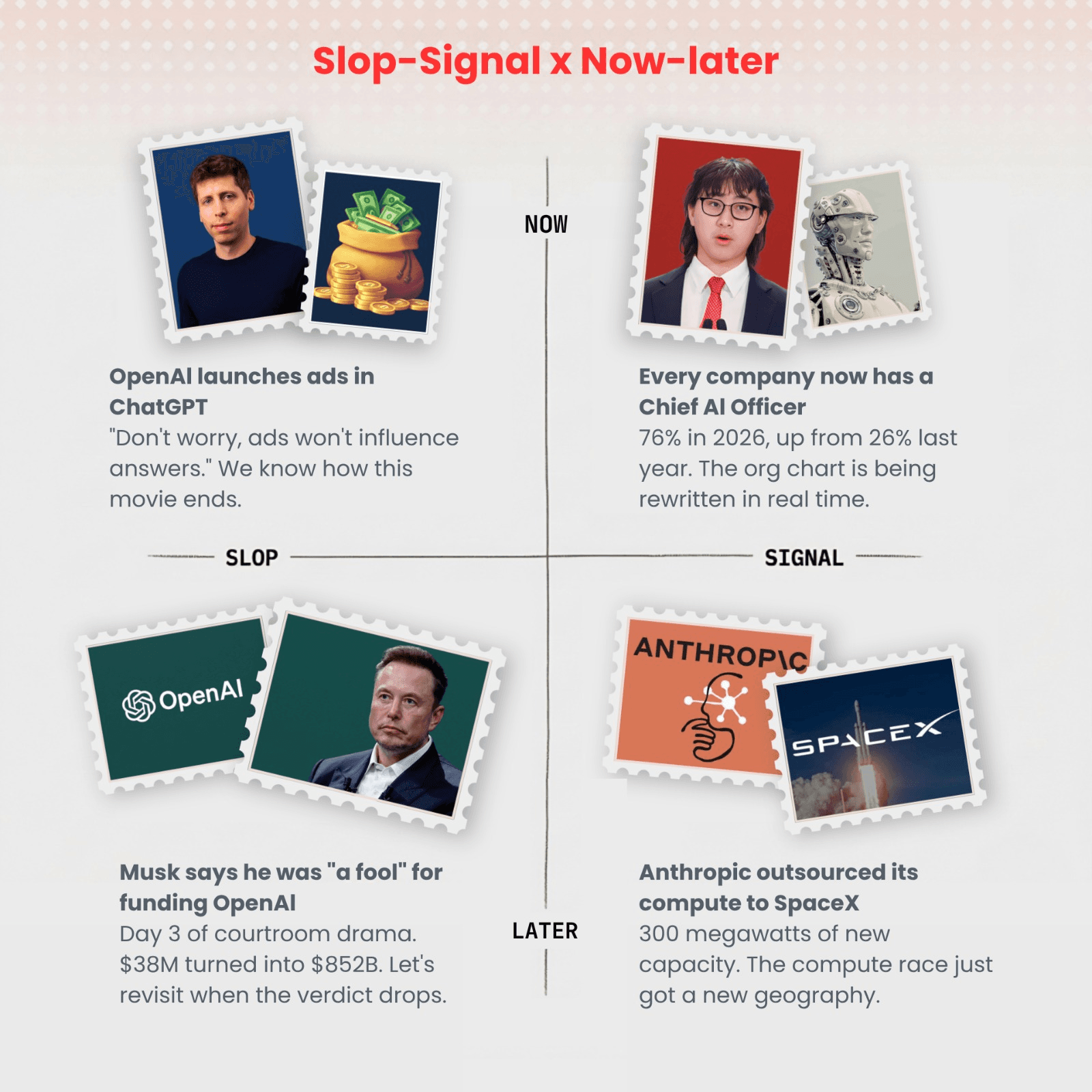
Every week we plot what happened in AI on two axes. Slop ↔ Signal: was there actual substance, or was it noise? Now ↔ Later: is this something you should act on this quarter, or a signal about where things are headed in 1-3 years? Let's see what happened this week.
NOW / SIGNAL (1) 76% of companies now have a Chief AI Officer. Up from 26% last year, per IBM's survey of 2,000 CEOs. 85% of CEOs say every functional leader must now be a technology expert in their own domain. The org chart is being rewritten in real time. (2) AI is now the official reason for layoffs. Pinterest, Dow, PayPal (-4,760 jobs), Coinbase (-700), Amazon (-16,000) NOW / SLOP (3) OpenAI's Ads Manager launches saying "don't worry." OpenAI now lets advertisers buy CPM and CPC inside ChatGPT, targeting $2.5B this year and $100B by 2030. The "ads won't influence organic outputs" caveat is the same promise every ad-funded platform has ever made. We know how this movie ends. (4) Snap–Perplexity's $400M partnership dies. Seems like most platform AI deals are only for press releases LATER / SIGNAL (5) Anthropic outsourced its compute to SpaceX. Anthropic doubled Claude Code's rate limits this week by partnering with SpaceX's Colossus One data center, picking up 300 megawatts of new capacity, the rough equivalent of 220,000 Nvidia GPUs in a single month. The compute race just got a new geography: orbit-adjacent. (6) AI chatbot doesn't have attorney-client privilege. Corporate lawyers are warning that AI-transcribed meeting notes are discoverable in lawsuits, even ones that would otherwise be protected. LATER / SLOP (7) Musk testifies he was "a fool" for funding OpenAI. Day-3 of courtroom drama. The number is real ($38M into what's now $852B). The newsletter-worthy substance is zero. Save your read for when the verdict drops. (8) Trump's "FDA for AI" executive order. But no scope, mechanism, or timeline. Political theater with no near-term build implications.
One ask before you go
Hit reply and describe the perfect piece of software in 2030. I read every response. Lucky one gets custom CrewAI swag and a shoutout to our 300k+ subscribers next time. Catch you next week. Go find the big idea.
Sumeru, Crew AI