There are two kinds of AI emerging
June 2, 2026
Welcome back to The Context Window, where each week I share one big idea on where AI is actually headed. In Issue #1, I shared what software might look like in 2030. Today’s issue covers the two kinds of AI workflows being used right now in the workplace. This distinction will help you evaluate use cases and tools for AI within your business. Here is how our founder João describes them:
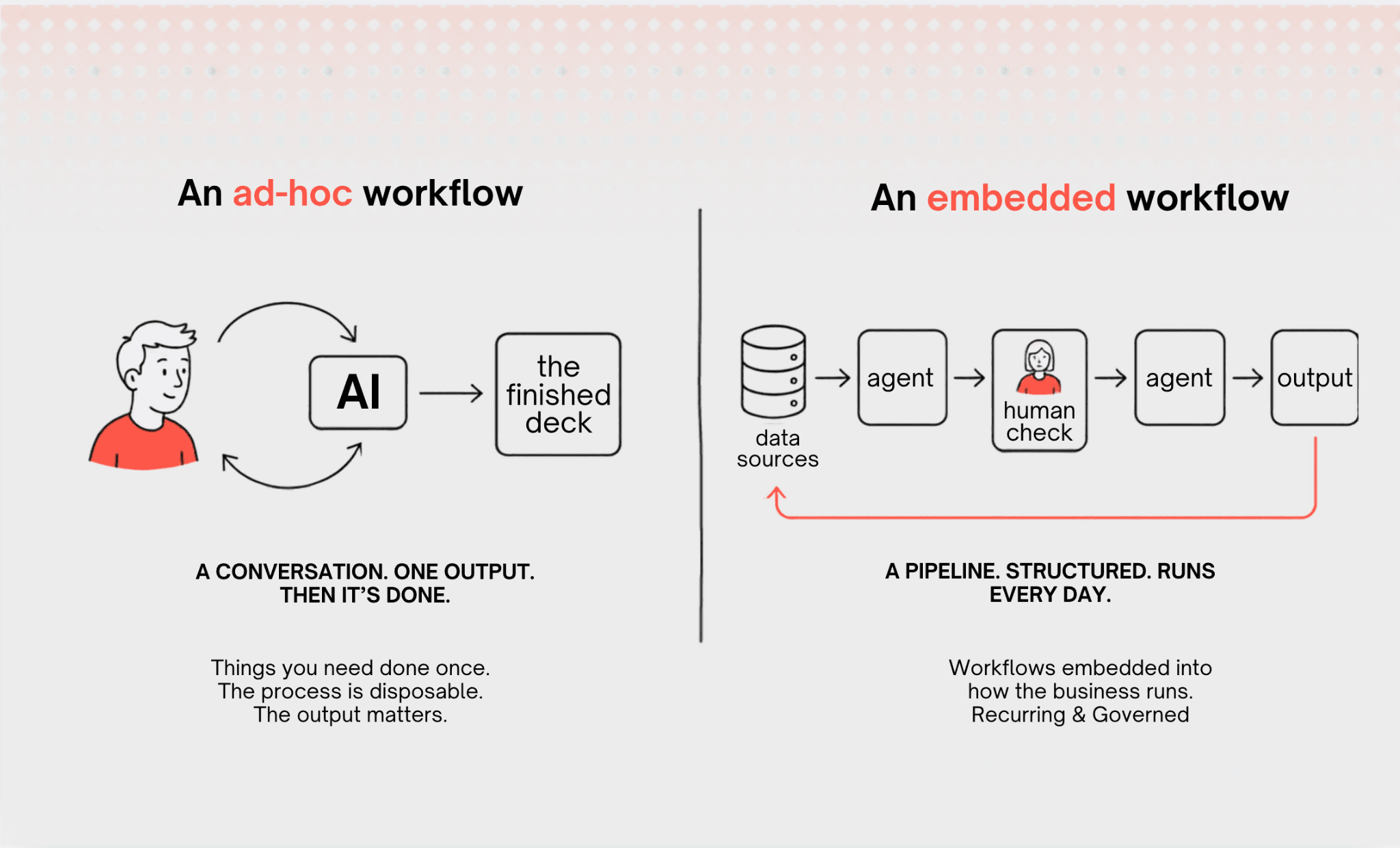
Ad-Hoc Workflows
Embedded Workflows
Ad-hoc AI Ad-hoc AI is the kind you already know. A problem comes up, you turn to AI, you work through it together, you move on. You paste a messy sales call transcript into Claude and ask it to turn the notes into a deck. You have OpenClaw draft an outreach sequence or respond to emails. You give your AI and it comes back with a dashboard or a formatted spreadsheet. The work is collaborative, it's short-lived, and the human is in the driver's seat the whole time. What makes ad-hoc AI good is a specific set of traits:
It has to be fast. You're waiting on it in real time.
It has to be good with context. You're feeding it your half-formed thoughts and expecting it to keep up.
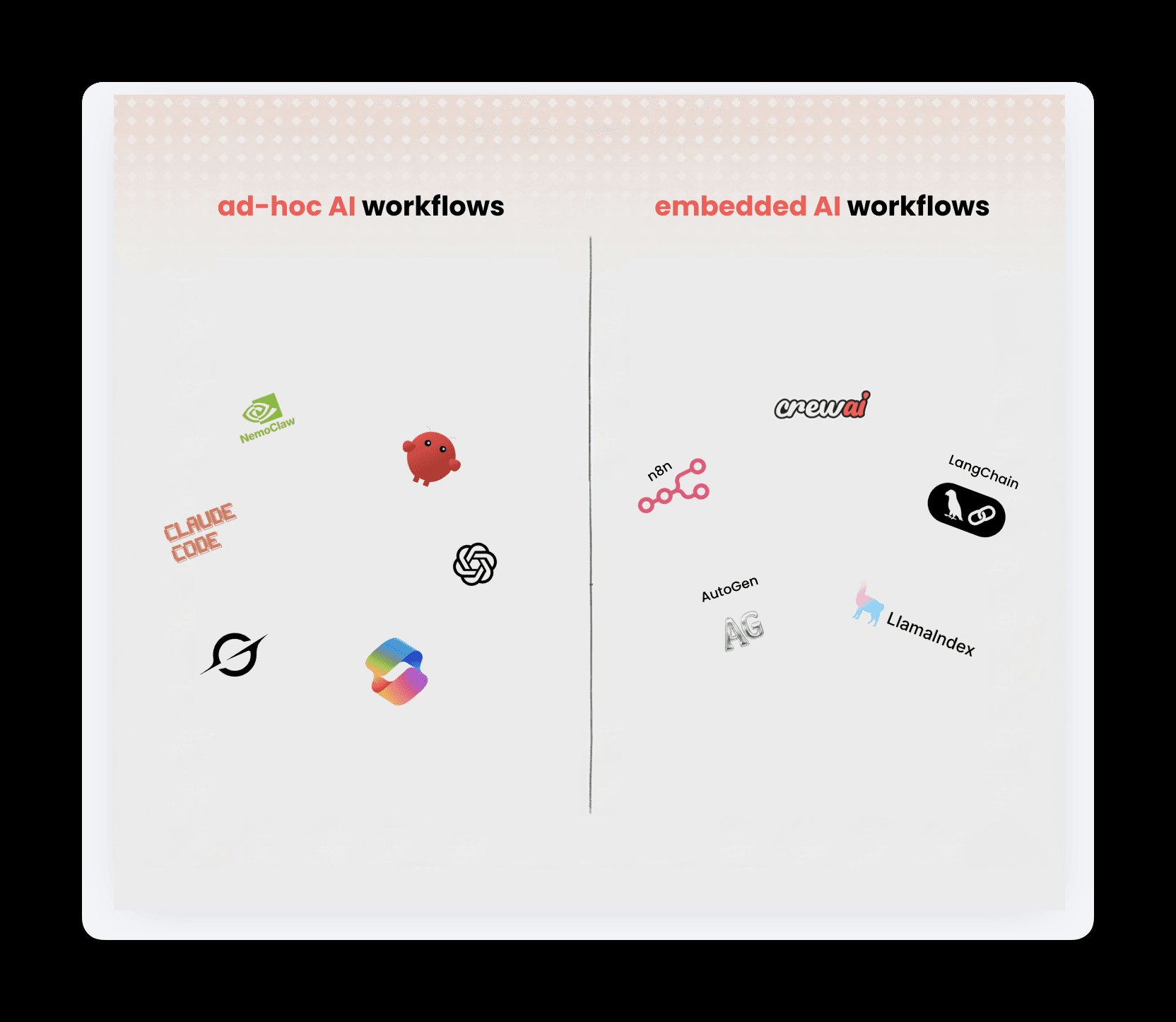
And it has to be creative. You want it to surprise you, suggest the angle you didn't think of, give you three options instead of one. Examples of great ad-hoc AI workflows:
NemoClaw
OpenClaw
Claude Code
Microsoft Copilot “With ad-hoc AI, you care about the output, but the process is disposable” When people picture ‘AI’ today, this is mostly what they have in mind. And for good reason - it has been genuinely transformative for day-to-day knowledge work. But there are a few tradeoffs:
Ad-hoc AI needs to be prompted and started every time there is a task
The quality of what you get depends heavily on the person operating it
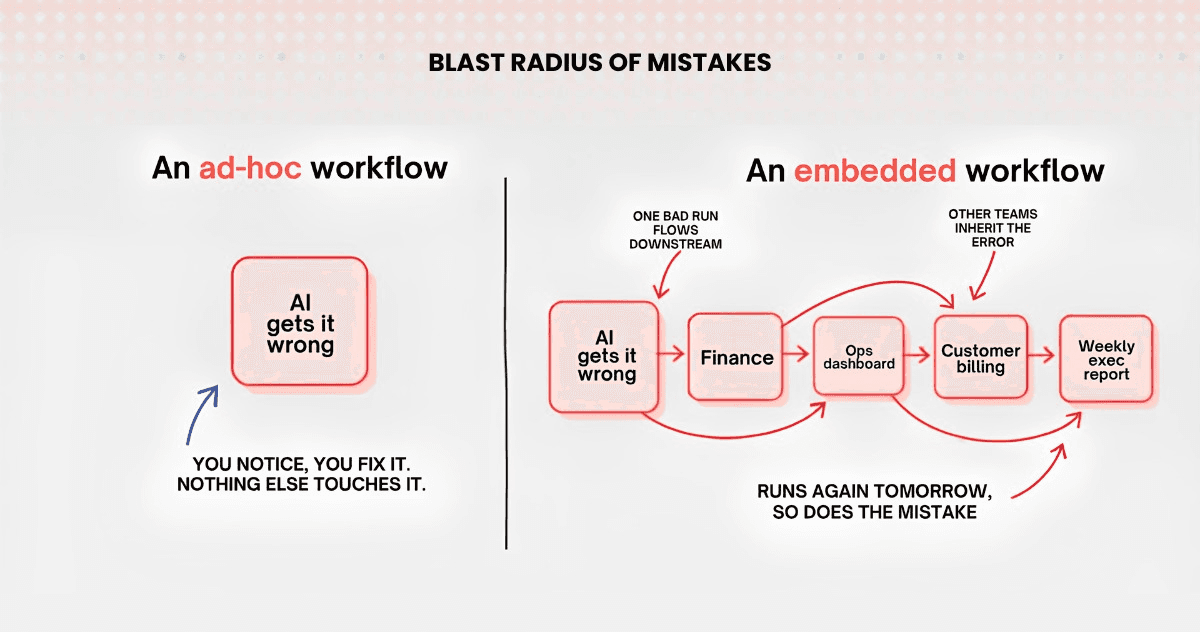
Audit and governance is hard - we’re never really sure when things go wrong If the AI gets it wrong, you notice, you fix it, you move on. The blast radius is usually one person.
Embedded AI Embedded AI is completely different. Here, AI is wired into a process that has to run whether you're thinking about it or not. Actual example: One of the largest beverage companies is a client of ours. They use an embedded workflow to manage their daily bottling logistics operations. An embedded system has to decide how many bottles to produce, where, and when. That process runs every single day. It pulls from a dozen messy data sources. This process can’t go down, hallucinate, or go creatively wrong. The cost of a mistake here is literally millions of dollars. Embedded AI doesn't need to be very imaginative -i t just needs to be dependable. It has to run 24/7, hit a very high accuracy bar, resist hallucination, and pull clean signals out of complicated systems of record. You don't want it to surprise you, like the ad-hoc agents. You want it to just work. Unlike an ad-hoc tool, an embedded system is built to remember. It accumulates context across every run: the exceptions it has seen, the patterns specific to your business, what worked last quarter. This is what people mean by agent memory, and it's why a well-built embedded workflow gets sharper the longer it runs. The thousandth execution isn't the same as the first. And when it doesn't work, things don't go a little wrong. They go badly wrong, at scale, until someone notices. This is why we need traces, observability, human-in-the-loop checkpoints, and governance. Embedded AI is also not new, exactly. For decades this was called business process automation. The AI era has given it a new name, ‘agentic operations’, or agentic process automation, with far more capability. But the underlying ambition is the same: take a critical, repeatable process and make it run itself, reliably. This is the harder problem, and it needs a different class of tooling. Where ad-hoc AI rewards speed and creativity, embedded AI rewards control: explicit structure, defined steps, clear handoffs between agents, and a human checkpoint where it matters. This is the world of agentic frameworks: CrewAI, LangChain, and others built for workflows that have to be governed. It's worth being honest about embedded AI's trade-offs too. It's slower and more expensive to build than an ad-hoc workflow. It demands governance you can't skip. And it might be an overkill for a one-off task. You wouldn't build an embedded workflow to make a single PowerPoint, just as you wouldn't run a bottling line to pour one glass. Several companies and startups are trying to solve the embedded AI workflows problem: CrewAI, n8n, LangChain, UiPath (legacy RPA) are popular examples, but there are several others and this is the most hotly contested enterprise AI space.
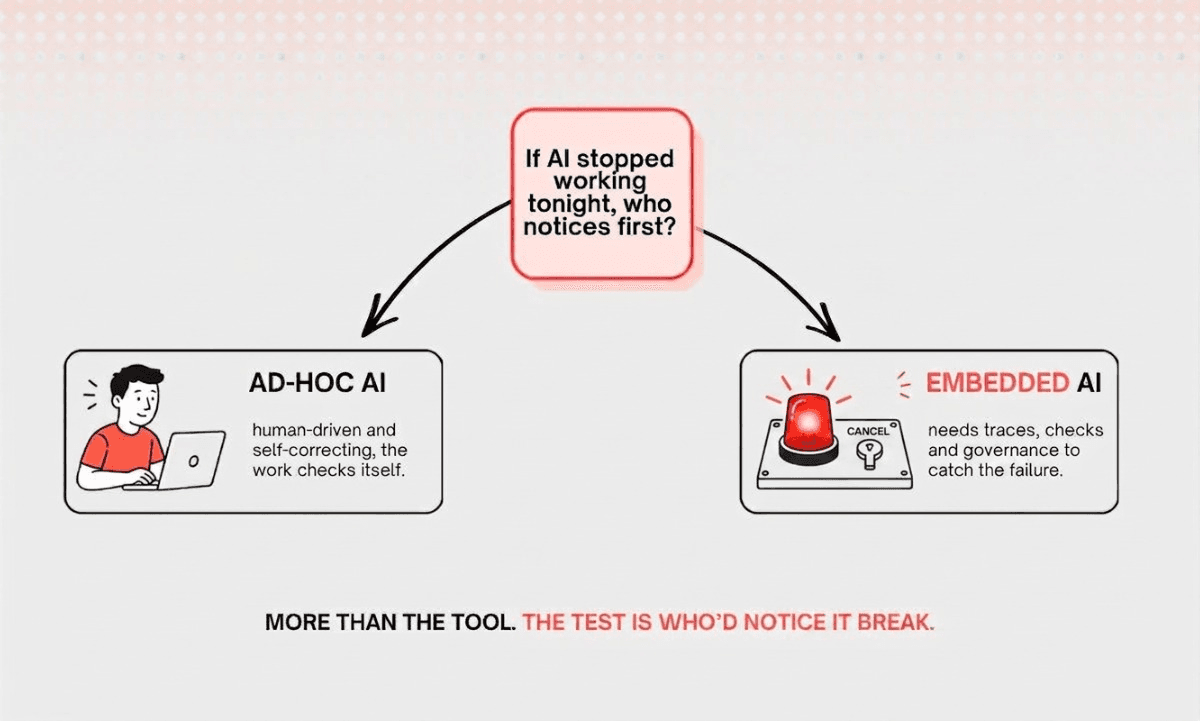
So how do you tell them apart? A useful test: if the AI stopped working tonight, would you find out from a person, or from a system generated alarm? If a person would notice, that's ad-hoc. The work is human-driven and self-correcting. If only a dashboard would catch it, that's embedded, and it needs the traces, checks, and governance to match. Most of CrewAI's work is on the embedded side: our answer to it is a deterministic flow that gives agents real structure while keeping a human in the loop where it counts.
What happens next Here's where we'll allow ourselves an opinion. Both kinds of AI are here to stay, and both will produce real winners. But we don't think the value splits evenly. Ad-hoc AI is enormously useful, and also increasingly commoditized; the tools are converging and getting cheaper. Embedded AI is harder, stickier, and closer to the actual operations of a business. If I had to put a number on it, I’d guess something like 30% of the long-term value flows to ad-hoc, 70% to embedded, though reasonable people will argue that split for years. The next six months will be loud on both sides. There may be one winner per category. There may be several. We'll be watching closely, and we'll report back. For now, the takeaway is this: the next time someone says "AI agent," ask yourself which kind they mean. You'll be surprised how often they haven't decided. What we're doing at Crew CrewAI now powers over 2 billion agent runs and 520 million workflows a month. What we're learning from that volume is consistent: embedded agents only compound if there's a layer underneath them, orchestration, memory, observability, and governance, keeping them in line. João: "What enterprises actually need is central visibility and control, reusable building blocks, flexibility with existing infrastructure and models, and agent-to-agent communication over the wire. The value is in running them at scale." That's the bet. The thing most teams skip when they're chasing the demo is the same thing that determines whether they end up with one production agent or thirty-eight orphaned ones. We're calling it the Agent Management Platform. That's where most of our time is going right now.
This weeks treats
One great long form read-
I am rich and I have no idea what to do with my life by Vinay Hiremath, ex-founder @Loom
Two tweets worth checking out:
How to achieve goals by the principal engineer at a $7.5B startup
Most AI initiatives start with a cool idea. That's the problem.
Three songs you should add to your work playlist
Kerala by Bonobo
A Calf Born in Winter by Khruangbin
Tar Hani by Bombino
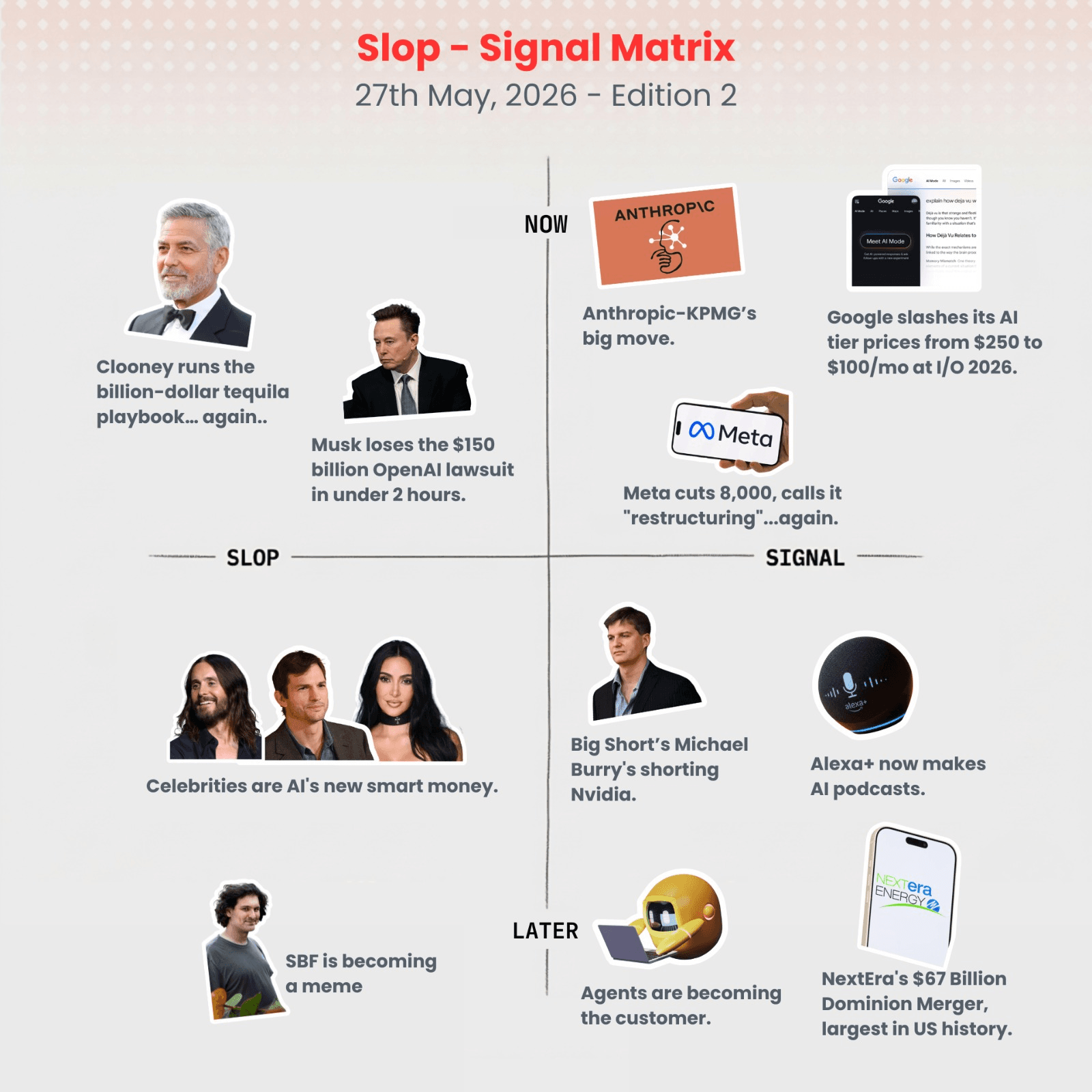
Slop- Signal Matrix
Every week we plot what happened in AI on two axes. Slop ↔ Signal: was there actual substance, or was it noise? Now ↔ Later: is this something you should act on this quarter, or a signal about where things are headed in 1-3 years? Let's see what happened this week.
🟢 NOW / SIGNAL (1) Anthropic-KPMG’s big move. It's happening. KPMG has embedded Claude agents into the platform its 276,000 staff use for client work. The firm says building an agent used to take weeks; now it takes minutes. (2) Google slashes its AI tier prices from $250 to $100/mo at I/O 2026. with a 24/7 personal agent bundled in. Every line item in your AI budget is now getting repriced. (3) Meta cuts 8,000, calls it "restructuring"...again. More than 113,000 tech workers have lost their jobs across 179 companies in 2026, and the memos no longer say "overhiring", they say "AI". 🔴 NOW / SLOP (4) Clooney runs the billion-dollar tequila playbook… again.. Casamigos sold for $1B; now the same crew launches Crazy Mountain, betting the formula repeats. (5) Musk loses the $150 billion OpenAI lawsuit in under 2 hours. A jury threw out every claim in under two hours. Three years of narrative with zero operational fallout. Altman's reply was two words. Match it. 🟡 LATER / SIGNAL (6) Big Short’s Michael Burry's shorting Nvidia. everyone's relitigating "circular deals." Same script as last autumn, and the data centers went up anyway. (7) Alexa+ now makes AI podcasts. two AI co-hosts debating any topic on demand. Is it the first step towards personalized content? What next? (8) NextEra's $67 Billion Dominion Merger, largest in US history. names AI power demand as the reason. Compute scarcity is coming for your cloud bill. (9) Agents are becoming the customer. Google's Universal Cart will let agents buy on your behalf. The next thing evaluating your product won't be a person, it'll be a machine reading your API. ⚪ LATER / SLOP (10)Celebrities are AI's new smart money. Kim Kardashian's SKKY Partners, Ashton Kutcher's Sound Ventures, and Jared Leto are all into AI seed rounds closed to everyone else. (11)SBF is becoming a meme. Drake referenced FTX's collapse on his new album, and Sam Bankman-Fried responded from prison with a joke. The villain-to-folk-figure pipeline is quietly real. 📬 You wrote back Last issue, we asked: what does the perfect software look like in 2030? A few dozen of you replied, some at genuine length. This one stayed with me. "The perfect software in 2030 doesn't require the customer to use all their senses and brainpower on the tool. Using it is like having a conversation with a friend or associate, it asks, understands, counters, and gets to the job. The most important part: even though it's software, it can get things done in the real world that require a physical presence. In short, the perfect software is a real-virtual agent that is adaptive to the user and as much human as it is computer. PS: I am highly doubtful of you reading this. Sneh Gupta Hi Sneh (check out his blog) - Yes, I read your response. Twice. Great job. Also: a "real-virtual agent, as much human as it is computer" is a sharper one-line definition of where software is headed. Sounds like the UX brain was the right brain for the question :)