Meet Jev, the AI That ‘JUST’ Knows How to Make Decisions…Quite Literally
October 6, 2026
It can't chat, write, or code. You give it a situation, and it makes the
call in a fraction of a second.
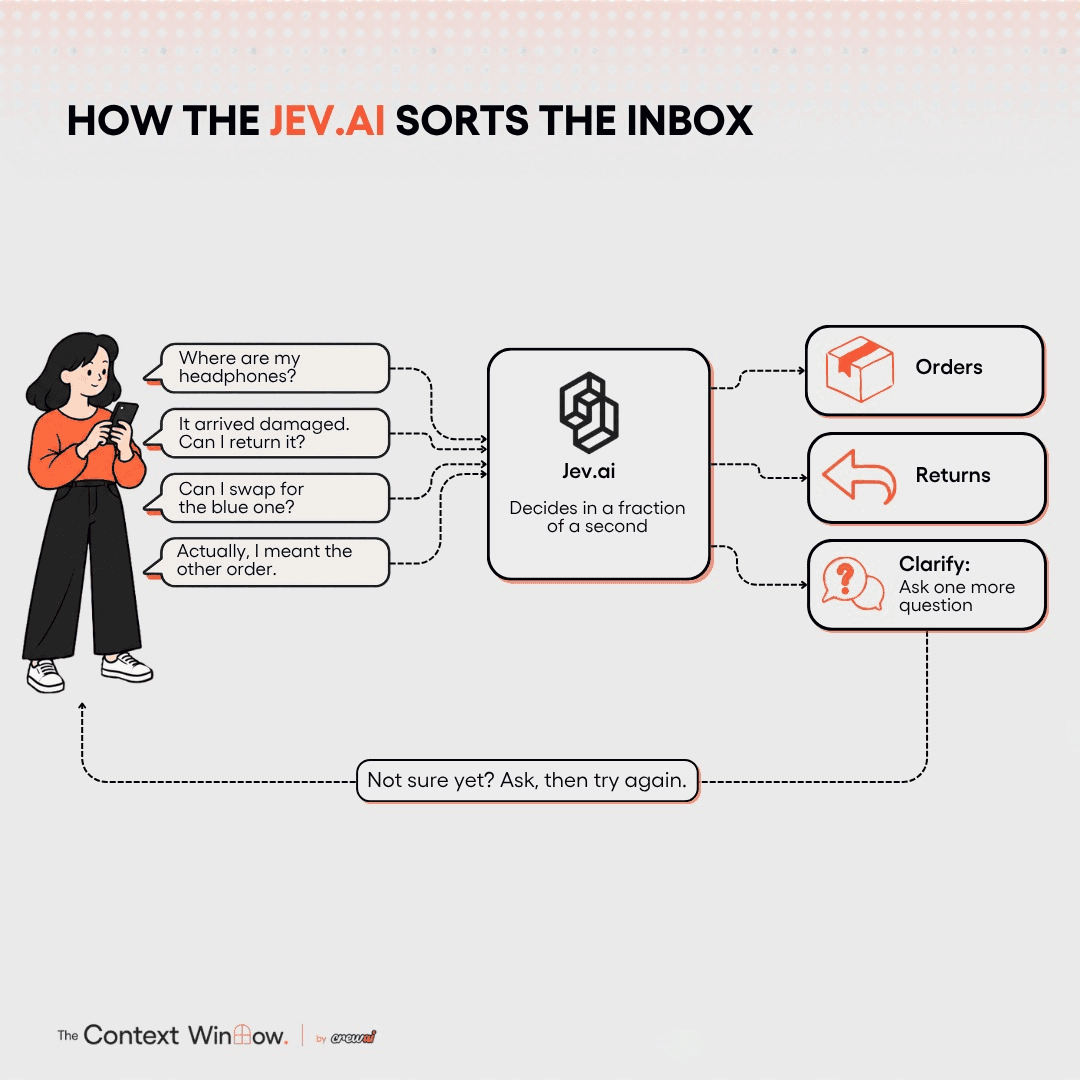
Picture the support inbox at an online store on a Monday morning. Four messages land in the first minute. "Where are my studio headphones?" "My package arrived damaged. Can I return it?" "Can I swap one of these for the blue one?" "Actually, I meant the other order." Before anything useful happens, someone / something has to read each message and decide where it goes between the three options. Option 1: Orders. Option 2: Returns. Option 3: "Let me ask you one quick question first." That's the receptionist's job. Engineers call it routing.
Most teams hand this job to the biggest model they have. It works. But it's also like hiring a senior consultant to sort the mail. In one of our internal tests, frontier models took between 0.85 and 1.4 seconds just to decide where a message should go. By the way, this is just the sorting time, not the time taken to answer anything, or issuing a refund. Across a few hundred messages, nobody notices this. But across millions a day, you notice on the invoice. On a voice call, a two-second silence before the agent speaks feels broken. This is one of the reasons agent pilots stall in staging. The AI is smart enough, but every tiny decision costs money and time. As João likes to say, “the problem isn't intelligence. It's architecture.”
A model built around what it can't do
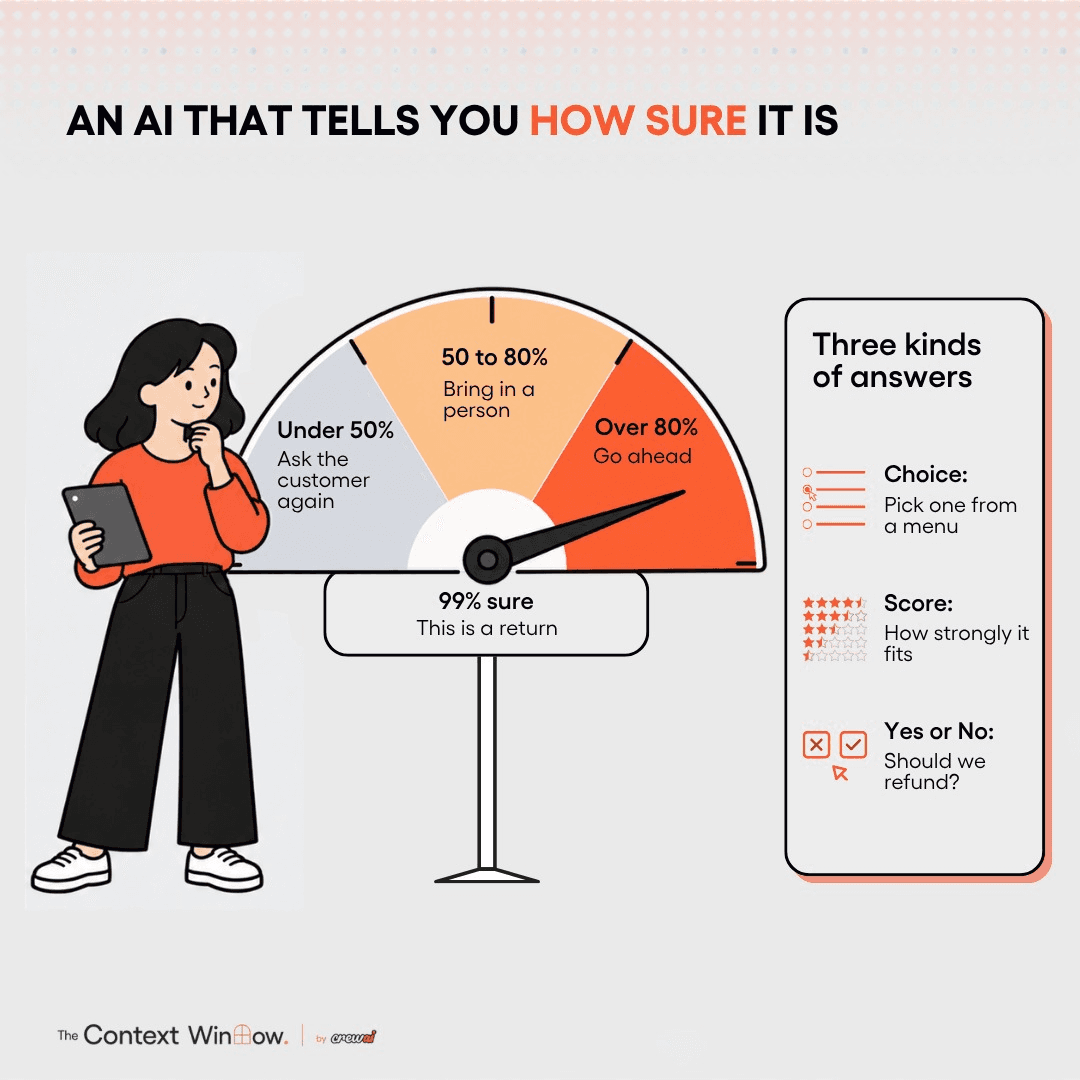
Choice. Pick one from a fixed menu: order, return, or clarify.
Score. How strongly does this fit, on a scale.
Yes or no. Should we refund this? TypeSafe calls this one "Noul."
Every answer comes with a number that says how sure it is. Developers moved fast. Vercel says Jev reached nearly 13% of paid teams on its AI gateway within 24 hours of launch.
How Smart Companies Will Now Split the Work Between AI
Models
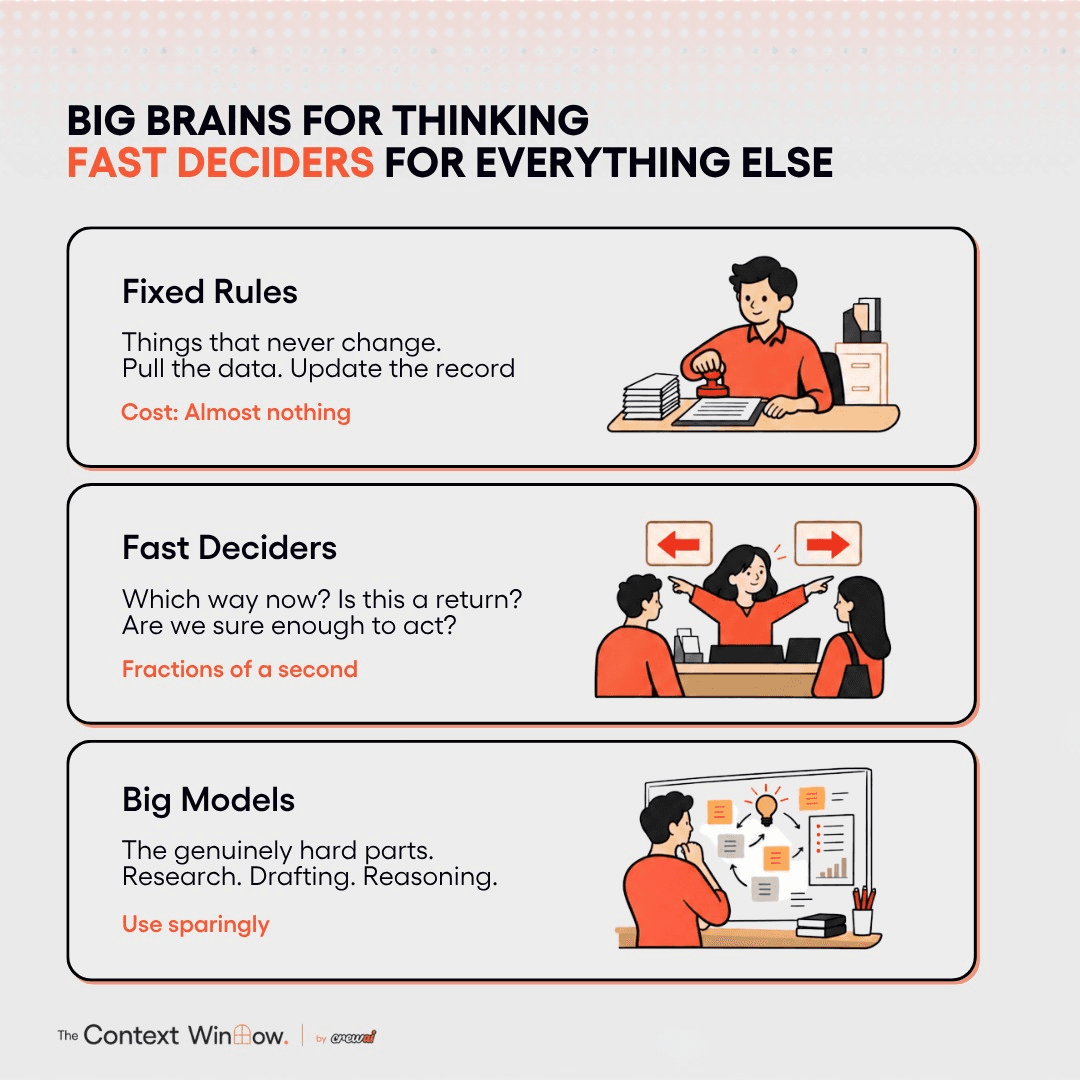
Think of a good AI setup like a well-run office. It has three kinds of workers:
The checklist: Some jobs are the same every time, like filing a form or updating a record. You don't need AI for these. A simple rule does it for free.
The receptionist: Some jobs are quick calls. Is this a refund or a delivery question? Is this customer urgent? Are we sure enough to act? You need judgment here, but only a second's worth.
The expert: A few jobs are genuinely hard, like researching a new client or writing a thoughtful reply. That's where the big, expensive AI earns its keep. The problem is, most of a company's daily work is checklist and receptionist work. Yet most companies send all of it to the expert. Since implementing jev.ai, an analysis of 12,759 launch posts found developers reporting a median 7x speedup, and about 30x in cost savings. Bryo AI's CTO found Gemini slightly more accurate at sorting emails, but 10 to 20 times pricier. TypeSafe's own docs warn that Jev is unreliable at counting, arithmetic and comparing dates. Keep the math in your code. And Jev never explains itself. If you need a reason on record, pair it with a chat model or a person. And that’s completely fine. A decider that tells you when it's unsure always beats the one that guesses with a straight face. The CTO question: How many of your AI's decisions are you paying a genius to make?
What we're doing at Crew
At CrewAI, we're testing Jev inside Conversational Flows, the part of our product that decides where each customer message should go. So far, it's helping in two ways. On some tasks, those routing decisions are getting faster and more accurate. And on voice agents, we're seeing them start talking sooner after a customer finishes speaking. Engineers call that "time to first speech." It's still early, but for anyone building an AI that talks to customers, those fractions of a second are the difference between a conversation and an awkward pause. That’s all from my end
Lorenze Jay Hernandez Open Source Lead @ CrewAI
This week’s treats
One great long-form read -
Excuses by Shaan Puri
Two tweets worth checking out:
Last month I founded an AI startup
Average hustle bro’s life
Three songs you should add to your work playlist
Cler Achel - Tinariwen
White Gloves - Khruangbin
Albatross - Fleetwood Mac
Signal vs Slop Matrix
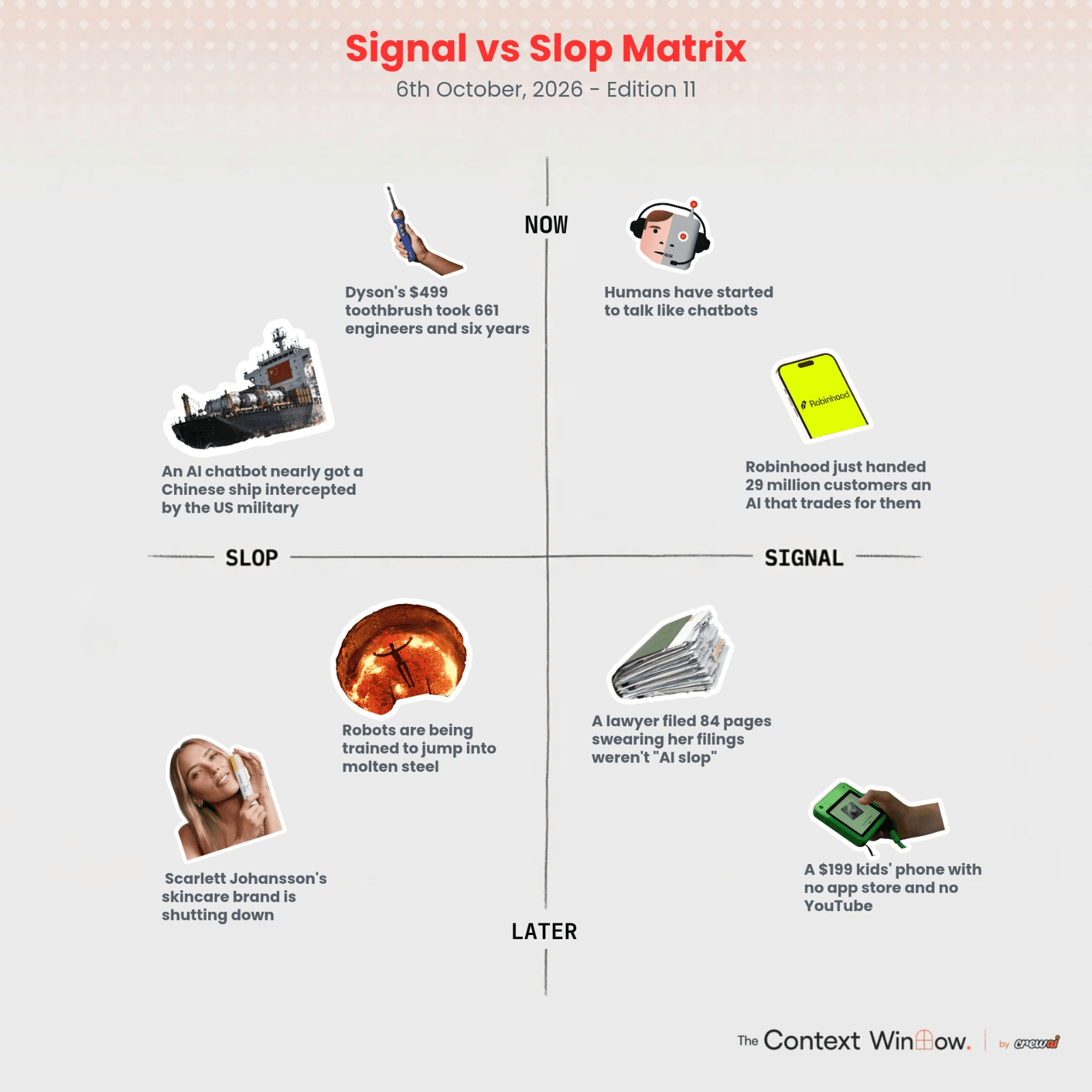
Every week we plot what happened in AI on two axes. Slop ↔ Signal: was there actual substance, or was it noise? Now ↔ Later: is this something you should act on this quarter, or a signal about where things are headed in 1-3 years? Let's see what happened this week.
NOW / SIGNAL
1/ Humans have started to talk like chatbots The WSJ found people catching themselves using prompt-style phrasing, explicit goal framing and over-polite instructions in meetings, texts and everyday conversation. 2.Robinhood just handed 29 million customers an AI that trades for them Over 150,000 customers already run AI agents on their accounts, and those agents now use Robinhood's tools almost 30 million times a day. Customers carry the full risk of their agents' trades, and Robinhood says it hasn't measured how those trades perform.
NOW / SLOP
661 engineers, six years, and a $499 toothbrush Dyson's CameraJet takes 28 images a second to find gaps between teeth and fires a mouthrinse jet at them within 100 milliseconds
An AI chatbot nearly got a Chinese ship intercepted by the US military CNN reports an AI tool misidentified ordinary cargo as nuclear-program components, and the military began preparing an interception before the error was caught.
LATER / SIGNAL
5 A lawyer filed 84 pages swearing her filings weren't "AI slop" The Florida lawyer is fighting sanctions after a state appeals court said her filings showed signs of generative-AI output.
Parents are paying $25 a month for a phone that does less Freckle is a $199 phone for kids aged roughly 7 to 13. It has no app store, open web, social media or YouTube, and parents unlock features at their own pace.
LATER / SLOP
Robots are being trained to jump into molten steel Figure CEO Brett Adcock showed F.02 humanoids learning to jump on their own, then being shipped to Finland to leap into a vat of molten steel as part of a decommissioning sequence.
Scarlett Johansson's skincare brand is shutting down The Outset is closing after about four years, despite growing from five products to around 14. Existing orders will be processed, but the online store has already closed. Until we meet again Sumeru Crew AI