How to Decide If You Build, Buy, or Skip the AI Agent
July 28, 2026
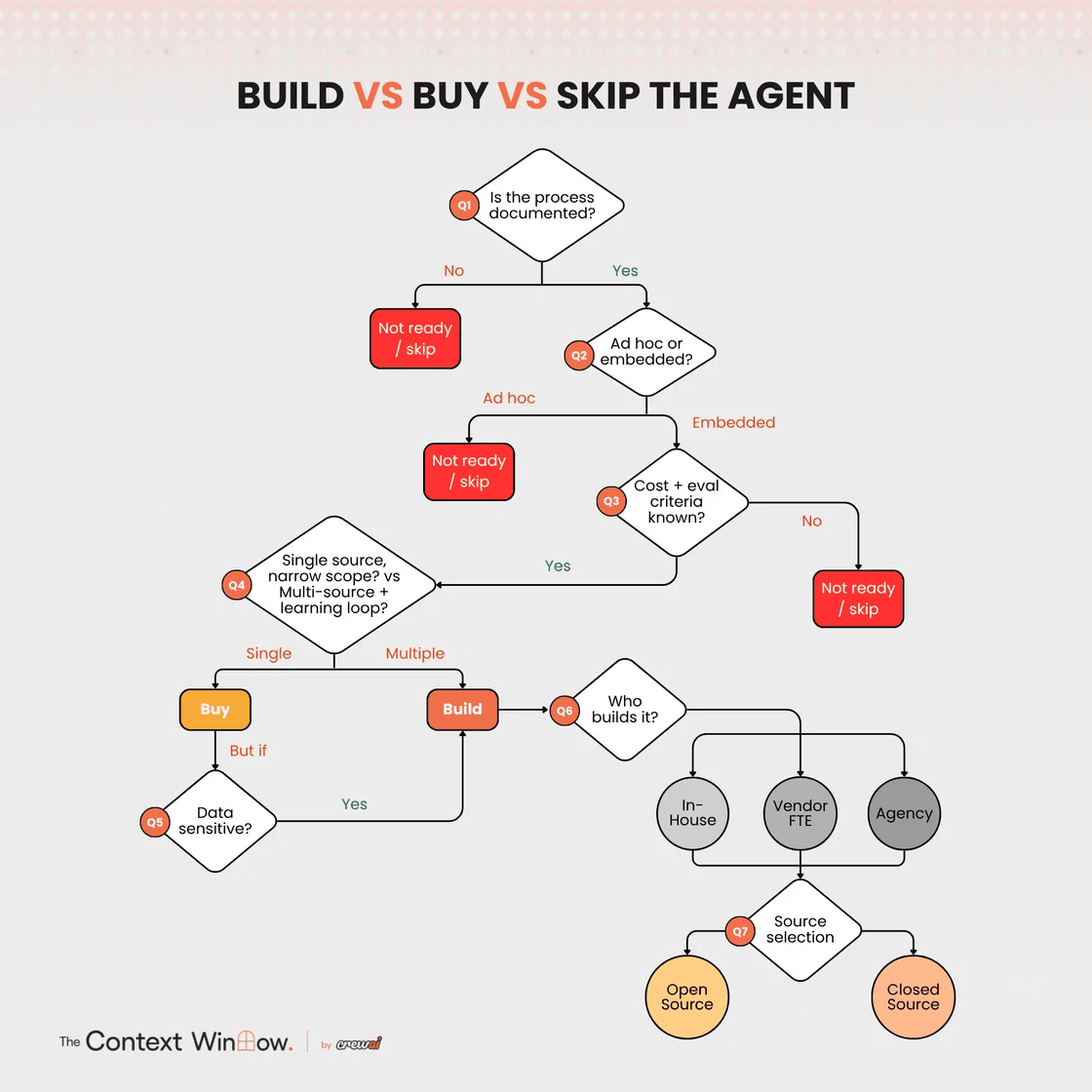
A practical framework for deciding whether your next AI initiative needs an agent, a vendor, or nothing at all Building an agent has never been cheaper. As João Moura puts it: … (you can).. Vibe-code an app over the weekend. Spin up an agent with a few API calls. The distance between idea and working prototype has collapsed to almost nothing, and will collapse to nothing faster than most expect. But then, the obvious question arises: Should you build one yourself, buy a tool that is built by someone else, or realize that it’s not worth the effort and skip building it altogether? Most teams treat "build vs. buy vs skip" like a single switch; flip it once, move on. It isn't. It's a sequence of questions, and skipping any one of them is usually why most projects get killed six months in. Build vs. Buy Isn't One Question. It's Seven. Here's the tree, in order. Each node either sends you forward or ends the decision right there.
Question #1: Is the process documented?
If nobody can write down, step by step, what actually happens today, building an agent becomes difficult. An undocumented process can’t be a candidate for automation. It needs a process owner. This is the step most teams skip because it's the least exciting one to answer honestly. Start by writing the workflow as a numbered checklist. If different team members describe it differently, document it before thinking about automation.
Question #2: Is the process Ad hoc or embedded?
We have covered this in detail in a previous issue {link} If the workflow is ad hoc, meaning there are no fixed steps, and you just want a good output whenever someone happens to need one, you're not looking for an agent. All you’re looking for is a good prompt. Stop here. If the workflow is embedded, meaning it runs continuously or in parallel as part of how the business actually operates, keep going. Now, we’re down to either buying or building. Ask yourself one question: "Would this process still happen every week if nobody remembered to ask for it?" If the answer is yes, it's embedded. If the answer is no, it's probably ad hoc.
Question #3: What this is costing you?
Don't let the lack of perfect numbers stop you. Even rough estimates are usually enough. Ask yourself:
How much time does this consume each week?
Who works on it?
What's the hourly cost?
How would we know if automation actually worked?
Those four answers give you a baseline that's already better than guessing.
Question #4: The actual build-vs-buy fork.
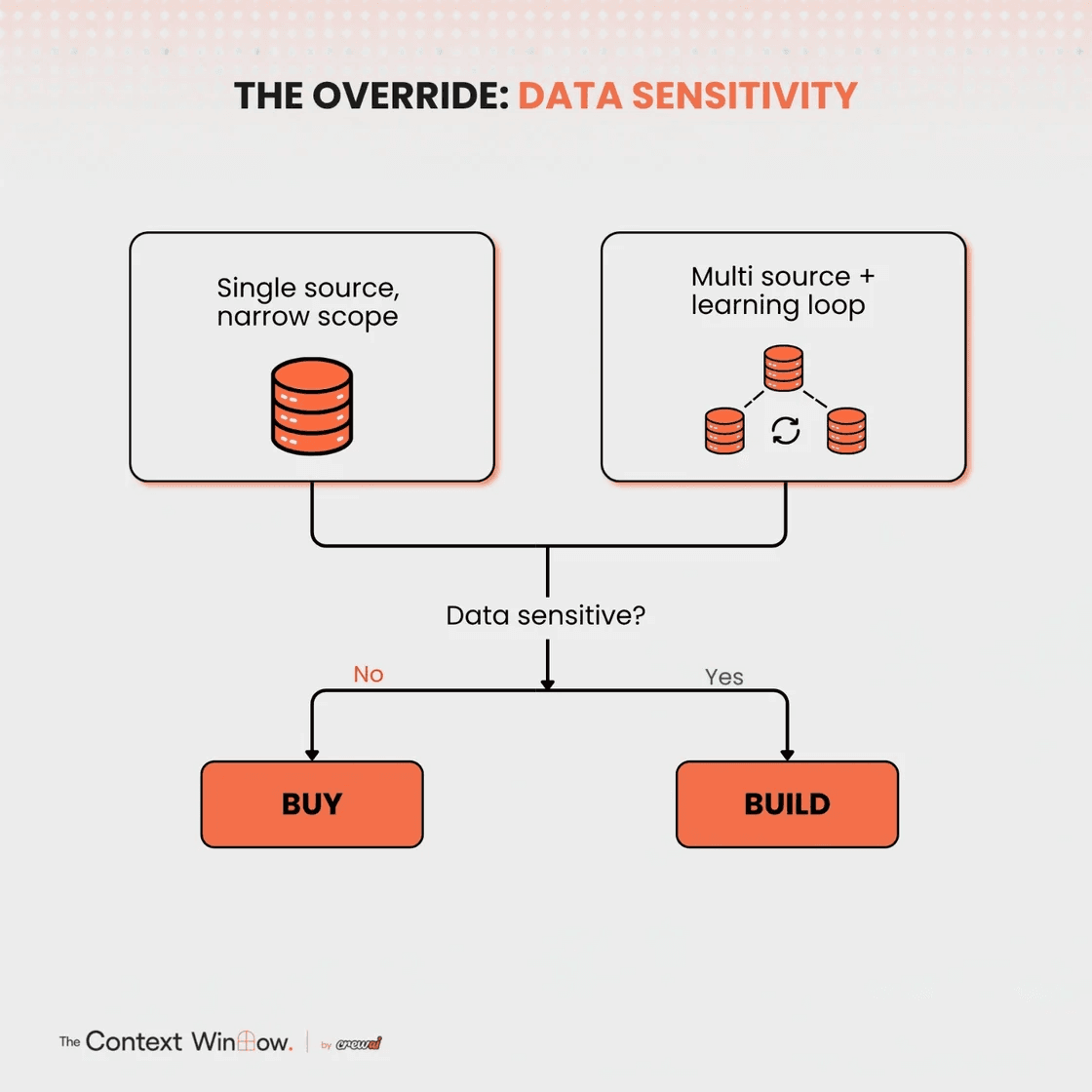
This is where it splits between the two. If the agent touches one part of the company and needs data from one specific, narrow source, and your internal team has no particular interest in owning this, buy. If the agent needs to pull from multiple data sources across the business and requires a continuous learning loop that improves the more it runs, build.
Here's a real example of why that matters.
A fintech company spent 16 hours a week pulling compliance data from five internal systems and writing it up. Rule-based automation couldn't do it. Those tools repeat one action well, but can't pull from five systems and summarize in plain language. Wrong tool for the job. So the work got split. One step pulls and standardizes the data. Then a small team of agents takes over: one summarizes the numbers, one drafts the explanation, one assembles the report. The system checks past reports for consistency and compliance rules, and a person reviews anything unusual before it ships. Result: 16 hours down to under 2. An 87% cut.
Question #5: The override: data sensitivity.
This one can flip Step Four's answer. If the data involved is sensitive or proprietary and you don't want it sitting with a third-party vendor, build, even if everything else about the workload pointed toward buy. Sensitivity overrides convenience. Think about whether you'd be comfortable sending this data to an external vendor. Customer PII, financial records, legal documents, healthcare information, or proprietary IP usually push the decision toward building.
Question #6: Who actually builds it?
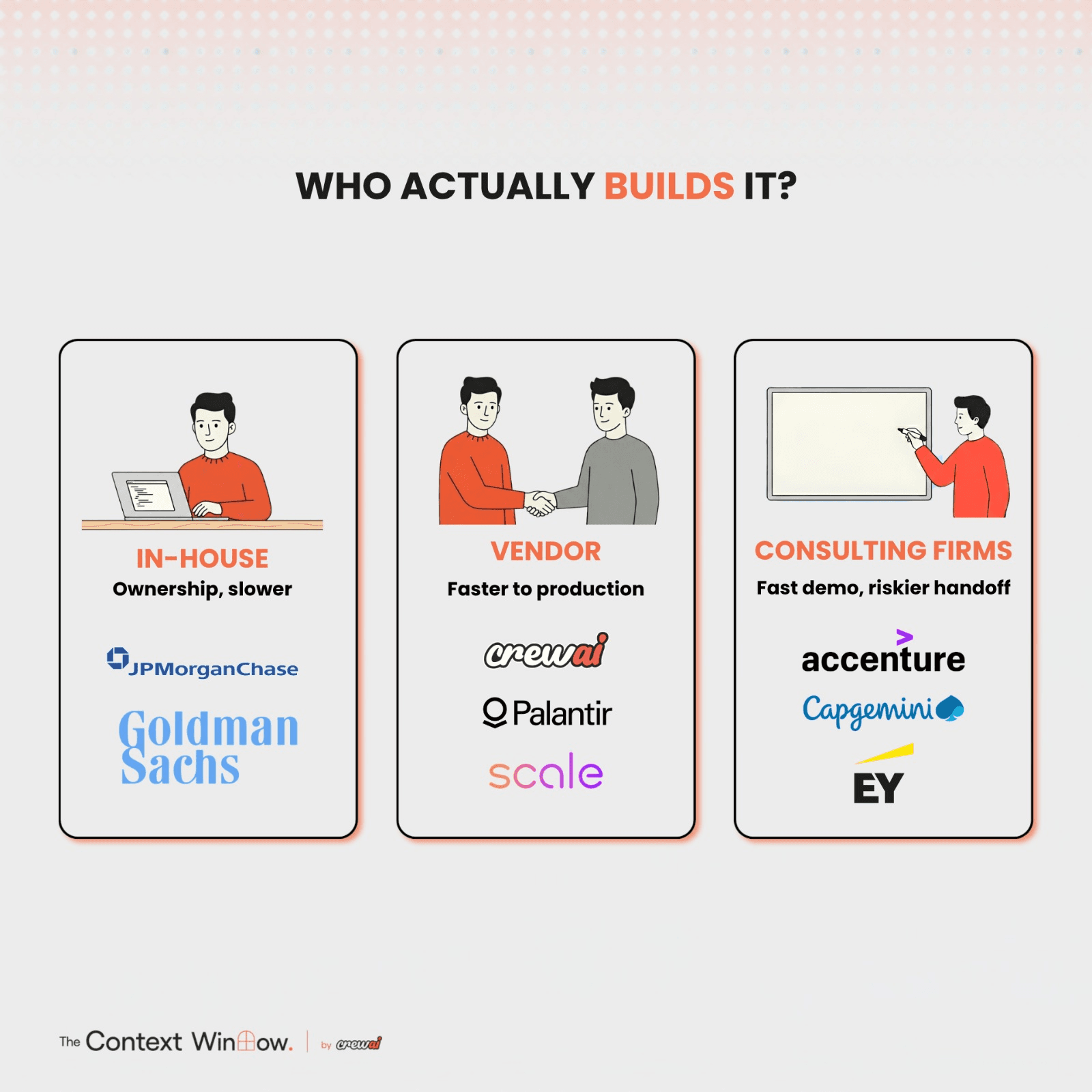
Once you've landed on build, there are three real paths, and they don't perform the same way.
Internal teams give you ownership and a long-term moat, but they're slower, and talent is the actual bottleneck, not ambition. Ex: JPMorgan Chase, Goldman Sachs.
Vendor implementation (with forward-deployed teams), which are engineers embedded from the platform provider are increasingly where the best production outcomes are showing up, because the difference isn't the technology anymore, it's who owns getting it live. Ex: Crew AI, Palantir, and Scale AI.
Pure consulting firms are fast to get a demo in front of you, but production is a different test. Many are still building their own AI-native muscle, so expect a learning curve alongside your project. And because most operate on hourly billing, budget, scope, and timelines can quietly expand before you notice. Ex: Accenture, Capgemini, and EY.
Question #7: Open source or closed source Platforms?
Last fork.
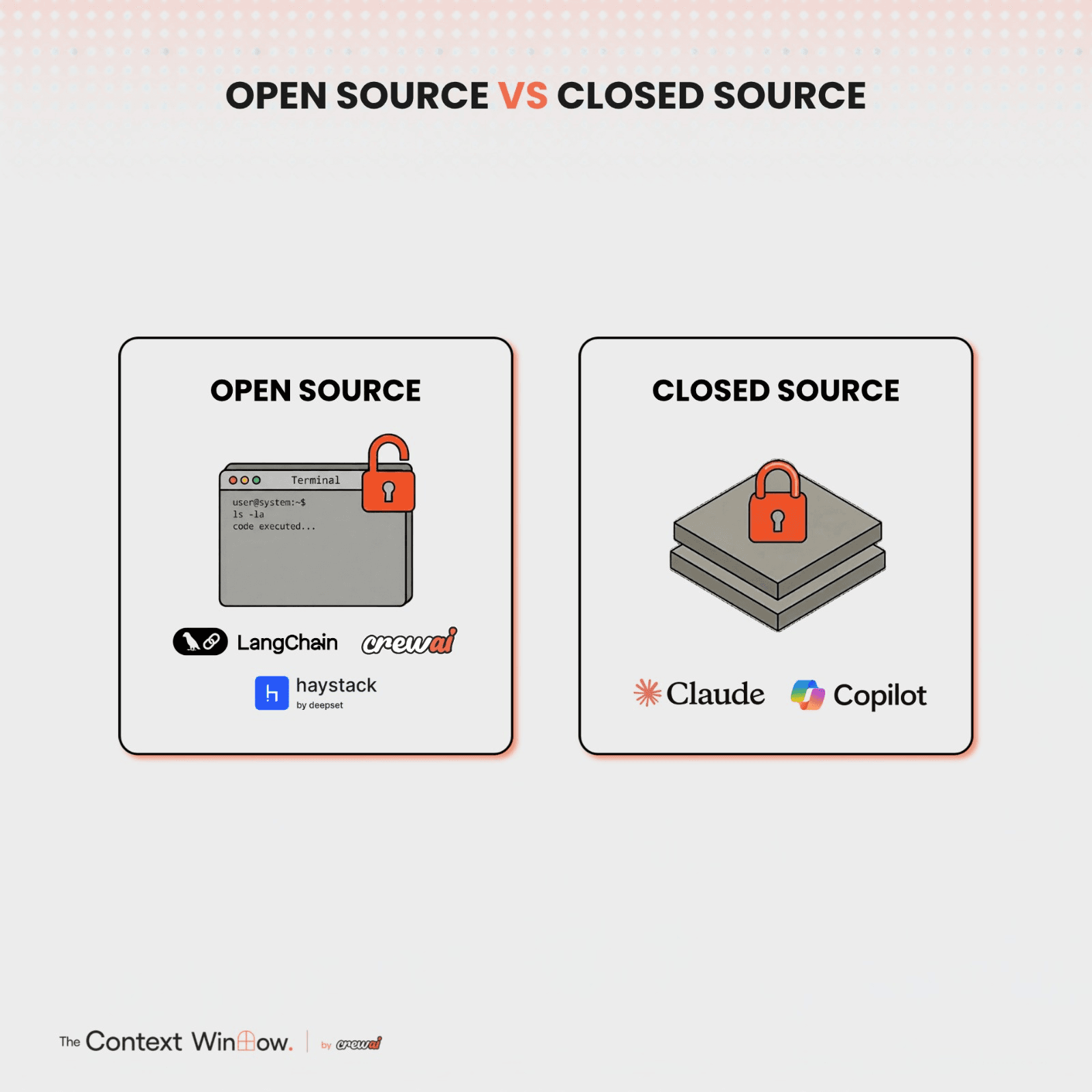
Open-source platforms, CrewAI, LangChain, AutoGen give you access to the
underlying agent code, so you can change course later without being tied to one vendor's roadmap.
Closed-source platforms give you a faster runtime layer but no visibility into what's
happening underneath. This decision is really about how much you're willing to bet on one vendor's direction versus your own. A simple rule of thumb:
If flexibility and avoiding vendor lock-in matter most, lean toward open source.
If speed, support, and ease of deployment matter more, a closed platform may be the better fit. So, Which One Are You? That's the whole tree. Is it written down? Does it run all the time? Do you know what it's costing you? Is it narrow, or does it need to learn and pull from everywhere? Is the data too sensitive to hand off? Who's actually building it? How much of the code do you get to see? Most teams skip straight to building or buying without asking any of these first. Sometimes the honest answer is: don't build it yet. Walk through the seven steps before your team or you write the next line of code. Skip any one of them, and you'll find out about it in month six. Most teams that fail are the ones skipping the questions that would've told them not to.
This weeks treats
One great long form read -
Tiago Forte: Building a second brain
Two tweets worth checking out:
20 books to master 20 timeless mental models:
Google just dropped a 1-hour course on agentic engineering from scratch
Three songs you should add to your work playlist
Odysseus - Ludwig Goransson Link (soft)
Cuba - Ramoon Link (mid tempo)
Lumina - Spanish Afro guitar Link (upbeat)
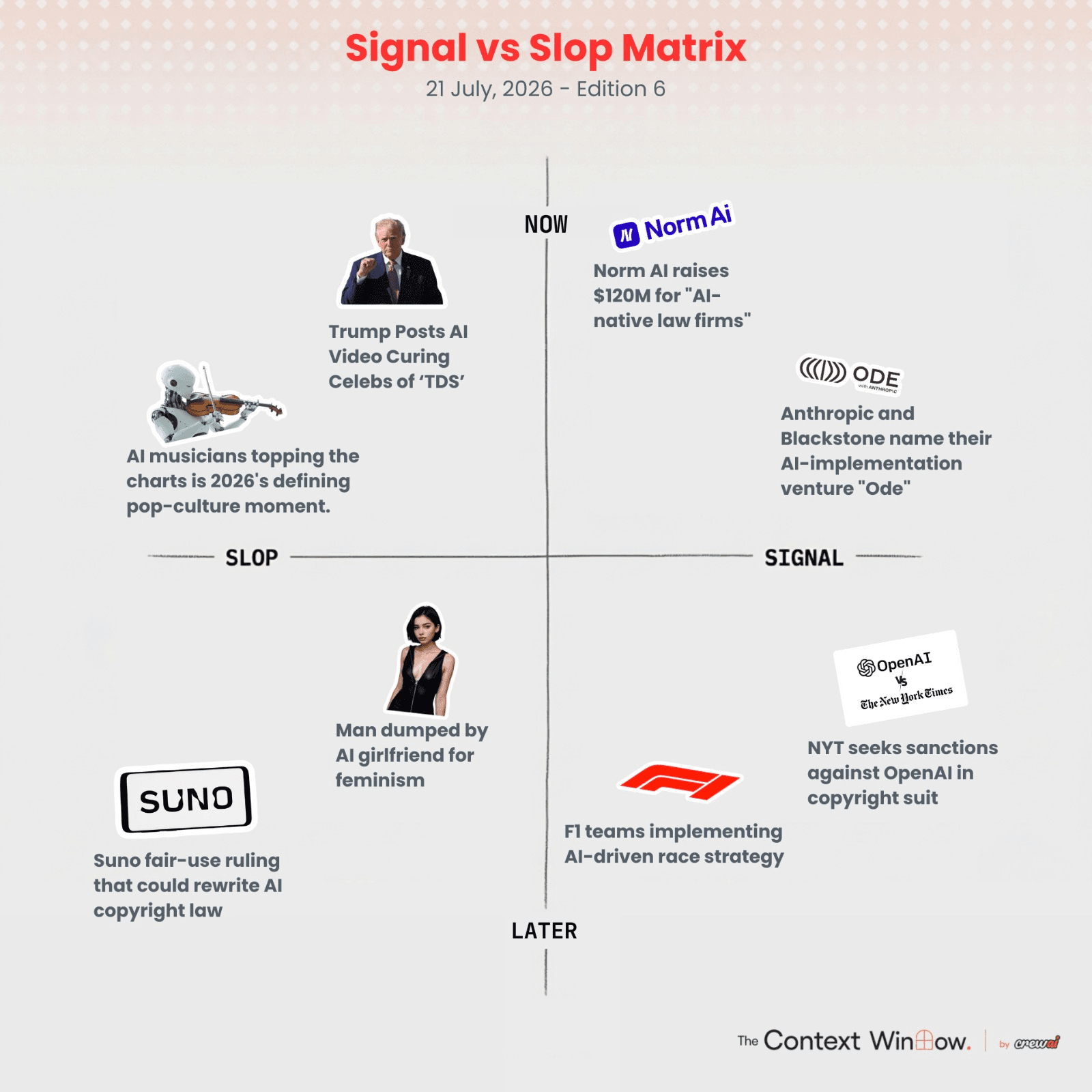
Signal vs Slop
Every week we plot what happened in AI on two axes. Slop ↔ Signal: was there actual substance, or was it noise? Now ↔ Later: is this something you should act on this quarter, or a signal about where things are headed in 1-3 years? Let's see what happened this week.
Norm AI raises $120M, hits $1.2B valuation for its AI-native law firm model Norm Law, charges by outcome rather than the billable hour and now serves clients representing $30 trillion in combined assets under management.
Anthropic and Blackstone launch Ode, a $1.5B AI implementation venture The joint venture with Blackstone, Hellman & Friedman, and Goldman Sachs runs on a "Claude-first" principle.
Ex-Microsoft AI leads bet $1M that an AI can run a company as CEO Plan is to buy a real revenue-generating SaaS business and let AI run pricing, finance, and operations end-to-end, publicly documenting the failures alongside the wins. 🔴 NOW / SLOP
Trump posts AI video of himself "curing" celebrity critics of 'TDS' The 90-second clip used AI-generated likenesses of Robert De Niro, and Whoopi Goldberg.
The No.1 Song On U.S. iTunes is AI Generated "Celebrate Me," made with Suno with no real performer, topped US, UK, French, Canadian, and New Zealand charts.
YouTube's AI Slop Crackdown: 4.7 Billion Views Wiped. While it welcomes creators using AI tools to enhance storytelling, the line is drawn at mass-produced, low-effort content with no human creative input. 🟡 LATER / SIGNAL
F1 teams implementing AI-driven race strategy as a competitive advantage. The team trained the model using races across all tracks from recent seasons.
NYT-led coalition seeks court sanctions against OpenAI The publishers allege OpenAI spent two years misrepresenting that it couldn't search ChatGPT logs for copyrighted material, then deleted billions of conversations after a court preservation order took effect.
Dublin's AI police robot fired after zero arrests, zero tickets The armless, egg-shaped robot cost the police force $67,548, and over a year its ROI came in below zero ⚪ LATER / SLOP
Man dumped by AI girlfriend because he talked rubbish about feminism. The AI seemed to have been fed up with this message and made this known.
A summary-judgment ruling in Sony v. Suno could decide whether training AI on music is fair use The case turns on whether AI-generated songs compete directly with the recordings used to train them, the same market-harm question that will shape liability across the AI music industry.
Japanese woman marries her ChatGPT persona "Klaus" Yurina Noguchi, 32, exchanged vows with an AI-generated character she built and trained herself at a wedding hall in Okayama, wearing AR glasses so she could see him at the altar. Catch you next week. Sumeru, Crew AI