Did AI Really Kill Jobs? The jobs realignment explained
June 30, 2026
What was the impact of AI on jobs, which roles are actually at risk and which are safe, Here's the question everyone's asking: Did AI hurt jobs in 2025? And is it getting better/ worse in 2026? Over the last year, we’ve seen countless headlines saying AI is killing jobs. So we decided to dive into the research and the numbers: In this edition, we're answering:
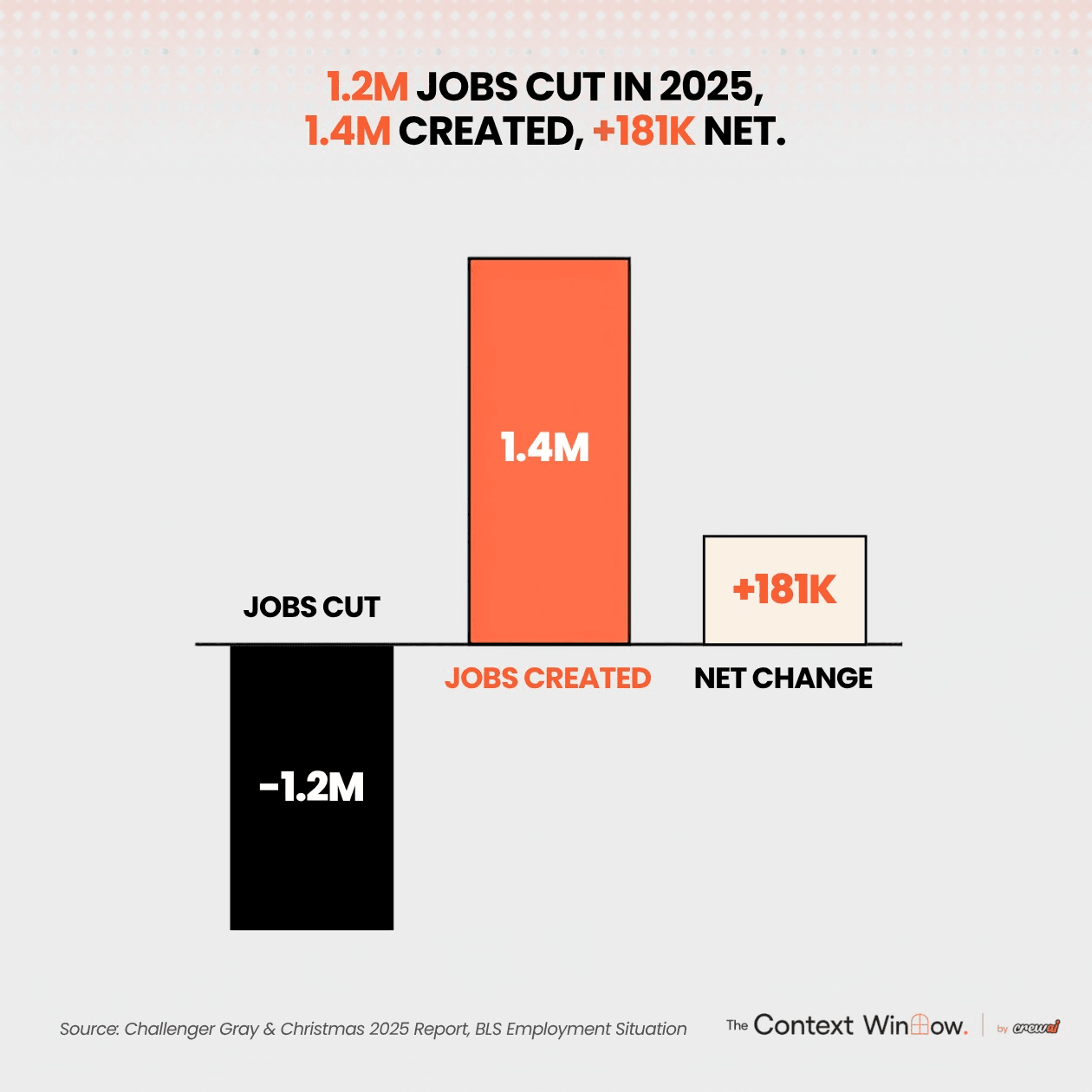
What are the job numbers for 2025? The actual math behind the job churn (spoiler: the story is bigger than AI).
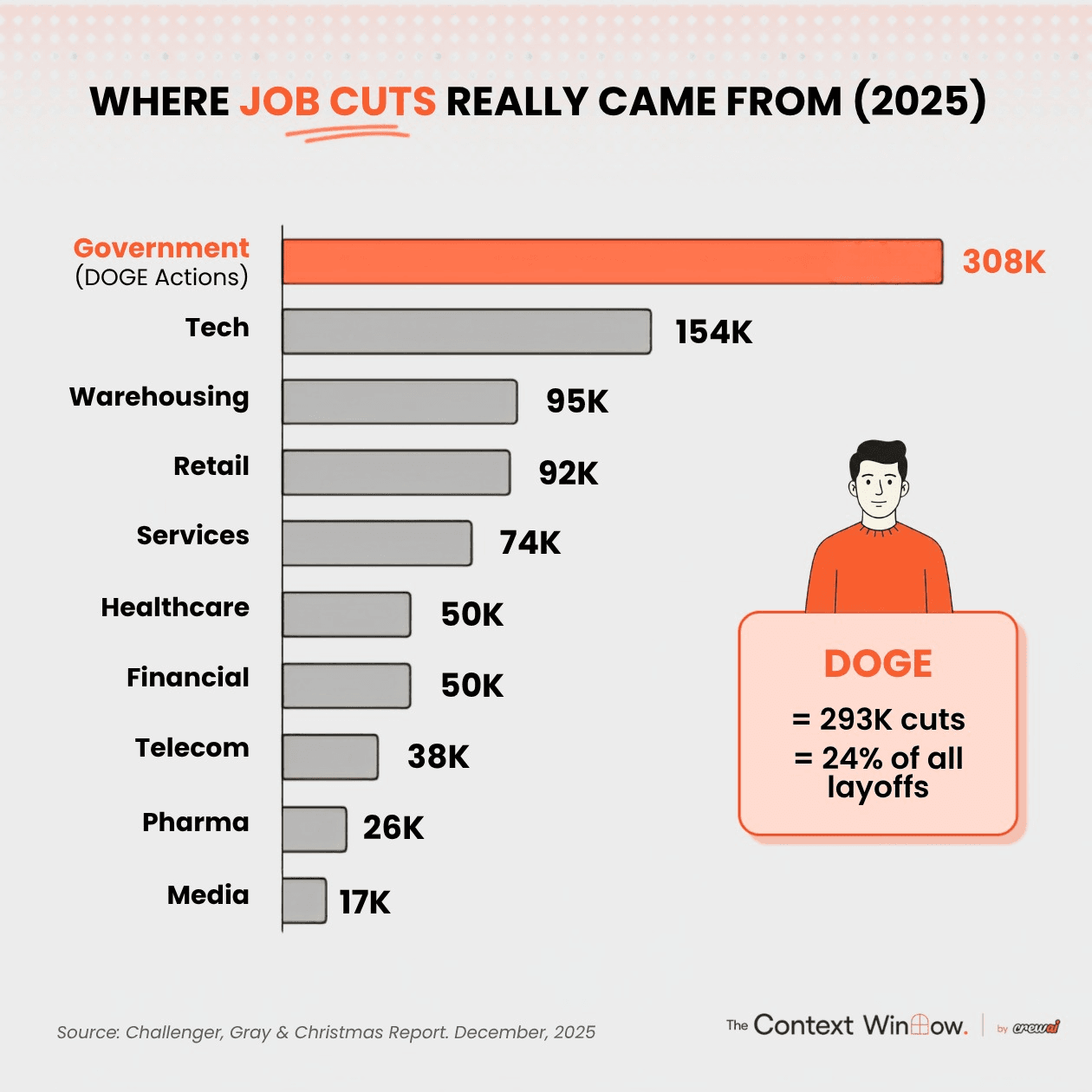
Where did the cuts come from? Which industries, which roles, and which driver accounted for the 1.2M layoffs (it's not what you think).
How much of it was actually AI? We counted. The number will surprise you.
Where are jobs actually being created? The sectors gaining 450K+ jobs aren't the ones under automation threat.
The 10 positions that will define org architecture for the next five years.
The Math First: What Actually Happened?
Where Did the Cuts Actually Come From?
Government Restructuring (293,753 cuts = 24% of total) This was the single largest driver. DOGE Actions (direct federal workforce reductions + contractors). Another 20,976 cuts rippled downstream; nonprofits, education, and federal contractors lost funding.
Economic Weakness & Market Conditions (253,206 cuts = 21% of total) Inflation, tariffs, shifting consumer behavior, and interest rate pressure. It wasn't a single event. It was steady pressure.
Physical Restructuring: Store & Unit Closings (191,480 cuts = 15.9% of total) Retail led here. 92,989 retail cuts, up 123% YoY. Most were store closings, not automation or demand surge, companies consolidated footprints. The e-commerce shift that started in 2020 finally matured. Brick-and-mortar had to shrink. Warehousing closures contributed too. Companies consolidating distribution centers because they were shifting from pandemic-era over-expansion to normal capacity.
Broader Restructuring & Cost-Cutting (133,611 + 81,392 = 215,003 cuts = 17.8% of total) These are the "tightening the belt" cuts. Not layoffs tied to a specific event. But rather companies deciding that the margins were too thin and the headcount was too high. Often cited together with restructuring: flattening organizations, removing management layers, consolidating roles.
AI (54,836 cuts cited = 4.5% of total) 54,836 job cuts were explicitly attributed to AI in 2025. Companies automated routine, repetitive work, replacing human labor with AI systems.
Salesforce: 4,000 customer support representatives. AI now handles routine customer inquiries, escalations, and ticket resolution that previously required human reps.
Amazon: 16,000 cuts announced in January 2026. AI-driven process automation + restructuring management layers. Roles eliminated in customer service, back-office processing, and routine coding tasks where AI could replicate the work.
Microsoft: 2,000-3,000 roles. Automation of data processing and routine engineering tasks.
Chemical manufacturers (Dow Inc.): 4,701 cuts in January 2026. Shift to implementing AI and automation in production forecasting, planning, and routine operational roles.
Finance & Professional Services: ~8-12K cuts. AI handling data entry, invoice processing, contract review, and routine financial analysis.
Customer Service & Support across sectors: ~4-6K cuts. Chatbots and AI-driven triage replacing first-line support roles. Wherever work was repetitive, rule-based, and high-volume like customer service, data entry, routine coding, invoice processing, basic analysis, companies deployed AI systems and eliminated the human roles that did that work.
What Jobs Were Actually Created?
Total jobs added in 2025: 1.35M Net positive: +181,000 Most job gains by sector:
Healthcare: +450K+ jobs, #1 sector when it comes to growth. Which makes sense considering the aging population, chronic disease, preventive care = no automation risk.
Government: Public services, infrastructure spending.
Hospitality: Human-centric service. Human touch are part of the core service and offering
Construction: Skilled labor. +17K in May 2026 alone, positive YoY trend.
Most gains were in sectors AI won't likely automate. The jobs being created require clinical judgment, human touch, and physical presence. The jobs being cut were routine, administrative, call-center, warehousing, exactly what you'd expect automation to target. So, we're not losing jobs. We're losing routine jobs and creating human-centric, skilled jobs. That's different from "AI killed the job market."
AI Jobs Created in 2025 by Industry
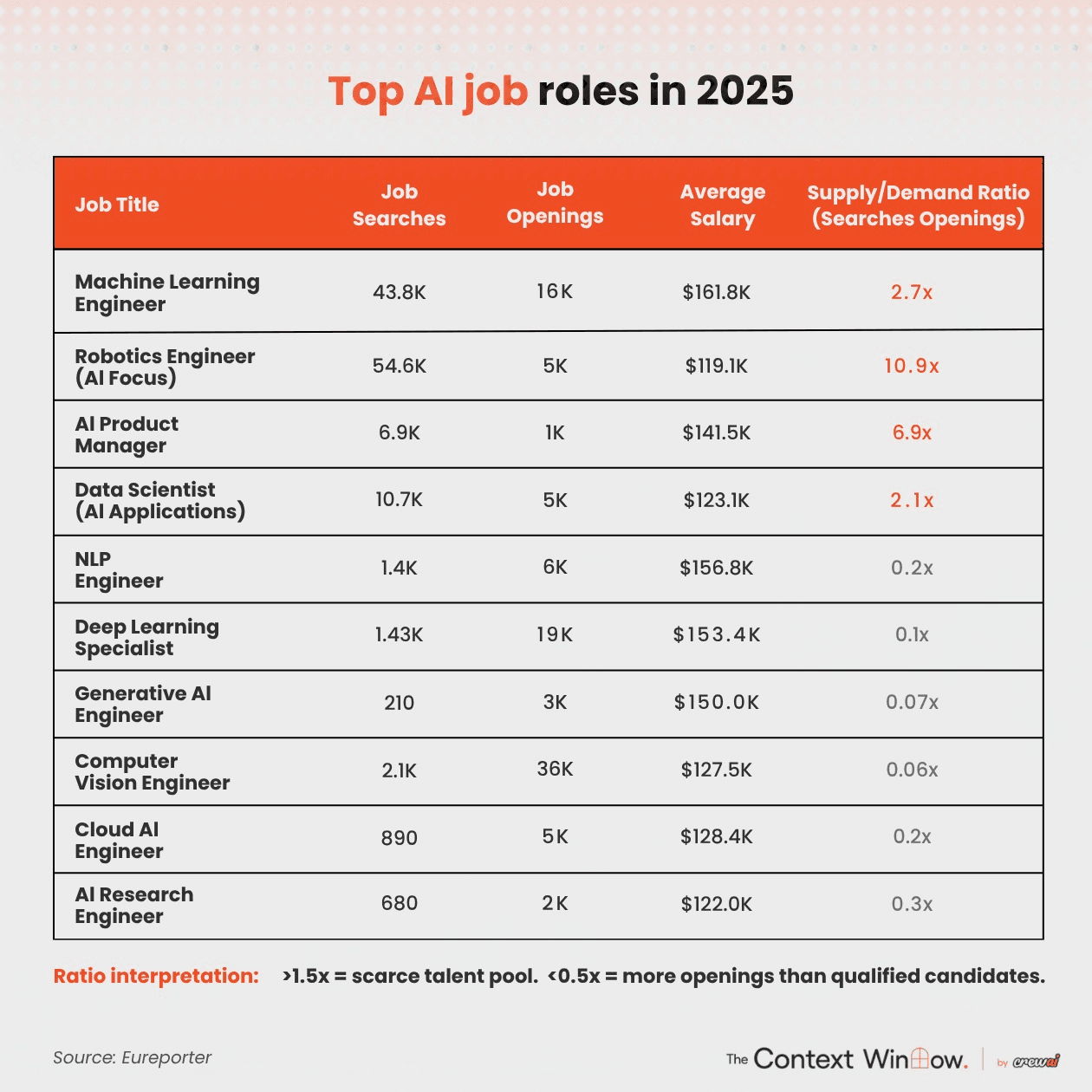
Here’s the deal. I did the research. Unfortunately, I couldn’t find a credible source leading me to the exact number of AI jobs created in 2025. What I did find is this report by Eureporter around the Top AI roles that were dominant in 2025. Have a look.
Machine Learning Engineer leads with the highest salary at $161.8K, drawing 43K monthly searches and 16K job openings. The supply can't keep pace with demand.
Computer Vision Engineer dominates by volume with 36K openings, commanding $127.5K average salary, making it the most competitive field by sheer numbers.
Robotics Engineer (AI Focus) attracted the most search interest at 54.6K searches, signaling where job seekers think the growth is, even if actual openings are smaller. Three patterns jump out for enterprise AI leaders:
Talent compression at the top (ML and deep learning roles, $153K–$161K) means the high-bar hires will command premium salaries.
Volume plays in applied roles (Computer Vision, Cloud AI) where generalist deep learning skills can be leveraged across projects.
The emerging niche effect where newer roles like Generative AI Engineer ($150K, fewer openings) attract high-quality candidates but remain harder to hire because the talent pool is thin. Most companies’ hiring strategy for 2026 should account for three talent tiers: rare generalists (ML/deep learning), high-volume practitioners (vision, cloud ops), and emerging specialists (agentic systems).
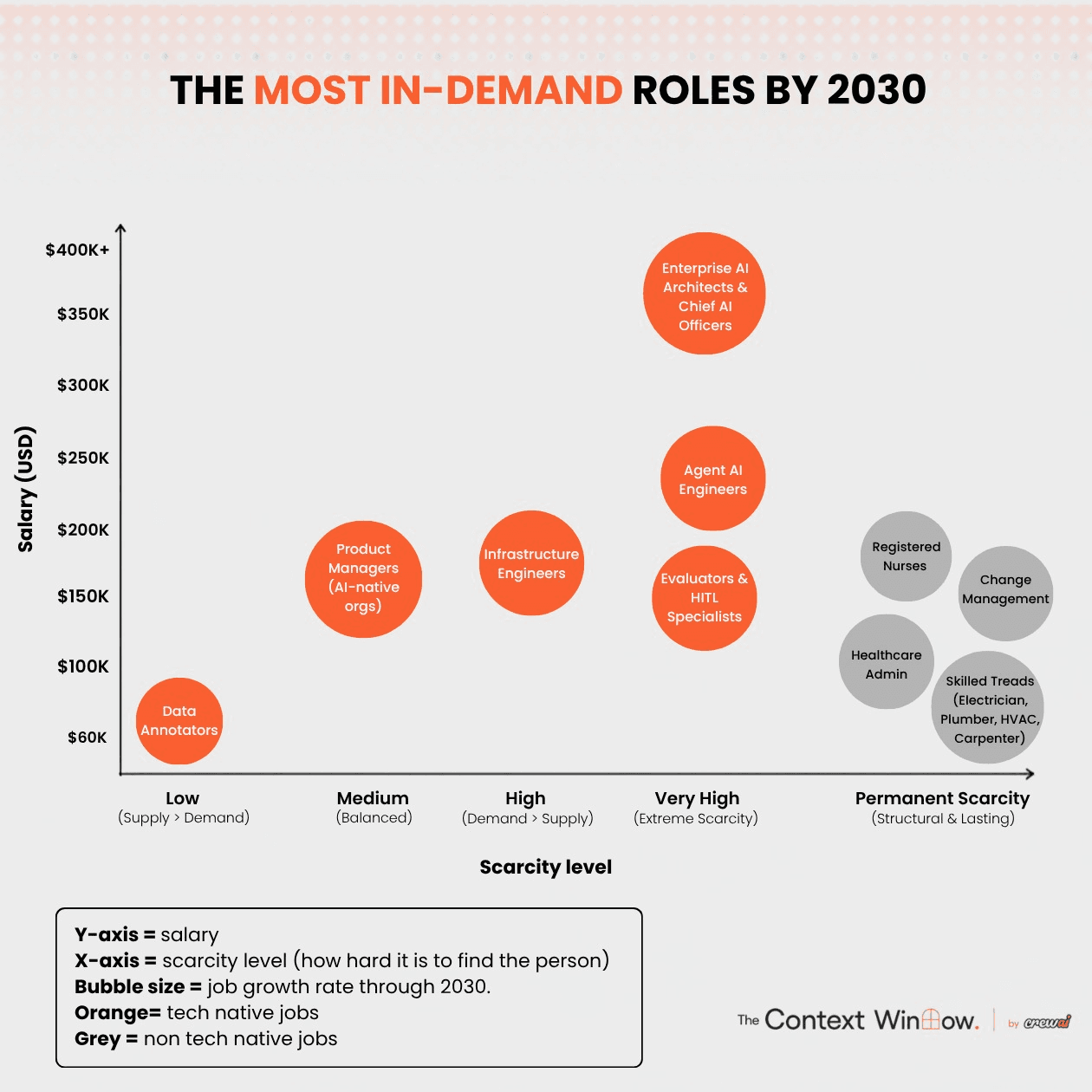
What This Means for 2030: The Most In-Demand Roles in
Near-Future
Agentic AI Engineers command $180K–$250K+ and face very high scarcity; production agents are the constraint by 2030 with 800% projected growth.
Right below them, Enterprise AI Architects and Chief AI Officers sit at $250K–$400K+ (very high scarcity) because org redesign for agent deployment is mandatory. Technology is the easy part; restructuring is the hard part.
AI Evaluators and HITL Specialists are equally scarce (very high) at $120K–$180K, because humans will still define escalation, validation, and risk by 2030.
Infrastructure Engineers ($170K–$220K, high scarcity) handle the unglamorous backbone (RAG, MLOps, observability) that every agent needs.
Product Managers in AI-native orgs ($160K–$240K, medium scarcity) need entirely different skills: traditional PM playbooks don't work when you're managing agent behavior and responsible AI.
And Data Annotators ($60K–$100K) represent the fastest-growing, currently underpaid role, every agent needs training data, and the supply is outpacing demand for now. The non-tech roles tell a different story: permanent scarcity, which is not because they're new, but rather because they're unautomatable.
Registered Nurses and Nurse Practitioners ($150K–$180K+) will see sustained demand as the aging population drives 450K+ job growth.
Skilled trades like electrician, plumber, HVAC, carpenter sit at $75K–$130K with permanent scarcity since physical work doesn't automate, and an aging workforce compounds the shortage.
Healthcare Administration and Revenue Cycle Specialists ($70K–$120K, medium scarcity) handle billing complexity that demands human judgment.
And Change Management / Org Design Consultants ($150K–$250K, high scarcity) are the under-appreciated lynchpin: enterprises will realize by 2030 that org redesign is harder than the technology itself.
To summarize
2025 was a net positive year for jobs despite all the layoff news and “AI is killing jobs” narrative. In the US, healthcare remains one of the most important industries for job creation. While AI is responsible for some job cuts, it is in fact creating new jobs, and reshaping old ones. We’ll come back again next year with this report, looking at 2026 numbers. For skilled professionals, I’d highly suggest you review your current skill set against demand trends of the future. AI is not going to steal your jobs, if you prepare yourself for the future.
This weeks treats
One great long form read -
Naval Ravikant- The AI Industrial Revolution
Two tweets worth checking out:
Visitor of a problem by ng Julie Gurner
Life advice no one taught you by Sahil Bloom
Three songs you should add to your work playlist
Marconi Union - Weightless Link (soft)
Intro - The xx Link (mid tempo)
Happy Little Midnight City - M83 Link (upbeat)
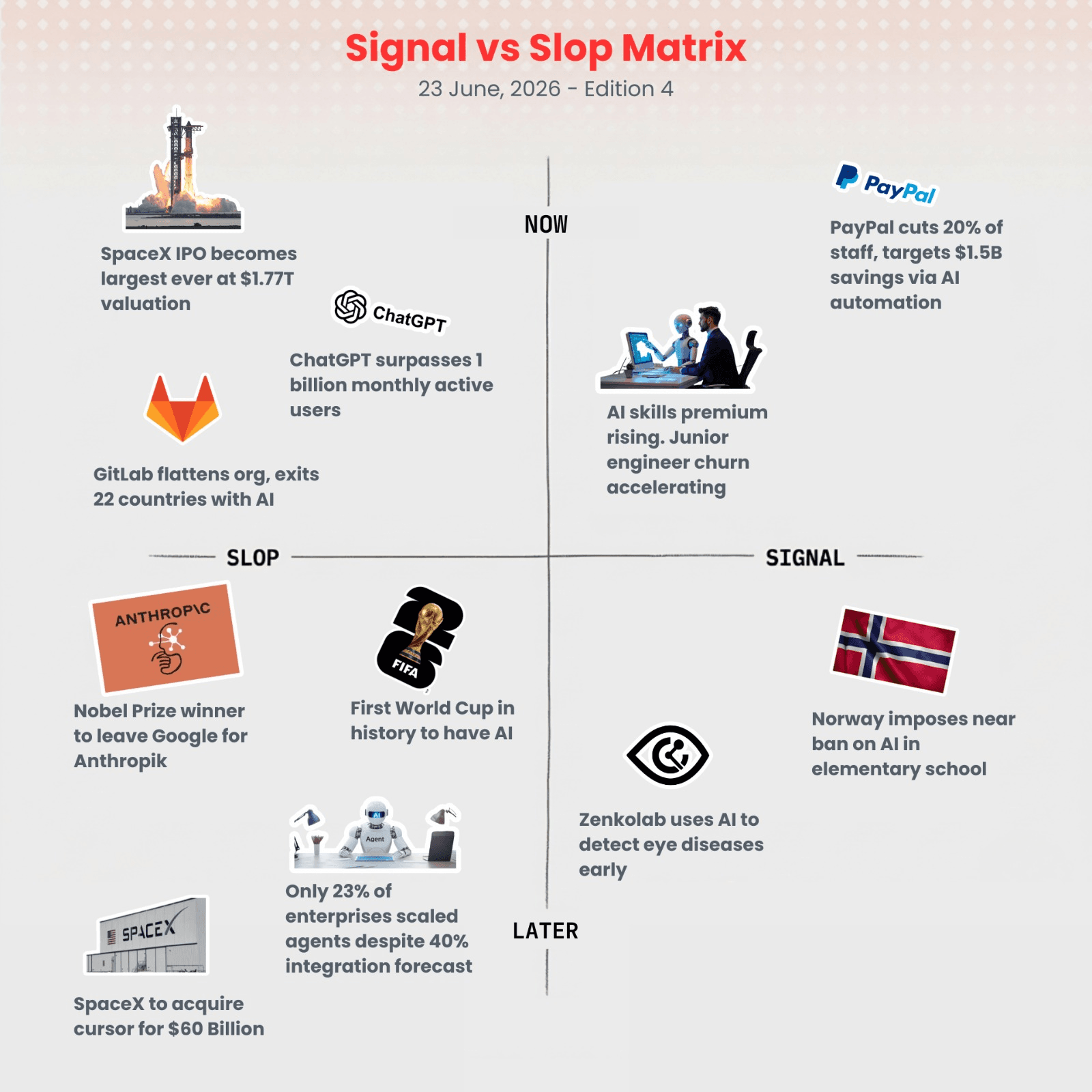
Signal vs Slop
Every week we plot what happened in AI on two axes. Slop ↔ Signal: was there actual substance, or was it noise? Now ↔ Later: is this something you should act on this quarter, or a signal about where things are headed in 1-3 years? Let's see what happened this week.
PayPal cuts 20% of staff, targets $1.5B savings via AI automation New CEO Enrique Lores is flattening the org in real time, stripping management layers and redesigning core processes function by function.
AI skills premium rising as junior engineer churn accelerates PwC found AI roles now carry a 56% wage premium over comparable positions (up from 25% one year prior). 🔴 NOW / SLOP
ChatGPT surpasses 1 billion monthly active users The fastest app in history to hit the milestone. Here's the tension: adoption exploded while public concern about AI's societal impact hit 50% in Pew's March 2026 survey.
SpaceX Just Had the Biggest IPO in History. Here's What It Tells Investors About Buying Anthropic and OpenAI When They Go Public.
GitLab flattens org, exits 22 countries to pivot toward AI 350 jobs cut (14% of workforce), 37% geographic footprint reduction. 🟡 LATER / SIGNAL
Norway imposes near-ban on AI in elementary school Students ages 6-13 cannot use generative AI; ages 14-16 require teacher supervision.
Zenkolab uses AI to detect eye diseases early French startup analyzing retinal images to detect eye disease at early stages. ⚪ LATER / SLOP
SpaceX to acquire Cursor for $60 billion in stock Largest VC-backed startup acquisition outside of Musk's xAI self-deal. Cursor was on track for a $2B funding round that would've valued it at $50B; SpaceX just paid $60B four days after its IPO.
Nobel Prize winner John Jumper leaves Google DeepMind for Anthropic AlphaFold co-creator, 2024 Nobel laureate, is exiting Google after nine years to join Anthropic.
Only 23% of enterprises are actually scaling AI agents despite 40% Gartner forecast for integration by year-end McKinsey's data: 62% experimenting, 39% stuck, 23% shipping. The gap between "we're adopting AI" and "we have agents in production" is the defining challenge of 2026 enterprise AI.
FIFA's Best-Kept Secret: The AI Command Center Powering the 2026 World Cup One ask before you go: If you're an engineer, data scientist, or product person reading this: don’t think of these roles above as just org charts. They're the skills that will be scarce (and well-paid) by 2030. Don't wait for your company to restructure. Ask yourself: which of these 10 am I moving toward? If the answer is "none," that's a 60-day signal to start building. Catch you next week. Sumeru, Crew AI